Advertising Your Small Business in the Okanagan, Made Simple
When you're running a small business, advertising can feel like you're just throwing money at a wall and hoping some of it sticks. But it doesn't have to be a guessing game. The secret isn't a massive budget; it's a smart plan built on understanding what you want to achieve and what's already working for you.
Once you have that clarity, you can make confident decisions that actually bring customers through the door.
Building Your Foundation for Smart Advertising
It’s easy to feel like you need to be everywhere at once. That constant pressure to post, boost, and run ads across a dozen platforms is overwhelming. We get it. Let's cut through that noise and start with something a bit more… focused.
The first real step is to simply take a breath and look at what you’ve already got. Chances are, you’re already doing some form of marketing, even if it doesn’t feel like a formal "strategy."
Start With a Simple Audit
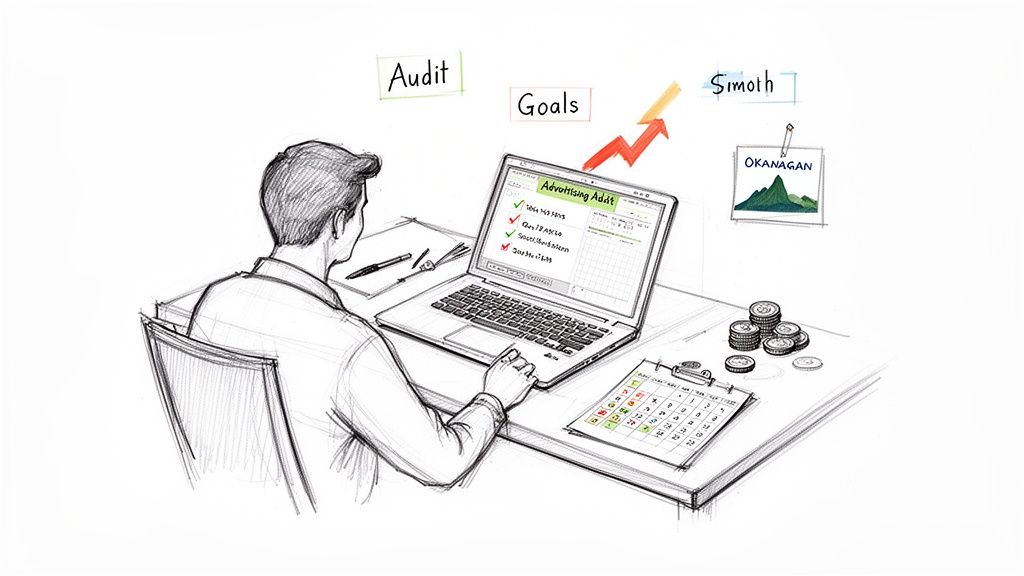
Before you put a single dollar into a new campaign, you need a clear picture of your starting line. This doesn't have to be some complicated, spreadsheet-heavy process. Just grab a notebook and ask yourself a few honest questions:
What’s working right now? Are you getting solid leads from your website's contact form? Do new customers mention your Facebook posts when they call?
What’s not working? Are you putting time into a social media platform that feels like a ghost town? Did that one-off print ad bring in zero calls? Be honest.
What’s just… there? Maybe you have an email list you haven’t touched in six months or a Google Business Profile that isn't fully optimized.
Jot it all down. This simple exercise gives you a real-world baseline to build from.
You wouldn't start a road trip from Kelowna to Vernon without looking at a map first. An advertising audit is your map. It shows you where you are so you can plot the best route to where you want to go.
Set Goals That Mean Something
It's time to move past vague targets like "get more followers." We're talking about setting clear, measurable goals that directly impact your bottom line. Effective digital marketing for small businesses is all about driving real-world results.
Your goals need to be specific to your business. A realtor in Penticton might aim for 10 new seller lead inquiries per month. A tour operator based in West Kelowna could set a goal to increase online bookings by 20% for the upcoming summer season.
These kinds of concrete goals give your advertising a genuine purpose and help you build a solid foundation for everything that comes next.
Finding Your People in the Okanagan
You know your customers are out there. But trying to find them online can feel like shouting into the wind and just hoping the right person happens to walk by. The secret to smart advertising, especially for a small business, is knowing exactly who you’re trying to reach before you spend a single dollar.
This means going deeper than just "people who live in Kelowna." You've got to get a clear picture of the real person on the other side of the screen. What are they actually struggling with? What problems are keeping them up at night?
Crafting Your Customer Persona
A customer persona is really just a semi-fictional sketch of your ideal client. Think of it as a character profile that helps you picture a real person. This simple shift makes your marketing feel less like a corporate announcement and more like a one-on-one conversation.
Try this: picture a recent customer you genuinely enjoyed working with. Let’s give her a name, like "Summerland Sarah." Now, let's build out her story.
Her Life: What does she do for work? What’s her family situation? What’s her go-to activity on a sunny Okanagan weekend?
Her Pains: What specific challenge does your business solve for her? Maybe she’s a busy mom who needs a reliable landscaper so she can actually enjoy her weekends instead of doing yard work. That’s a powerful insight.
Her Digital Hangouts: Where does she spend her time online? Is she scrolling through home renovation ideas on Instagram, or is she asking for recommendations in a local Vernon community group on Facebook?
This quick exercise can be a total game-changer. Suddenly, you’re not just guessing anymore. You have a much clearer idea of where to find her and what to say.
When you try to talk to everyone, you end up connecting with no one. But when you create an ad that speaks directly to "Summerland Sarah's" specific problem, she’ll feel like you read her mind.
How Personas Steer Your Ad Strategy
Once you have this profile in your head, making advertising decisions gets a whole lot easier. You're no longer just throwing money at different platforms and hoping for the best.
For example, if your ideal customer is a professional looking for financial advice, they're probably on Google typing in very specific questions. Running a search ad that directly answers their query is a no-brainer.
On the other hand, if you’re an artisan based in Penticton, your ideal buyer is more likely discovering new creators on a visual platform like Instagram. Your ads there need to be beautiful, inspiring, and designed to stop the scroll.
Knowing who you’re talking to is the key to creating ads that truly connect instead of just getting lost in the noise. It’s what makes every dollar in your ad budget count. If you're finding it tricky to nail down your audience, getting an expert partner to help build these profiles can be an incredibly valuable first step. You can always reach out to us for a chat about it.
Choosing The Right Digital Advertising Channels
Alright, you’ve nailed down who you're talking to. That’s a huge piece of the puzzle. Now, the million-dollar question: where do you actually find them online?
Picking an advertising channel can feel like standing in front of a giant wall of TVs, each one blaring a different show. You've got Google Ads, Facebook, Instagram, local search results, email marketing… it's easy to get overwhelmed.
Let's cut through the noise.
Find Out Where Your Customers Hang Out Online
The best advertising channel isn't about what's newest or trendiest. You just need to show up where your ideal customer already spends their time. Go back to that customer persona you built.
Are they actively searching for an immediate solution to a problem? Google Ads is your spot. People turn to Google when they have a specific need—they’re typing "plumber in Vernon" because they need one right now.
Are they more likely to be scrolling through their feed, looking for inspiration or discovering new things? That’s where Instagram and Facebook shine. A West Kelowna winery, for instance, can stop a potential visitor mid-scroll with a gorgeous photo of their vineyard at sunset.
Is your business built on local reputation and being the go-to choice in town? Then investing your energy into your Google Business Profile and local SEO is an absolute must.
Choosing a channel is like picking a venue for a party. You wouldn't host a quiet book club in a loud concert hall. You need to match the vibe of the channel to the conversation you want to have with your customers.
A Quick Rundown of the Heavy Hitters
Let's break down the most common options without getting bogged down in jargon.
Google Ads (Paid Search): This is your tool for capturing "high-intent" customers—people who are actively looking for what you sell. You bid on keywords like "Kelowna real estate agent," and your ad appears right at the top of their search results. You only pay when someone actually clicks your ad. Pretty straightforward.
Social Media Ads (Facebook & Instagram): These platforms are incredible for building awareness and reaching very specific groups of people based on their interests, demographics, and online behaviours. The targeting can get impressively granular, letting you show ads to people who love hiking in the Okanagan, are recently engaged, or follow other local businesses.
For a deeper look at which one might be better for you, check out our guide comparing Google Ads vs. Facebook Ads for small businesses.
Local SEO: This isn't a traditional paid ad, but it’s absolutely critical for any Okanagan business with a physical storefront or a local service area. You'll optimize your online presence to show up at the top of local map searches and results when people search for businesses "near me."
Making the right choice here is the difference between a great return on investment and just throwing money away. It's a competitive world. To put it in perspective, in a market like California, 4.2 million small businesses are all fighting for attention. With the average small business ad budget hovering around $78,000, every single dollar has to count. Effective channel selection is a cornerstone for growth.
Which Advertising Channel Is Right for Your Okanagan Business?
To help you get started, here's a quick-glance guide to help you match common small business types with the digital channels where they often see the best results.
| Business Type | Primary Goal | Recommended Channels | Why It Works |
|---|---|---|---|
| Local Service (Plumber, Electrician, etc.) | Generate immediate leads | Google Ads, Local SEO | Catches customers at the exact moment they're searching for an urgent solution. |
| Real Estate Agent | Capture seller/buyer leads | Google Ads, Facebook/Instagram Ads | Google gets active searchers. Social media is great for showcasing listings and building your personal brand. |
| Tourism/Hospitality (Winery, Hotel) | Drive bookings & awareness | Instagram/Facebook Ads, Google Ads | Visuals on social media inspire travellers, while Google captures those actively planning their trips. |
| eCommerce Store | Drive online sales | Google Shopping, Instagram/Facebook Ads | Shopping ads show your product directly in search results. Social ads are perfect for retargeting and discovery. |
| Restaurant/Cafe | Increase foot traffic & reservations | Local SEO, Instagram/Facebook Ads | Local SEO gets you in front of hungry people searching nearby. Social media is ideal for food photography and specials. |
Ultimately, picking the right channels from the start prevents you from burning through your budget and helps you connect with the customers who are genuinely looking for a business just like yours.
If you’re feeling stuck at this stage, this is a great time to get some expert help. A bit of strategic guidance here can save you a world of headaches down the road.
Budgeting, Bidding, and Building Ads That Convert
Alright, let's get down to brass tacks: money. "How much should I spend?" is the million-dollar question for every small business owner, and the honest answer is… it depends. There isn't a magic number, but there are smart ways to figure out a budget that feels right for you and actually gets results.
Don't let the thought of setting a budget intimidate you. You're in the driver's seat. Even a small, strategically spent budget can be the engine that starts driving real growth for your business.
A huge part of making your budget work harder is picking the right channels in the first place. This decision tree is a great visual guide for how your goals should dictate your choices.
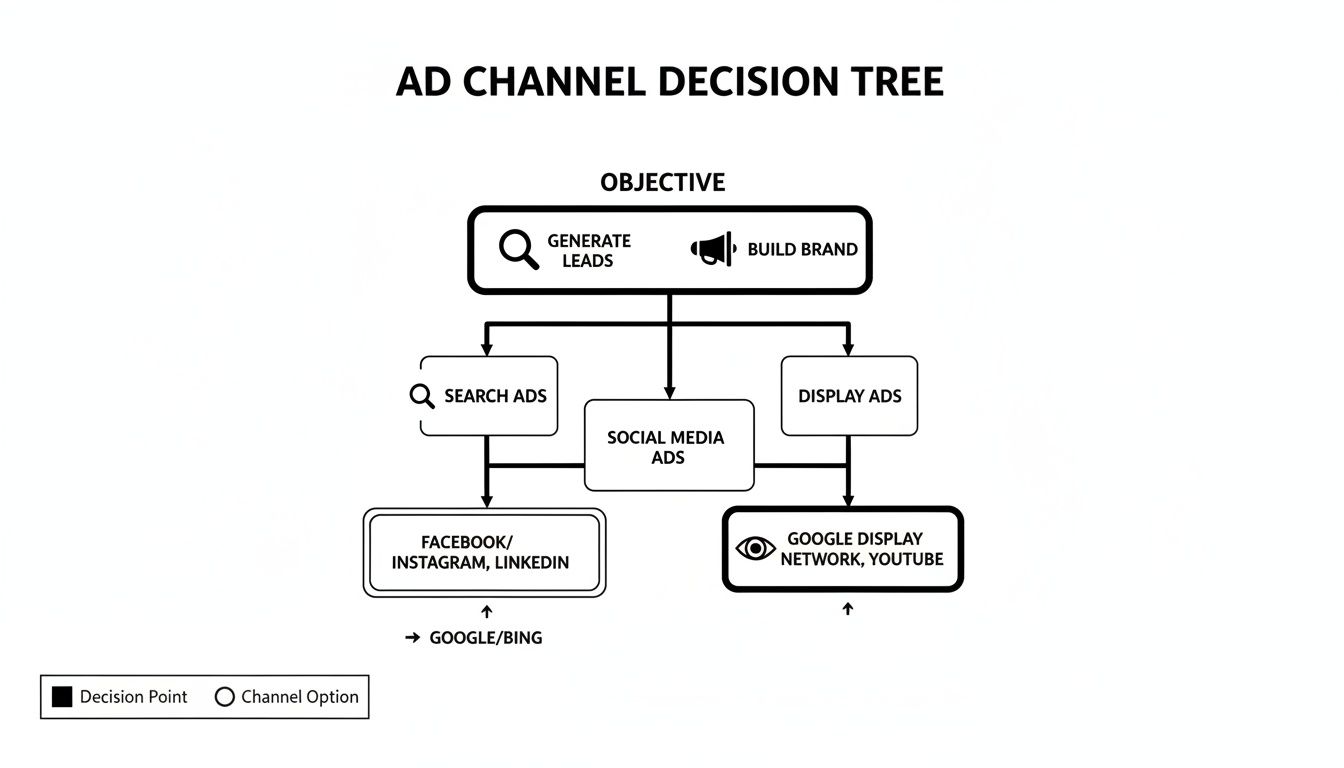
Whether you need leads knocking on your door tomorrow or you're playing the long game of brand building, this helps clarify the best path forward.
How Much Should You Actually Spend?
A solid rule of thumb for many small businesses is to allocate 5-10% of your revenue to marketing. If you're a brand new venture or fighting for attention in a competitive market (like many of us are!), you'll likely want to lean towards the higher end of that range to get some initial momentum.
Another way to approach it is to work backwards from your customer value. Let's say you know a new client is worth, on average, $500 in lifetime value to your business. From there, you can determine what you're willing to pay to acquire that customer (your Cost Per Acquisition, or CPA). This method ties your ad spend directly to tangible business results, which is exactly where you want to be.
Smart spending has become non-negotiable. In 2024, economic pressures forced 48% of small business owners to slash expenses. Yet, for those who leaned into marketing, the story was different. Of the 37% who increased their ad budgets, a whopping 88% saw their sales hold steady or grow.
Creating Ad Copy and Creative That Clicks
Your budget gets you in the game, but your ad creative is what wins it. The words, the images, the video—this is what has to do the heavy lifting. It needs to be a "thumb-stopper," catching someone mid-scroll and making them think, "Hey, they're talking to me."
The best ads don’t feel like ads at all. They feel like a helpful answer to a question you were just thinking about.
Here are a few battle-tested tips for crafting compelling ads:
Write for one person. Imagine your ideal customer and write your ad copy as if you're speaking directly to them. Use "you" and focus on their problem.
Sell the benefit, not the feature. Instead of saying, "We use high-tensile steel," try, "Built to withstand the toughest Okanagan winters, so you can rely on it for years." You're selling peace of mind, not just steel.
Use authentic visuals. A stunning photo of a local landmark will always beat a generic stock photo. Use high-quality, real images of your products, your team, or your customers enjoying your service. Show, don't just tell.
The Landing Page: Where Clicks Become Customers
This is hands-down the most overlooked piece of the advertising puzzle. You can have the most brilliant, persuasive ad on the planet, but if it clicks through to a slow, confusing, or irrelevant homepage, you've just thrown your money away.
A dedicated landing page should have one clear job: get the visitor to take one specific action. That's it. No distracting navigation, no competing messages. It needs to be a clean, clear continuation of the ad's promise.
Getting traffic is one thing; converting that traffic into actual leads and sales is what moves the needle. If your landing pages are letting you down, that's something we can fix. Let's chat about getting your conversion rates up.
Measuring Success and Refining Your Campaigns
Launching your ad campaign is really just the starting line. The real work—and the real results—come from paying close attention to what happens next and making smart adjustments based on what you see.
It might sound complicated, but you don't need to be a data scientist. It all boils down to repeatedly asking one simple question: is this actually working? Answering that question is how you turn your advertising from a business expense into a reliable engine for growth.
Knowing Which Numbers Matter
The first time you log into an ad platform, the sheer amount of data can be overwhelming. Clicks, impressions, reach… where do you even start? While every campaign has its own unique goals, you can usually slice through the noise by focusing on a handful of key performance indicators (KPIs).
Cost Per Click (CPC): This is straightforward—it’s what you pay every time someone clicks on your ad. Monitoring your CPC helps you gauge whether you're paying a fair price for your ad placements.
Click-Through Rate (CTR): This is the percentage of people who saw your ad and were compelled enough to click it. A low CTR is often a sign that your ad copy or imagery isn't resonating with your audience.
Conversion Rate: This is the big one. It's the percentage of people who clicked your ad and then took the specific action you wanted them to, like filling out your contact form, signing up for a newsletter, or making a purchase. This is your most important metric because it directly links your ad spend to tangible business outcomes.
It's easy to get distracted by "vanity metrics" like likes, shares, or impressions. An ad with 10,000 views but zero leads is far less valuable than one with 100 views that brought in two new clients. Focus on what moves the needle for your business.
The Power of Tracking and Tweaking
Nobody gets their campaign perfect right out of the gate. The strategy is to launch, learn, and then refine. After you’ve collected a few weeks' worth of data, you can start making genuinely informed decisions.
Maybe you'll discover your ads perform significantly better on mobile devices between 6 PM and 9 PM. Or perhaps you'll notice one particular ad photo is driving twice as many clicks as the others.
These little insights are gold. They tell you exactly where to shift your budget to double down on what’s working and what to cut so you stop wasting money. This cycle of continuous improvement is what truly maximizes your return on investment over time.
Tools like Google Analytics are invaluable for digging into this data, but they can be a bit intimidating at first. If you want a gentle introduction, we've put together a guide on Google Analytics for beginners that walks you through the essentials.
Making sense of the numbers is a crucial part of running successful ads. If you’d rather have an expert partner manage the tracking and optimization for you, that’s exactly what we’re here to do.
Putting It All Together With Real-World Examples
Theory is great, but let's be honest—seeing how it all works in the real world is what truly matters. To help you connect the dots, I've sketched out a few mini-plans for businesses you'd find right here in the Okanagan.
Think of these as starting points to get your own creative and strategic ideas flowing. We're going to tie together the goals, the audience, and the right advertising channels for a few common local industries.
The Real Estate Agent in Penticton
In the competitive world of real estate, the game is all about generating high-quality seller leads. You're not just looking for clicks; you're looking for homeowners who are seriously thinking about listing their property in the next few months.
Audience: Homeowners aged 45-65 in specific Penticton neighbourhoods who have owned their homes for 10+ years. These folks are likely researching local property values and searching for a trustworthy, experienced agent.
Key Channels: A smart combination of Google Ads and Facebook Ads is incredibly effective here. Google lets you capture people actively searching terms like "home valuation Penticton," while Facebook is perfect for reaching your target demographic with valuable content, such as a guide on "5 Tips for Preparing Your Home for Sale."
Example Metric: Your North Star metric here would be Cost Per Qualified Lead. How much are you spending to get one serious seller on the phone?
The Kelowna Tourism Company
For any local tourism business, summer is make-or-break. The main goal is to fill up those tour slots and book activities well before the peak season arrives, drawing in both out-of-town visitors and locals looking for a fun weekend.
For a tourism business, visuals are your best friend. Your ads need to sell the experience before they even click. Think stunning Okanagan Lake views and happy people enjoying the sunshine.
Audience: Tourists actively planning their trips to the Okanagan and local families scrolling for weekend ideas. They’re browsing travel blogs and getting inspired on social media.
Key Channels: Instagram and Facebook ads are non-negotiable for showcasing breathtaking photos and engaging videos. You can also use Google Ads to catch people searching for specific phrases like "things to do in Kelowna."
Example Metric: Here, you'd be laser-focused on the Booking Conversion Rate. How many people who see your ad actually complete a booking?
To make this even clearer, here are these concepts (plus one more for an e-commerce brand) laid out in a simple table.
Mini-Plan Advertising Examples
| Business Type | Audience | Key Channels | Example Metric |
|---|---|---|---|
| Real Estate Agent | Penticton homeowners (45-65) in their homes 10+ years. | Google Search Ads, Facebook Ads | Cost Per Qualified Lead |
| Tourism Company | Tourists planning Okanagan trips and local families. | Instagram/Facebook Ads, Google Search Ads | Booking Conversion Rate |
| E-commerce Brand | Young adults (18-34) interested in sustainable fashion. | Instagram Shopping Ads, Pinterest Ads, Email Marketing | Return On Ad Spend (ROAS) |
These simple frameworks show just how much of a difference a tailored approach can make. You’re focusing your budget where it will have the most impact instead of casting a wide, expensive net.
If you're ready to build a custom plan that fits your business like a glove, we're here to help map it out. Just get in touch with us and we can start the conversation.
Answering Your Top Advertising Questions
Jumping into the world of advertising always sparks a few questions. It’s a big step, and it's smart to be curious. Here are a few of the most common things we hear from small business owners right here in the Okanagan.
How Much Should a Small Business Spend on Advertising?
This is the big one, isn't it? While there’s no single magic number, a solid benchmark to start with is 5-10% of your total revenue.
If you’re a new business trying to make a splash or you’re up against some stiff competition, you'll probably want to lean closer to that 10% mark. The most important thing, though, is to set a budget you can actually stick to. You can make a real impact with just a few hundred dollars a month as long as it's being spent smartly. Start small, see what works, and reinvest in your winners.
Which Advertising Platform Is Best: Facebook or Google?
The classic showdown! The truth is, they serve completely different purposes.
Google Ads is all about capturing intent. Think about it: someone is actively typing "plumber in Kelowna" into a search bar. They have a problem right now and are looking for a solution. If that's your business, you need to be there.
Facebook & Instagram Ads are fantastic for creating demand. You can get your message in front of people who fit your ideal customer profile, even if they aren't actively looking for you. It's about planting a seed and building brand awareness so they think of you when they do need you.
For many local businesses, the sweet spot is a combination of both.
How Long Does It Take to See Results from Digital Advertising?
This isn't an overnight fix, but you can see movement surprisingly quickly. With paid advertising like Google or Facebook, you'll start seeing traffic, clicks, and data rolling in within a day or two of launching a campaign.
However, turning that initial traffic into a steady, profitable stream of customers usually takes a bit of time—plan for 1-3 months of learning and refining. It’s a process. You'll be testing ad copy, tweaking your audience targeting, and figuring out what truly resonates. Patience and consistent tracking are your best friends here.
Figuring all this out can feel like a full-time job in itself, but you don't have to tackle it alone. If you're ready to build a smart, effective advertising plan that brings in real business, the team at Navigator Multimedia is here to help.