A Guide to PPC Ad Management for Your Business
So, what is PPC ad management, really? Let's break it down, coffee in hand. You’ve probably heard the term PPC, or Pay-Per-Click, but what does managing it all actually involve?
Think of it as having a dedicated, expert guide for your online advertising journey. Instead of just handing your credit card to Google and hoping for the best, PPC ad management is the art and science of making every dollar you spend work as hard as you do. It’s a hands-on, continuous process.
More Than Just "Set It and Forget It"
It's a common thought that you can just create an ad, set a budget, and watch the leads pour in. If only it were that simple. The truth is that a successful campaign needs constant attention—it’s about checking in, seeing what’s working, what isn't, and finding opportunities to do even better.
This is a game-changer for a local tourism operator in Kelowna trying to attract summer visitors, or a Penticton real estate agent targeting first-time homebuyers. It’s about putting your business in front of the right people at the exact moment they're searching for what you offer.
Imagine putting up a billboard, but you only pay when someone who is actually looking for your product stops to read it. That's the power of well-managed PPC.
This process is a combination of several key activities working in harmony:
Strategic Planning: This is the foundation. It’s where we figure out who you want to reach, what message will resonate with them, and what you’re willing to spend to get a new customer.
Ongoing Monitoring: We keep a close eye on your campaigns to see which ads are hitting the mark and which ones are just wasting money. No guesswork here.
Constant Optimization: This is where the magic happens. We make small, data-backed tweaks to your ads, keywords, and targeting to steadily improve your results over time. It’s a marathon, not a sprint.
Why It Matters for Your Business
Without active management, it's alarmingly easy to burn through your budget on clicks that never turn into customers. You might be showing ads to people in Vernon when your ideal clients are in West Kelowna, or using keywords that attract window shoppers instead of serious buyers.
Proper PPC ad management helps you sidestep these common and costly pitfalls. It builds a clear bridge between your ad spend and your business goals, whether that’s more phone calls, more online sales, or more foot traffic through your door. If you’re feeling a bit lost in the digital maze, getting some expert help might just be the clarity you need to see real results.
The Core Components of a Great PPC Campaign
So, what makes a PPC campaign truly work? It’s a series of moving parts that all need to sync up perfectly. Think of it like building a high-performance engine. Every single component—from the biggest piston to the smallest screw—has a critical role. If one piece is off, the whole thing sputters.
Let's pop the hood and look at the essential components. To make this real, let’s imagine you run a local business selling homemade jams at the Kelowna Farmers' Market.
1. Smart Campaign Structure
First things first: organization. A solid campaign structure is the bedrock of everything else we do. You wouldn’t just toss all your jams into one big crate at the market, would you? Of course not. You’d have a section for your classic fruit jams like strawberry and peach, and another for your more adventurous spicy pepper jellies.
We apply that same logic to your PPC account. We group your ads into tightly-themed campaigns and ad groups. This keeps everything organized, making it infinitely easier to manage your budget, track performance, and figure out what’s resonating with customers and what isn’t. This is the blueprint for effective PPC ad management.
At the end of the day, a well-managed campaign is all about getting two things right: putting your money in front of the right people.
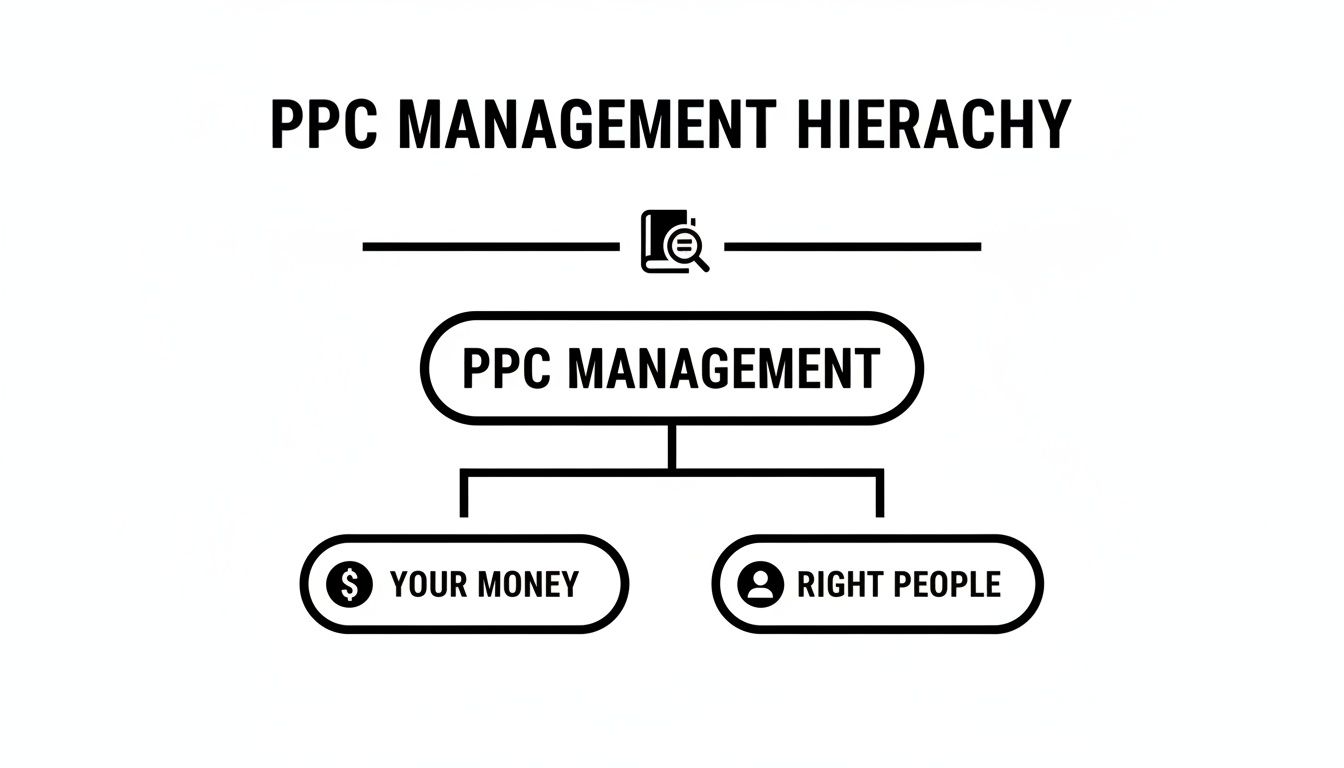
Every component we're about to discuss is designed to make your ad spend more efficient and more effective at achieving that goal.
2. Finding the Right Keywords
Next up is keyword research. This is the art and science of getting inside your customers' heads to figure out the exact words and phrases they type into Google when they need what you offer. It’s like being a mind reader for shoppers.
Someone craving your jam might search for “best strawberry jam Kelowna” or “local Okanagan preserves.” Our job is to unearth all of these terms—the obvious ones and the hidden gems—so your ad appears at that precise moment of need.
Good keyword research is the difference between setting up your jam stand on a busy street corner versus a quiet, empty alleyway. You have to be where the people are.
We go deep, focusing on the keywords that signal real buying intent. This ensures we're attracting people who are ready to make a purchase, not just casual browsers.
3. Writing Ads That Actually Get Clicked
With our keywords in hand, it's time for the creative part: writing the ad copy. These are the short, punchy lines of text that show up in the search results. They have one job, and one job only: to earn the click.
Think about the sign for your market stall. Does it just say "Jam"? Or does it say something more enticing, like "Taste the Okanagan Sunshine: Award-Winning Strawberry Jam"? You know which one will stop people in their tracks. We craft ad copy that is clear, compelling, and mirrors the searcher's original query, making them feel like you have the perfect solution.
4. The All-Important Landing Page
This is the final, and arguably most critical, piece of the puzzle: the landing page. After someone clicks on your perfectly crafted ad, where do they end up? This step is a massive deal.
Sending them to your generic homepage is like inviting a customer over to your booth, then pointing to a pile of fruit and sugar and telling them to figure it out. It's confusing and ineffective. Instead, we direct them to a custom-built landing page that continues the conversation started by the ad.
If they clicked on an ad for strawberry jam, the page they land on should be a celebration of your strawberry jam.
It needs beautiful photos of the jam.
It should tell a quick story—what makes it special (local berries, a family recipe?).
Most importantly, it must have an unmissable, dead-simple way to buy it.
This is where so many DIY campaigns fall flat. A brilliant ad is wasted if the landing page doesn't convert that interest into action. When all these components—structure, keywords, copy, and landing page—work in harmony, you get a campaign that doesn’t just run, it delivers results.
If you feel like your current ads are missing a piece of the puzzle, we can help you put it all together.
Targeting and Bidding to Reach the Right People
Okay, so you’ve got your campaigns organized and some fantastic ads written. Now for the exciting part. This is where the real power of PPC ad management comes into play—getting your message in front of the exact people you want to reach.
Think of it this way. If you run a beautiful winery in West Kelowna, traditional advertising might mean putting up a billboard and hoping some wine lovers drive by. With PPC, you can show your ads to people within a 20-kilometre radius who have actively searched for "Okanagan wine tours" in the last week. That's not just advertising; that's precision marketing.
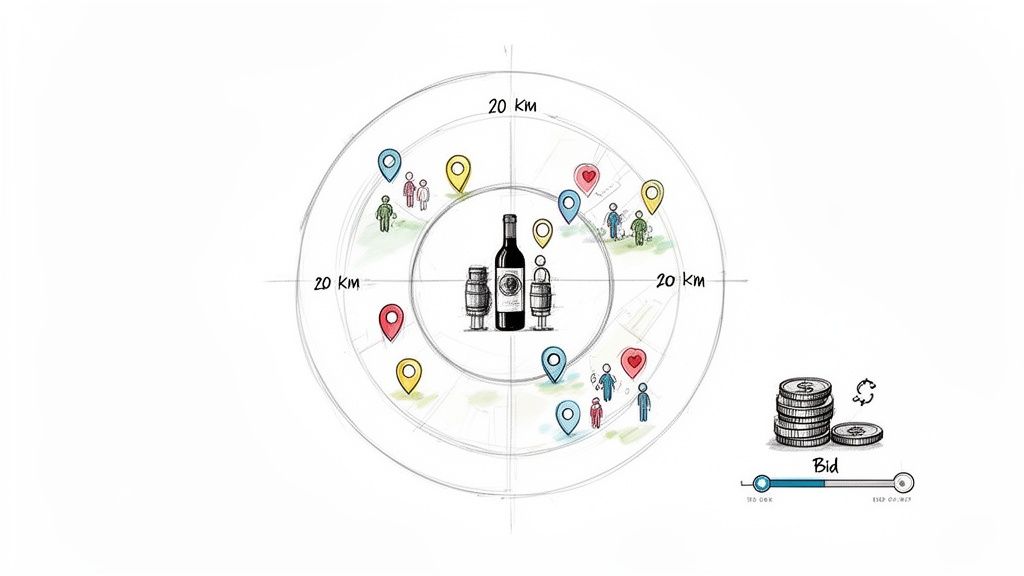
This level of detail is what transforms advertising from a guessing game into a reliable engine for business growth.
Zeroing In on Your Ideal Customer
Targeting goes so much deeper than just location. We can get incredibly specific to make sure every dollar you spend is reaching people who are actually likely to become your customers. It’s all about working smarter, not just spending more.
Here are just a few ways we can narrow down the audience:
Demographics: We can target by age, gender, and even income level. This is perfect for a business in Vernon that sells products geared toward a specific generation or lifestyle.
Interests & Habits: Google has a pretty good idea of what people are into, based on their search history and online behaviour. We can show your ads to folks who are avid golfers, foodies, or home renovation enthusiasts.
Past Behaviour (Remarketing): This one is a game-changer. We can show specific ads to people who have already visited your website but left without buying or filling out a form. It’s a gentle, effective nudge to remind them you’re still there.
Think of remarketing like a friendly follow-up. It's like having a brief chat with someone who browsed your shop but walked out. You get a second chance to say, "Hey, remember that thing you liked? It's still here!"
Getting this targeting right is a core part of effective PPC management. It stops you from wasting money on clicks from people who were never going to be the right fit in the first place.
Making Sense of Bidding
Once we know who we want to reach, the next question is how much we’re willing to pay to reach them. That’s where bidding comes in. It might sound complex, but the basic concept is quite straightforward.
Bidding is simply telling an ad platform like Google the maximum amount you’re willing to pay for a single click on your ad. This is often called your Cost-Per-Click, or CPC. You can dive deeper into how to calculate your ideal Cost-Per-Click in our detailed guide.
There are two main ways to handle this:
Manual Bidding: This is the hands-on approach. We set the bids for your keywords ourselves and adjust them based on what’s working and what isn’t. It gives you maximum control, which is great for very specific campaign goals.
Automated Bidding: With this strategy, we let Google’s algorithm do the heavy lifting. We give it a goal—like getting the most conversions possible within your budget—and it automatically adjusts your bids in real-time to hit that target.
PPC is a rapidly growing market in Canada. In 2025, Canada's PPC ad market snagged over 10% of North America's total, showing just how many local businesses are seeing the value. With the market expected to grow significantly by 2033, getting your strategy right now is a huge advantage, especially since the average cost for a click on Google Ads is already over $5.
Ultimately, choosing the right bidding strategy depends entirely on your business goals. For a new campaign, we might start with a more manual approach to gather data. Then, once we know what works, we can switch to an automated strategy to scale up. It’s all part of a thoughtful, flexible approach to PPC management that ensures your budget is always working its hardest for you.
How to Know if Your Ads Are Actually Working
You’re putting hard-earned money into advertising, so you absolutely deserve to know what you’re getting back. Let’s connect the dots between your ad spend and your bottom line. It’s all about tracking results and understanding the numbers—without needing a math degree.
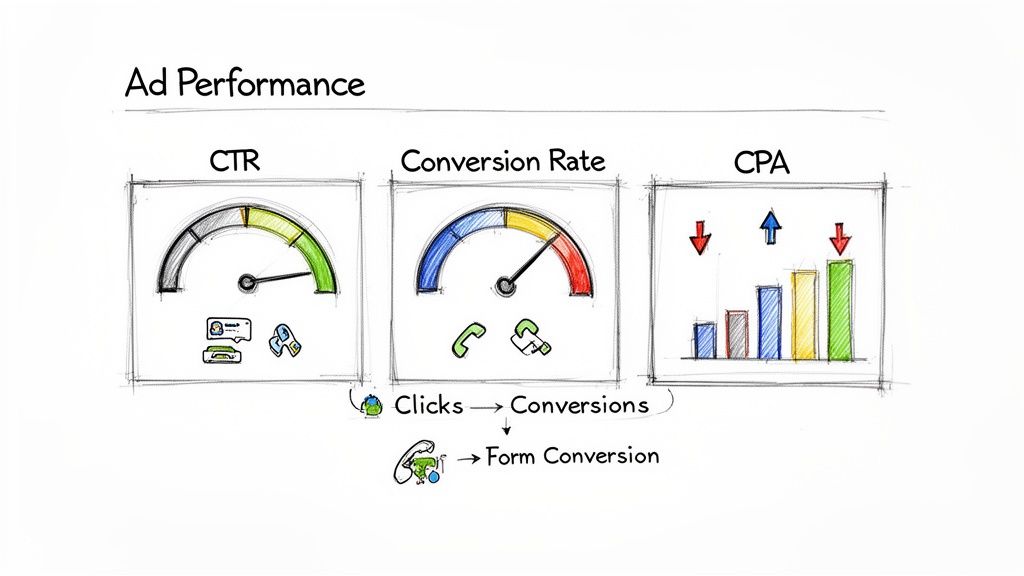
It’s easy to get lost in a sea of data, but honestly, only a handful of metrics really tell the story of your campaign’s health. We’ll look at the big three: Click-Through Rate (CTR), Conversion Rate, and Cost Per Acquisition (CPA). But we won’t just define them; we’ll talk about what they actually mean for a business like yours.
Making Sense of the Key Metrics
Let's break down the most important numbers you’ll come across. Think of these as the dashboard gauges for your campaign’s engine. Each one gives you a specific read on how things are running.
A high Click-Through Rate (CTR) is a fantastic start. It means your ad is catchy and relevant enough to make someone stop scrolling and actually click. But if those clicks aren't turning into customers, that's a huge clue that something is off after the click, likely on your landing page.
This is where your Conversion Rate comes into play. This metric tracks the percentage of people who clicked and then took the action you wanted them to, like filling out a contact form or buying something. A strong conversion rate is the ultimate sign that your entire funnel—from the ad right through to the landing page—is working together seamlessly.
Then there’s Cost Per Acquisition (CPA). This is the big one. It tells you exactly how much you had to spend on ads to get one new customer or lead. Knowing this number is what lets you make smart decisions about your budget and proves the real return on your investment.
Key PPC Metrics and What They Mean for Your Business
Sometimes, just seeing it all laid out simply makes it click. This table is a quick reference to keep these key terms straight and understand what they signal for your business.
| Metric | What It Measures | Why It's Important |
|---|---|---|
| Click-Through Rate (CTR) | The percentage of people who see your ad and actually click on it. | This tells you if your ad copy and visuals are compelling. A low CTR often means your ad isn't resonating with your target audience. |
| Conversion Rate | The percentage of ad clicks that result in a desired action (e.g., a sale, form submission, or phone call). | This is a crucial indicator of your landing page's effectiveness. A high CTR but low conversion rate points to a disconnect between your ad's promise and the landing page experience. |
| Cost Per Acquisition (CPA) | The total cost of your advertising divided by the number of conversions you got. | This metric shows the real-world cost of getting a new customer through your ads. Keeping this number below your customer's lifetime value is the key to profitable advertising. |
At the end of the day, these metrics are feedback from your potential customers. They tell you what's working and, more importantly, what isn't.
Connecting Ad Spend to Real Business Results
The whole point of tracking these numbers is to see if your PPC ad management is generating real-world outcomes. Are the phones ringing more? Are more quote requests coming through your website? These are the results that actually matter.
Recent data shows just how powerful optimized campaigns can be. In 2025, 65% of industries saw their conversion rates climb on Google and Microsoft Ads, with the average conversion rate on Google hitting 7.52%. Even though costs are rising—the average cost per lead on Google search is now over $70—a well-managed campaign can deliver an incredible return.
At the end of the day, data is just a tool. The real goal is to use that tool to understand what’s working, fix what isn’t, and make confident decisions that help your business grow.
By focusing on these core metrics, you move away from just hoping your ads work and into a place where you know they do. You can draw a clear line from the money you invest to the new business coming in the door. If you're feeling a bit overwhelmed by the data, our guide on Google Analytics for beginners is a great, no-nonsense place to start getting comfortable with the numbers.
Common PPC Mistakes to Sidestep
After more than 30 years in this business, we’ve pretty much seen it all. We've watched countless smart, well-meaning business owners dive into PPC ads, full of hope, only to hit the same few bumps in the road that cost them real time and money. Think of this as a friendly chat with someone who’s been there and wants to help you avoid those stumbles.
Getting your PPC ad management right from the very beginning can make a world of difference. When you learn from these common pitfalls, you can put your budget to work in the smartest way possible.
The 'Set It and Forget It' Trap
One of the biggest mistakes we see, time and time again, is the classic "set it and forget it" approach. It’s so tempting to get a campaign launched, feel that rush of accomplishment, and then immediately get pulled back into the million other things your business demands.
But PPC campaigns are a lot like a garden; they need constant tending. If you're not checking in regularly, you could be blowing your budget on keywords that aren't bringing in customers or showing ads that have gone stale.
A PPC campaign isn't a slow cooker; it's a stovetop that needs a watchful eye. A little tweak here, a small adjustment there… that’s what turns a good campaign into a great one.
We once worked with a tourism operator in the Okanagan who had ads running for a seasonal event… a full three months after the event had ended. It happens! That's precisely why active management is so critical—it keeps your money focused on what's happening right now.
Sending Everyone to Your Homepage
Here’s another incredibly common misstep: directing all your ad traffic to your website's homepage. Let's say you run a local renovation company and someone clicks your ad for "custom kitchen cabinets Kelowna."
If that click sends them to your homepage, they suddenly have to become a detective. They need to find your services page, then hunt for your kitchen renovation section, and maybe then find a photo gallery. That's a lot of work, and frankly, most people won't bother. They'll just hit the back button.
Instead, they should land on a page dedicated exclusively to your beautiful custom kitchen cabinets. This page needs to have:
Stunning photos of your best kitchen projects.
Clear information about your process and materials.
An obvious, easy-to-use form to request a quote.
By creating a specific landing page for each ad, you make it incredibly simple for a visitor to take that next step. You’re essentially continuing the conversation you started with the ad, and that makes a huge difference in turning clicks into actual leads.
Forgetting About Negative Keywords
This last one is a bit more technical, but it’s a real budget-saver. Imagine you’re a high-end interior designer in Penticton, and you're bidding on the keyword "interior design services."
But what happens when someone searches for "free interior design software" or "interior design courses"? Your ad might pop up, they might click it, and you've just paid for a click from someone who was never, ever going to be a customer.
This is where negative keywords come in. Think of them as your campaign’s bouncers. By adding words like "free," "jobs," "school," and "DIY" to your negative keyword list, you’re telling Google, "Don't show my ad to anyone searching for these things."
It's a simple step that stops you from wasting money on clicks that have zero chance of converting. Proper PPC ad management is about both attracting the right people and actively filtering out the wrong ones. If you feel like your campaigns might be falling into some of these traps, we can help you take a closer look and get things on the right track.
Finding the Right Partner for Your PPC Management
Let's be honest, trying to manage all this yourself can quickly feel like you've taken on a second full-time job. It’s a lot to juggle. Sometimes, the smartest and most strategic move you can make for your business is to bring in a partner.
So, what should you actually look for? Think of this as a checklist for finding the right fit—a team that feels like a genuine extension of your own, someone who’s truly invested in seeing you succeed.
Look for Real Transparency
First and foremost, you should always know exactly where your money is going and what results you're getting for it. A true partner will be an open book. They should give you clear, easy-to-understand reports that connect their work directly to your business goals, whether that’s more phone calls or qualified leads.
There should never be any mystery around your ad spend or how your campaigns are performing. If you feel like you're being kept in the dark, that's a massive red flag.
They Should Get Your Goals
A good PPC partner doesn't just ask for your credit card; they start by asking about your business. They take the time to dig in and really understand what you’re trying to achieve. Are you trying to drive more foot traffic to your Vernon storefront? Are you a Penticton real estate agent who needs more qualified buyer leads?
The strategy for each of those goals is completely different. You need to find a team that starts by listening, making sure the entire PPC ad management plan is built around your specific definition of success.
A great partner works with you, not just for you. They should feel like a trusted member of your team who just happens to be an expert in digital advertising.
Local Expertise Matters
There's a massive advantage to working with someone who just gets the local market. An agency that knows the difference between Kelowna and West Kelowna, or what really drives tourism in the Okanagan Valley, can craft campaigns with so much more local flavour and impact. They understand the community because they're a part of it.
Finding a partner who ticks these boxes sets you up for a relationship built on trust and a shared desire to see your business grow. You can learn more about what to look for by checking out our guide on how to choose the best marketing agencies.
If you're ready to see what a true partnership can do for your business, Navigator Multimedia is here to help. We'd love to chat about your goals and see how we can help you achieve them. Let's get in touch.