A Practical Guide to SEO for Realtors in the Okanagan
SEO for realtors isn’t some dark art. It’s just about making sure that when local buyers and sellers look for an agent on Google, your name is the first one they see. It's how you get your website working for you, so you can stop chasing leads and start having them come to you.
It's a lot to juggle, I get it. You're already managing listings, clients, and a million other things. Thinking about your website can feel like one task too many. But stick with me… we're going to make this simple.
Your Foundation in Local Search
Let's get straight to the point. If a family is relocating to Kelowna and searches for a “realtor near me,” and your name is nowhere to be found… you’re invisible to them. It’s a harsh reality, but that's how people find professionals now. The good news is that this is the single most powerful thing you can fix, and it starts with your Google Business Profile.
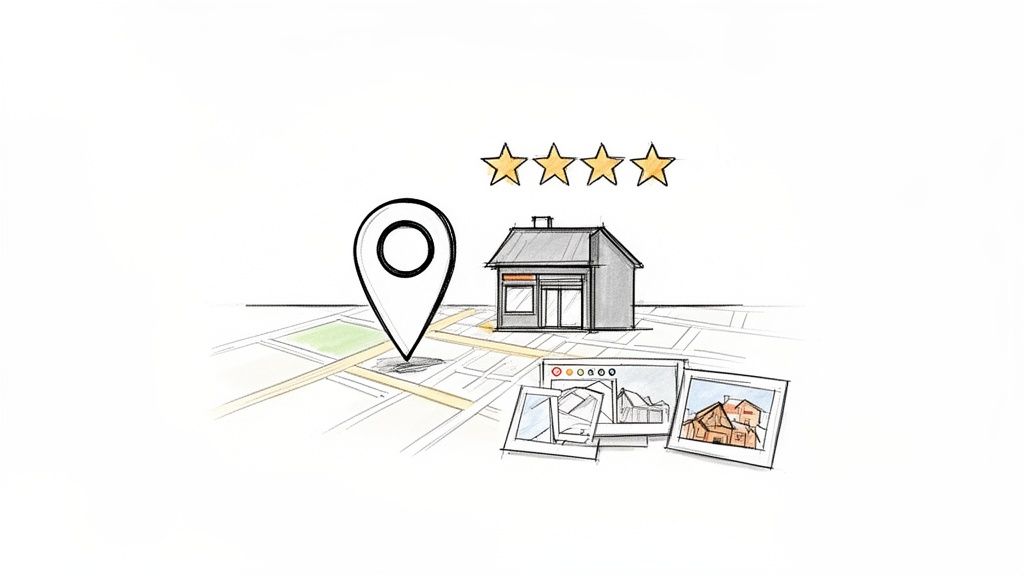
Think of your Google Business Profile (GBP) as your digital storefront. It’s that handy box that shows up in Google Maps and on the side of the search results, complete with your photo, contact details, and those crucial client reviews.
Why Your Google Profile Is Your Top Priority
Getting your GBP right is non-negotiable. It's the absolute foundation of your local SEO efforts. Why? Because the Google "Local Pack"—that map box showing the top 3 results—gets a staggering 33% of all clicks in a local search. If you’re not in that top trio, you’re missing out on a huge chunk of potential business.
A well-managed profile with a steady stream of reviews is a lead-generation powerhouse. Seriously. In competitive markets, it's not unusual for agents with strong profiles to field 15-25 qualified calls every single month. The return is incredible; some agents have tracked as many as 26 closings in a single year just from this one source.
A complete, active profile tells Google that you're a legitimate, trusted expert in the Okanagan real estate market.
Optimizing Your Profile for Maximum Impact
Just claiming your profile isn't enough. The real work—and the real results—come from filling it out completely and keeping it fresh. This sends powerful signals to Google that you’re a key player in communities like Penticton, Vernon, or West Kelowna.
Here's a quick-glance checklist to make sure your profile is set up to attract local buyers and sellers.
Your Google Business Profile Priority Checklist
| GBP Element | Why It Matters for Realtors | Action Item |
|---|---|---|
| Business Categories | Tells Google exactly what you do. The primary category is most important for ranking. | Set Primary to "Real Estate Agent". Add secondary ones like "Real Estate Consultant." |
| High-Quality Photos | Builds trust and showcases your brand. People want to see who they'll be working with. | Upload a professional headshot, team photos, sold listings, and local neighbourhood shots. |
| Client Reviews | The single most important trust signal for both Google and potential clients. | Create a simple process to ask every happy client for a review post-closing. Send a direct link. |
| Google Posts | Shows Google your profile is active and provides timely info to searchers. | Post weekly updates: new listings, open houses, market news, or community spotlights. |
| Complete NAP Info | Ensures your Name, Address, and Phone number are consistent everywhere online. | Double-check that your details are 100% accurate and match your website. |
Finishing this checklist is a huge step forward. It sets the stage for everything else you'll do.
Building a strong local presence is the bedrock of any successful digital strategy for realtors. If you want an expert team to help you dominate the local map pack, you can learn more about our SEO services in Kelowna. Getting this piece right turns your online profile into your best salesperson.
Crafting Website Content That Converts
So, someone found you on Google and clicked through to your website. Great! But… now what?
That click is just the beginning. Your website has about three seconds to convince that visitor they’ve landed in the right place and that you’re the expert they’ve been looking for.
This next layer of the SEO puzzle is what we call on-page SEO. It’s all about the actual words, photos, and structure of your website pages. Getting this right turns your site from a simple online brochure into a valuable resource that both clients and Google will love.
Go Hyper-Local With Neighbourhood Guides
You have an advantage that the big national real estate websites will never have—you actually live here. You know the best coffee shop in Pandosy, the quietest streets in Glenmore, and which parks in Penticton are the most dog-friendly. Use that knowledge!
Creating detailed neighbourhood guides is one of the most powerful things you can do. After all, people aren’t just buying a house; they’re buying a lifestyle.
Imagine a family moving to the Okanagan. They're probably searching for things like:
Best family neighbourhoods in Kelowna
Schools in the Lower Mission
Vernon communities with lake access
When you create a page dedicated to answering these questions, you’re providing immense value. Talk about the local quirks, the annual community events, and the pros and cons of living there. This is the kind of content that builds trust and establishes you as the go-to local expert.
Writing Property Descriptions That Actually Work
Let’s talk about your listings. It’s easy to just pull the standard description and call it a day, but that’s a huge missed opportunity. Your property descriptions need to do double duty: they must be compelling for human readers and optimized for search engines.
Think about how people search. They use specific phrases. Instead of just listing "3 beds, 2 baths," try weaving in descriptive, searchable keywords naturally.
For example, a title like "Stunning Lakeview Home for Sale in West Kelowna" is much more powerful than "123 Apple Street." In the description, you can mention things like "a perfect family-friendly condo near UBCO" or "enjoy the Okanagan lifestyle from this walkout rancher." These are the exact terms potential buyers are typing into Google.
Your goal is to become a local thought leader. By creating amazing, hyper-local content, you can start ranking for valuable terms that get hundreds of searches a month.
Structure Your Pages for Success
How your content is organized is just as important as what it says. A giant wall of text is overwhelming. Google and your website visitors prefer clean, well-structured pages that are easy to scan.
Use clear headings (like the ones in this article!) to break up your text. An H1 heading should be your main page title, followed by H2s for major sections and H3s for sub-points. This creates a logical flow and helps search engines understand the hierarchy of your information.
Another key piece is internal linking. This just means linking from one page on your site to another. For instance, in your Glenrosa neighbourhood guide, you could link to a current listing you have in that area. Or, from a blog post about downsizing, you could link to your page on condos for sale in Penticton. This keeps people on your site longer and helps Google discover all your great content.
This strategy is a core part of what we do when we build a content plan for our real estate partners. If you're curious about how a full-funnel approach works, you can check out our guide on real estate content marketing.
Recent data shows that a massive 98% of buyers consider interactive floor plans important, and 97% are influenced by online reviews. Integrating these elements directly onto your pages adds layers of trust and authority.
By making your website a truly valuable local resource, you give people a reason to stick around, and you give Google a reason to rank you higher.
Mastering the Technical Side of SEO
Alright, let's pull back the curtain and talk about what’s happening behind the scenes on your website. The term “technical SEO” can sound intimidating… like you need a computer science degree to get it. But honestly, it’s just about making sure your website is built on a solid foundation so search engines can easily find, understand, and rank your content.
Think of it this way: you could build a house with a gorgeous kitchen and a stunning master bedroom, but if the foundation is cracked, the whole structure is at risk. Technical SEO is your website’s foundation.

Why Site Speed Is Non-Negotiable
Have you ever tried to check out a listing on your phone, only to sit there while the photos take forever to load? You probably hit the back button after a few seconds. We all do.
That’s a site speed problem, and it’s a killer for both potential clients and Google. Google has made it crystal clear that site speed is a major ranking factor, especially on mobile, where more than half of all web traffic now comes from.
A slow website is frustrating and it actively costs you leads. Every extra second a potential client waits for your page to load is another opportunity for them to leave.
Making Your Site Mobile-Friendly
Your entire website needs to look and function beautifully on a phone. We call this being mobile-friendly or having a responsive design.
This means text is readable without pinching and zooming, buttons are big enough for a thumb to tap, and property photos display perfectly on smaller screens. A clunky mobile experience is one of the quickest ways to lose a potential lead browsing listings on their lunch break.
In fact, Google now uses the mobile version of your site for ranking. If your website isn't built for mobile users first, you're already playing from behind.
You could have the most beautifully written neighbourhood guide for Kelowna's Lower Mission, but if it's impossible to read on a phone, most people will never see it. Getting the technical details right ensures all your great content actually gets discovered.
A Secret Weapon: Schema Markup
Now for a pro tip that can give you a serious edge in the search results: schema markup.
Schema is a specific type of code you add to your website that acts like a cheat sheet for Google. It helps search engines understand your content on a much deeper level, especially your property listings.
Instead of just seeing a wall of text, schema explicitly tells Google things like:
The property’s address
The listing price
The number of bedrooms and bathrooms
The square footage
When Google has this neatly organized data, it can feature your listings in more eye-catching ways, sometimes showing photos and key details right on the search results page. This can dramatically improve how many people click through to your site. If you're looking to dive deeper into this topic, our guide on what is technical SEO can shed some more light on it.
Navigating the World of IDX Feeds
Most realtor websites use an Internet Data Exchange (IDX) feed to pull listings directly from the MLS. While incredibly convenient, this can sometimes create a few technical SEO headaches.
One of the biggest issues is duplicate content. The exact same listing description from the MLS can appear on hundreds of different realtor sites, making it tough for Google to figure out which one is the original source.
Slow-loading IDX pages or messy, long URLs can also be a problem, making it harder for search engines to crawl your site effectively. This is where working with a web developer who truly understands real estate tech is crucial. They can make sure your IDX is integrated properly, so you get full credit for your listings without damaging your site’s overall SEO health.
Getting these technical elements sorted out is a true game-changer. It’s the behind-the-scenes work that ensures all the effort you put into your photos, your content, and your brand actually gets seen by the right people at the right time.
Building Your Authority Across the Web
So far, we’ve focused on the nuts and bolts of what you can control on your own website and Google profile. But a huge piece of the SEO puzzle happens off your site. It’s all about building your reputation across the web so Google sees you as the go-to expert in your market.
Think of it like a real-world referral. When another respected business owner sends a client your way, that recommendation carries weight. The same principle applies online, but the currency is backlinks.
A backlink is simply a link from someone else's website to yours. When a reputable site—say, a local news outlet or a popular Okanagan lifestyle blog—links to one of your neighbourhood guides, they’re essentially giving you a vote of confidence. They're telling Google, "Hey, this realtor in Kelowna really knows their stuff. You should pay attention to them."
Earning Links the Right Way
Now, let's be clear: this has nothing to do with spammy, old-school tactics like buying links. That's a quick way to get your site penalized by Google. This is about earning those votes of confidence by building genuine relationships and becoming a recognized authority in the Okanagan community.
It all comes down to being a valuable resource that people want to reference.
A strong backlink profile is a powerful signal to Google. It shows that other credible sources trust your expertise, which makes it easier for you to rank for those really competitive search terms like "homes for sale in Penticton."
Practical Ways to Build Your Authority
This might sound intimidating, but it’s more straightforward than you think. It often blends perfectly with the community-building activities you’re probably already doing.
Here are a few practical ideas to get the ball rolling:
Write for a Local Blog: Do you follow a popular Okanagan parent blog or lifestyle site? Pitch them a guest post on a topic you know inside out, like "5 Things Families Should Know Before Moving to West Kelowna." You'll almost always get a link back to your website in your author bio.
Sponsor a Community Event: Sponsoring a local charity fun run or a minor hockey team in Vernon? Ask if they can include a link to your website on their event page or list of sponsors. It's a natural and positive way to get a relevant local link.
Get Featured in Local News: Local media outlets are always looking for experts to quote when they write about the housing market. Be that expert. Connect with local journalists on social media and let them know you're available for commentary on real estate trends. A feature in an article often comes with a very powerful backlink.
Partner with Local Businesses: Create a "Local Favourites" guide on your blog highlighting the best coffee shops, wineries, or contractors in your farm area. Once it's published, email those businesses to let them know you’ve featured them. They'll often share it on social media or even link back to it from their own site.
Building your website’s authority is a long game, but it’s the key difference between realtors who get consistent leads and those who don’t. It takes patience and a genuine effort to build relationships.
If finding these opportunities and building partnerships feels like one more thing on an already full plate, this is where a partner can make a huge difference. We can help you identify these opportunities and build a strategy that works. Feel free to reach out to us if you want to chat about what that could look like.
How to Measure Your SEO Success
You’re putting in all this work—optimizing your Google profile, writing fantastic neighbourhood guides, and building your online authority. So… how do you know if any of it is actually working?
It’s a fair question, and probably the most important one you can ask. The last thing you want is to pour your time and energy into a black hole without seeing a clear return. Let's break down how to track what really matters, without getting lost in a sea of confusing data.
The whole point of SEO for realtors is to generate leads. Full stop. That means we need to connect our online efforts to tangible, real-world results. We can do that by focusing on a few key numbers.
Key Metrics That Actually Matter
Forget about vanity metrics that sound impressive but don't pay the bills. When we work with realtors, we zero in on the data that points directly to business growth. These are the numbers that tell you if you're on the right track.
You can find all of this information for free using two essential tools from Google: Google Analytics and Google Search Console. If you haven’t set these up yet, that’s your first move before you do anything else.
Here’s what you should be looking at every month:
Organic Traffic: This is simply the number of visitors who land on your website by clicking a link from a search engine like Google. It’s a direct measure of your visibility. Is this number climbing month over month? If it is, your efforts are paying off.
Keyword Rankings: Are you showing up on the first page when someone in your area searches for "homes for sale in Kelowna" or "Penticton real estate agent"? Tracking your rank for a handful of your most important local keywords is a fantastic way to see concrete progress.
Leads and Conversions: This is the big one. How many people are filling out your contact form, clicking the "call" button from their phone, or signing up for your market report? This is the ultimate measure of success, telling you exactly how many potential clients your SEO is bringing through the door.
Don't get bogged down by every single chart and graph. Your monthly check-in can be simple: Are more people finding us through search? Are we ranking for the right terms? And most importantly, is our phone ringing more often?
Creating a Simple Reporting Habit
This doesn’t need to be some complicated, time-consuming task. Just set aside 30 minutes at the start of each month to pull up your data and see what’s happening. A quick check-in helps you understand what’s working, so you can do more of it.
For instance, you might notice that one of your neighbourhood guides is suddenly bringing in a ton of organic traffic. That’s a huge clue! It tells you that creating more content just like it for other communities in the Okanagan is a very smart move.
Or maybe you’ll see your rankings for a key phrase have jumped from page three to the bottom of page one. That’s a major win worth celebrating! It shows the momentum is building.
It’s all about creating a simple feedback loop. You do the work, you check the numbers, and you adjust your strategy based on what the data is telling you. This is how you build a powerful, lead-generating machine over time instead of just guessing what might work next.
This is a core part of how we build partnerships. We handle the complex data analysis so our clients get a clear, straightforward summary of what’s happening and what’s next. If you’d rather focus on your clients than on spreadsheets, let's have a chat. We can help you turn all this data into a clear path forward.
Your Simple 90-Day SEO Roadmap
Feeling a bit overwhelmed by all this? That’s completely normal. SEO is a marathon, not a sprint, and you don't need to tackle everything at once. The key is to start with the highest-impact tasks first.
Let's map out a clear, manageable plan that fits into a busy realtor's schedule. Think of the first three months as laying the essential groundwork.
Here's a prioritized roadmap breaking down the key tasks into a manageable 90-day timeline.
90-Day Realtor SEO Action Plan
| Timeframe | Primary Focus | Key Actions |
|---|---|---|
| Days 1-30 | Local SEO Foundation | • Set up or fully optimize your Google Business Profile. • Fill out every single field. • Upload at least 10 high-quality photos and 3 videos. • Develop a system to consistently get client reviews. |
| Days 31-60 | On-Page & Content Creation | • Identify 3 core neighbourhood/community targets. • Write your first in-depth neighbourhood guide. • Optimize the on-page SEO for that new guide and your homepage. |
| Days 61-90 | Authority & Link Building | • Find a local business, blogger, or community group to earn your first backlink from. • Share your neighbourhood guide with them. • Set up basic KPI tracking in Google Analytics and Search Console. |
This table gives you a bird's-eye view, but let's talk about what this really looks like in practice.
Your First 30 Days: The Foundation
Your entire focus for the first month is simple: master your Google Business Profile. We covered this in the first section, and for good reason—it’s your biggest opportunity for a quick win.
Fill out every single section you see. Upload at least 10 high-quality photos. Most importantly, create a simple system to ask every happy client for a review. That one habit alone will put you miles ahead of many competitors.
Your Next 30 Days: Content Creation
With your Google profile looking sharp, Month 2 is all about creating your first piece of high-value local content. Pick one neighbourhood you know like the back of your hand—maybe it's Kettle Valley in Kelowna or the North End in Penticton.
Write the ultimate guide to living there. Talk about schools, parks, the best coffee shop, local events… everything a potential buyer would want to know. This becomes a powerful asset that starts attracting organic traffic and cements your status as the local expert.
These efforts compound over time. You won't see a flood of leads on day one. Instead, you'll see a steady progression from improved rankings to more traffic, and eventually, to consistent leads.
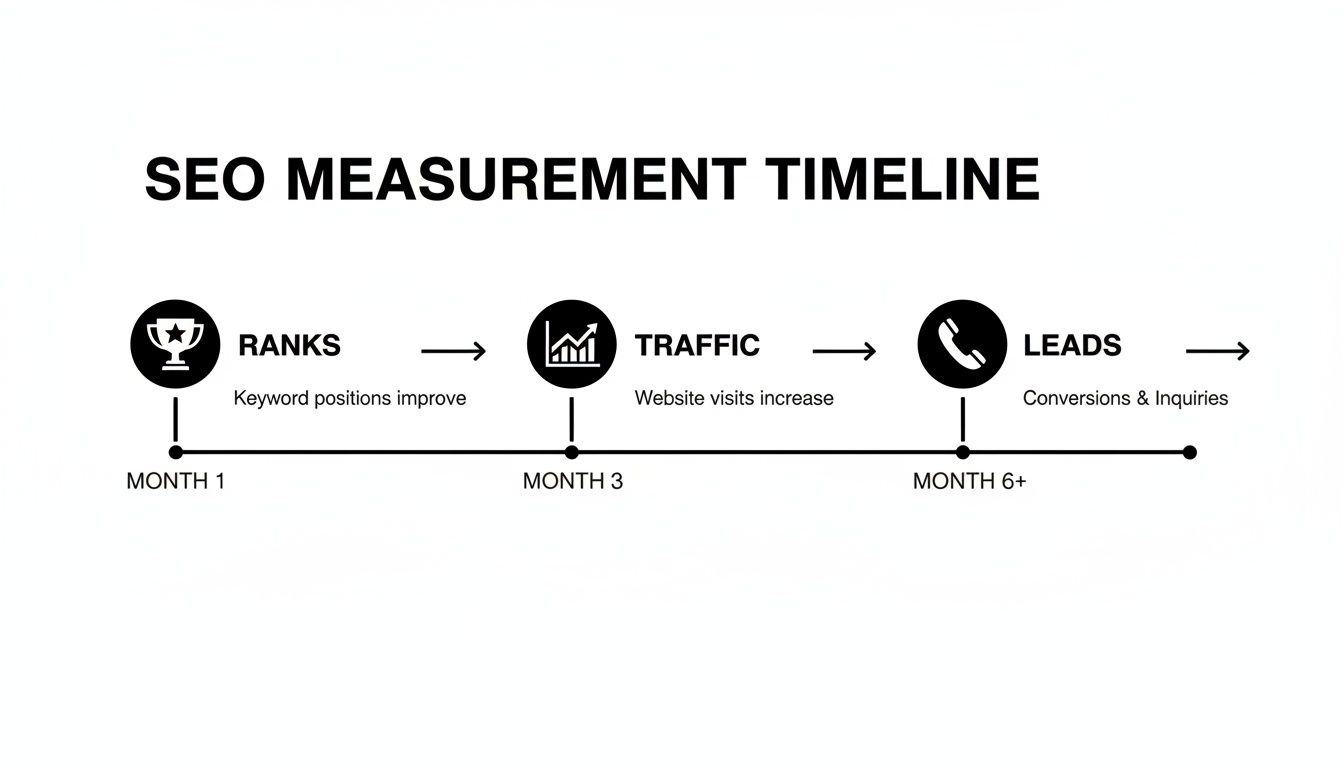
As the timeline shows, consistent effort in the early months directly leads to tangible business growth down the line.
Your Final 30 Days: Building Momentum
In Month 3, you’ll focus on earning your very first backlink. Take that amazing neighbourhood guide you wrote and share it. Email a local blogger, a non-competing business you featured in the guide, or a community association and let them know you've created a great resource they might want to link to.
If you ever feel stuck, remember that having a partner to guide you can make all the difference. Sometimes, the best next step is asking for help.
Common Real Estate SEO Questions Answered
We get a lot of questions about this stuff. Here are answers to a few common ones we hear from realtors across the Okanagan.
How Long Until I See SEO Results?
That’s the million-dollar question, isn't it? The honest answer is that SEO is a marathon, not a sprint. While you might see some quick wins from things like optimizing your Google Business Profile in the first few months, you're really looking at a 6 to 12-month runway before you see significant, lasting results.
Think of it like building a reputation in your community. It takes time to build that authority and trust with Google. The payoff, though, is a steady stream of high-quality leads that come to you.
Should I Do My Own SEO or Hire an Expert?
You can absolutely get started yourself! Seriously, just following the steps in this playbook—especially locking down your Google profile and creating some solid neighbourhood content—will put you light years ahead of many of your competitors in the Okanagan.
Where it starts to get tricky is with the technical side and link-building. Many realtors we work with decide to partner with us when they're ready to really scale. It lets them hand off the digital marketing to a specialist and focus on what they do best: selling homes.
Is Local SEO Really That Important?
For realtors, local SEO is everything.
Your clients are searching for things like "downtown Kelowna condos for sale" or "family homes in the Lower Mission." Nailing your local strategy, particularly your Google Business Profile, is exactly how you show up for those high-intent buyers and sellers right in your own backyard.
General SEO, like blogging about broader market trends, helps build your overall authority. But local SEO is what gets your phone to ring.
This whole process is a journey, not a one-time fix. If you’re ready to turn your website into a lead-generating machine but aren’t sure where to start, the team at Navigator Multimedia can build a clear path forward with you. Let's have a chat about what that could look like.