Web Design With SEO: Turning Your Site Into a 24/7 Salesperson
Let's be real for a minute. Pouring your heart, soul, and money into a website that doesn't bring in customers? It’s frustrating. It feels like you’re shouting into the wind.
This is where web design with SEO steps in. It’s all about building a website that doesn't just look amazing to your visitors, but also makes perfect sense to search engines like Google.
Think of it like building a shop. You need great curb appeal to get people in the door, but you also need a rock-solid foundation so the whole thing doesn't fall over. One without the other just doesn't work.
Your Website Should Work For You
One of the biggest heartaches we hear from small business owners here in the Okanagan is that they've invested in a website, but it just… sits there. It’s not pulling its weight. It definitely doesn't feel like the superstar salesperson they were hoping for.
So, let's fix that. This guide is all about what it really means to build SEO into your web design from the very first sketch. A beautiful site alone won’t bring in new customers from Kelowna or Penticton. You need a smart, search-friendly design that helps you get found by the right people—the ones who are already looking for exactly what you do.
This little pyramid from Wikipedia gives you a good look at all the moving parts.
See how it’s a mix of things you do on your site (like the words and the code) and things that happen off your site (like getting links from others)? They all have to work together.
Why This Matters More Than Ever
How people find local businesses is always changing. For example, Google's new AI Overviews are answering tons of questions directly. That means your website has to be set up to give clear, straightforward answers to stand out.
The proof is in the numbers. One study of 500 companies found that when they got a handle on their Core Web Vitals (a fancy term for site speed and user experience), their bounce rates dropped by a whopping 25%. That's a huge thumbs-up to Google that your site is a great place to be. You can learn more about this in our guide to web design for marketing.
The magic happens when you blend a great user experience with smart search engine strategy. It’s this powerful combo that turns your website from an online brochure into a machine that actually grows your business. Get it right, and your website becomes your best employee.
Building a Blueprint Google Can Read
Before we even start thinking about colours or fonts, we need a plan. You wouldn't start building a house in West Kelowna without a solid blueprint, right? Same idea here. We have to map everything out first.
This is where we sketch out your site's structure, making it super simple for both visitors and Google to find what they need. A logical flow and clear navigation are an absolute must—nobody wants to get lost in a digital maze.
This whole planning phase is called site architecture. It’s a huge piece of the puzzle for successful web design with SEO. It’s about planning your pages around the things your customers are actually searching for.
From a Vague Idea to a Clear Path
Here’s a real-world example: a winery in Penticton. A basic website might just have a single 'Wines' page. But a website planned with SEO in mind goes much deeper. It would have separate pages for topics like:
-
Okanagan red wines
-
Vineyard tours in Penticton
-
Wine club memberships
-
Private event bookings
This does two amazing things. First, it helps a potential customer land on the exact page that solves their problem. Second, it tells Google you’re an expert on these specific topics, making it way more likely your site will show up when people search for them. You have to think like your customer and build the digital paths they'll actually use.
A well-planned site structure is your secret weapon. It guides users effortlessly to a solution and signals your expertise to search engines, building trust on both fronts.
Thinking through this structure at the beginning saves so many headaches down the road. It makes sure every single page has a clear job and helps with the main goal: bringing in more business. It might feel like extra work up front, but a solid blueprint is the foundation for a website that truly performs.
This infographic breaks down how design and SEO should work together right from the start.
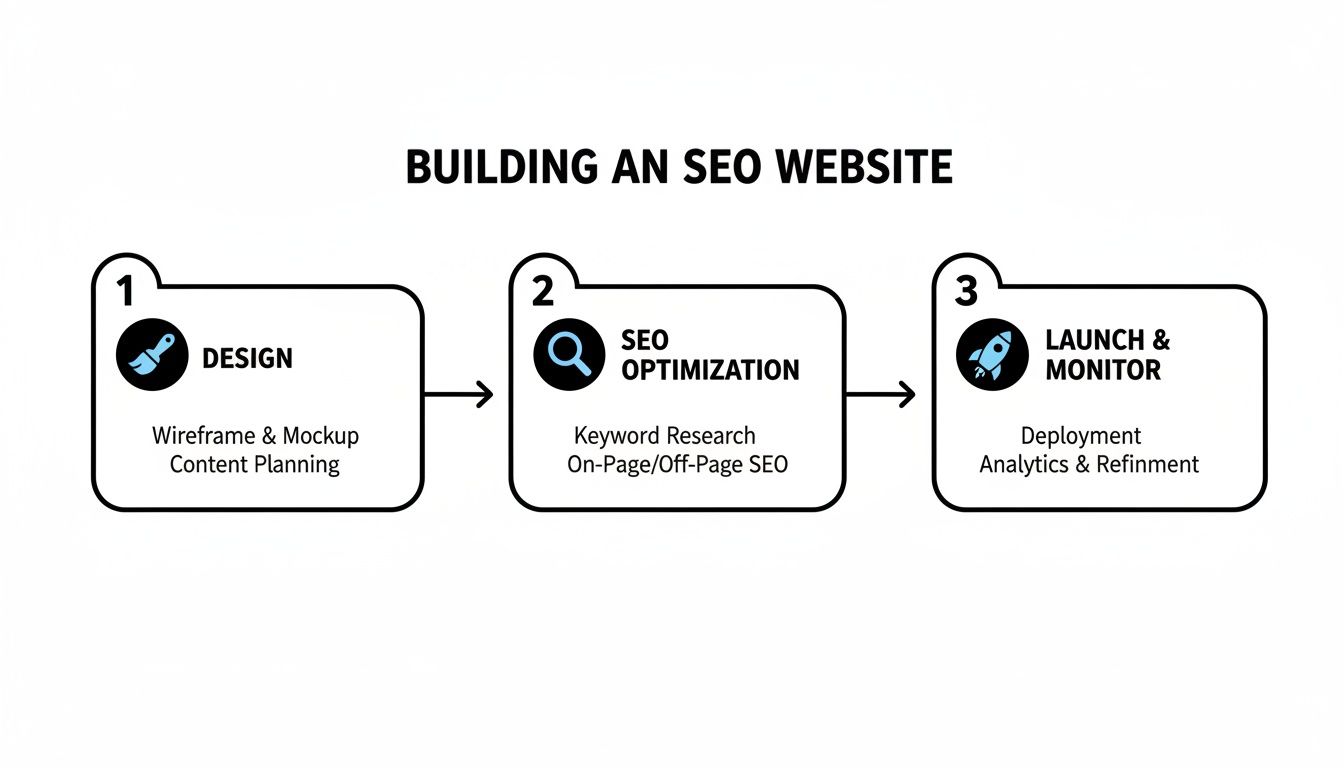
As you can see, design and SEO aren't two separate things—they're partners from day one, working toward a powerful launch. If your current site feels more like a random jumble of pages, it might be time to look at that original blueprint again.
Designing For People First, Search Engines Second
Okay, this is where the creative fun bumps up against smart strategy. Your website has to look good, no doubt. But even more important, it needs to work perfectly for every single person who visits, especially if they’re on their phone.
Think about it. How many people are browsing while waiting for a coffee in Kelowna or sitting by the lake in Vernon? If your website is slow, clunky, or just plain broken on their screen, they’re gone in a flash. That’s why a 'mobile-first' design is an absolute must-have.
It’s a simple idea: we design the mobile version of your site first, and then we expand that layout for bigger screens like tablets and desktops. This makes sure the experience is great for most of your users, instead of treating them like an afterthought.
What a Great User Experience Actually Feels Like
User experience, or UX, is just a fancy way of asking, "How easy and pleasant is it for someone to use this website?" A great UX isn't about flashy animations; it’s about clarity, simplicity, and helping people find what they need… without any fuss.
We're talking about the basics:
-
Easy-to-tap buttons: Nobody should have to pinch and zoom just to click a link.
-
Readable text: Fonts should be clear and big enough that people aren't squinting.
-
Blazing-fast speed: Pages should load almost instantly. Patience is a rare thing online.
-
Obvious contact info: Your phone number and address should be impossible to miss.
All these little details send powerful signals to Google. They prove your site is helpful and user-friendly, which gives your SEO a nice, direct boost. We talk more about how visuals and usability work together in our guide to graphic design for the web.
I remember working with a Vernon business whose mobile traffic was practically zero. After we rebuilt their site with a focus on speed and a clean, mobile-first layout, their visitor numbers from phones just skyrocketed. It's a perfect example of how putting the user first pays off in a big way.
Key Design Elements and Their SEO Impact
To get a clearer picture, let's break down how specific design choices directly affect your site's performance in search results.
| Design Element | Why It Matters for Users | How It Helps Your SEO |
|---|---|---|
| Mobile-First Layout | Gives a smooth experience on any device, which is how most people browse now. | Google mainly uses the mobile version of your site for ranking (mobile-first indexing). |
| Fast Page Load Speed | Stops people from getting frustrated and leaving. A fast site just feels more professional. | Page speed is a known ranking factor. Faster sites have lower bounce rates and better engagement. |
| Intuitive Navigation | Lets users find what they need quickly, without getting lost or confused. | A clear structure helps search engine crawlers understand your site's layout and what's important. |
| Clear Calls-to-Action (CTAs) | Guides visitors on what to do next, whether it's calling you or buying something. | Strong CTAs improve user engagement, which are positive signals for SEO. |
| Readable Fonts & Sizing | Makes sure your content is easy to read and understand, reducing eye strain. | Good readability keeps users on your page longer, telling Google your content is valuable. |
Ultimately, a fantastic design is one that solves your customer’s problem with zero friction. It guides them smoothly from their first click to their final phone call.
Keeping Up With How People Search
The way people look for things is always changing. For example, voice search has exploded, with an incredible 58% of consumers now using it to find local businesses. This shift means we have to think about how people talk, not just how they type.
This ties right back to mobile-first design. People expect to ask a question and get a quick, conversational answer on a site that looks great on their phone. And when you know that a tiny 0.63% of searchers ever click to the second page of Google, being voice-ready and mobile-friendly is no longer optional.
When you design for people—making your site fast, intuitive, and genuinely helpful—you’re automatically doing most of the right things for SEO. Google just wants to reward the websites that give its users the best experience.
The Nuts and Bolts: Technical SEO Under the Hood
This next part can sound a bit techy, but it’s so important for your site's success. Think of technical SEO as the foundation of your house. You don't really see the concrete slab or the support beams, but without that solid base, the whole thing would be shaky.
It's all the behind-the-scenes work that makes your website visible and trustworthy to search engines.
Making It Easy for Google to Visit
First things first, we need to make sure Google's crawlers—the little bots that index the web—can find and understand your site. We start by creating a sitemap, which is basically a map of your website that we hand directly to Google. This map guides the crawlers to every important page so nothing gets missed.
We also focus on crawlability. This is just a way of saying we make sure there are no dead ends or blocked paths on your site. The easier we make it for these bots to move through your content, the better they can understand what your business does and how to rank it.
A clean technical foundation is the invisible work that creates very visible results in your search rankings. It ensures Google can find, understand, and trust your website from day one.
Building Trust With Every Click
Ever notice that little padlock icon in your browser's address bar? That's an SSL certificate at work. It means the connection to the site is secure. Today, this is an absolute must-have for any professional website.
An SSL certificate tells both visitors and Google that any information they share on your site is encrypted and safe. It's a small detail that builds instant trust, and it's one of the very first things we set up when building a new website.
Key Technical SEO Items We Handle
Here’s a quick peek at some of the essential "under-the-hood" things we manage to get your website running smoothly for search engines:
-
Page Speed Optimization: Nobody waits for a slow website. We optimize everything to make sure your pages load in the blink of an eye, because a site that takes more than 3 seconds to load loses visitors and rankings.
-
Fixing Broken Links: We carefully check for and fix any "404 error" pages. A bunch of broken links tells Google your site isn't well-maintained, which can really hurt your credibility.
-
Clean URL Structures: A simple, logical URL like
yoursite.ca/kelowna-plumbing-servicesis much better than a messy one full of random letters and numbers. Clean URLs help both users and search engines understand what a page is about before they even click.
Getting these details right from the start is a core part of our process. It ensures the beautiful, user-friendly website you see on the outside is powered by a rock-solid, search-friendly engine on the inside.
If you're curious and want to learn a bit more, we've created a straightforward guide on what is technical SEO that explains this stuff in more detail.
Creating Content That Connects and Ranks
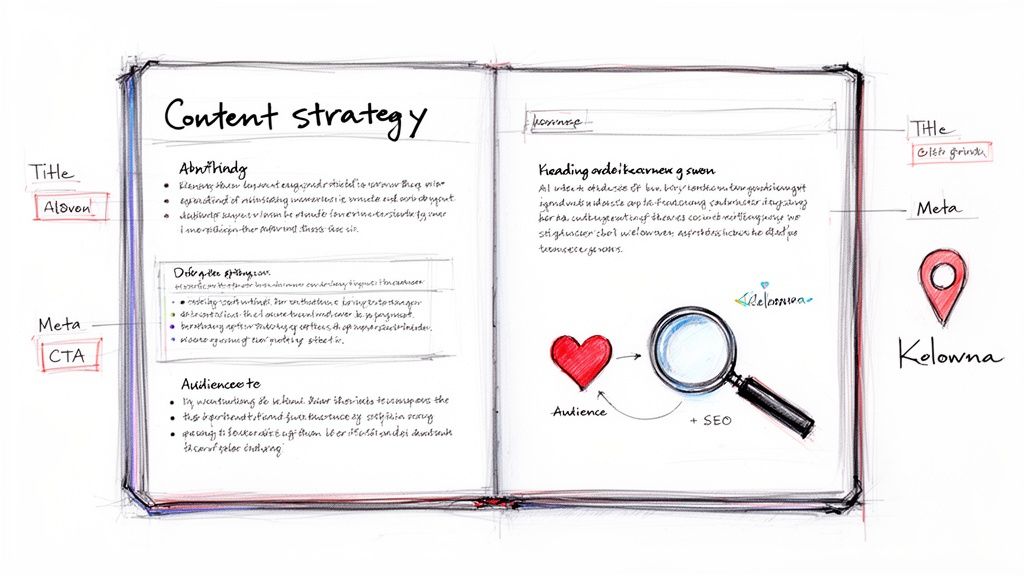
Alright, this is where the magic really happens. Your website’s content is your handshake, your sales pitch, and your expert guide all rolled into one. It’s how you connect with people, answer their questions, and show them why you’re the best choice in town.
When we talk about web design with SEO, a huge part of that is crafting pages that are not just well-written, but also structured in a way Google can easily understand. The secret is to write headings and text that real people love to read, while naturally using the keywords they’re already typing into Google.
Writing for Your Neighbours
Let's get practical. One of the most powerful things you can do is create content with a local feel. Think about it… someone in Kelowna isn’t just searching for “landscapers”; they’re searching for “landscapers in Kelowna” or “best lawn care near me.”
Creating content that speaks directly to your community shows both your customers and Google that you’re a true local expert. This isn’t just about dropping city names; it’s about making a genuine connection. For example, you could create:
-
A blog post about a community event you sponsored in Penticton.
-
A service page detailing your work in specific Vernon neighbourhoods.
-
A guide to choosing the right contractor specifically for homes in the Okanagan Valley.
This local focus is an absolute game-changer. When you combine it with a sharp, user-friendly website, you can really start to own the local search results. The goal is to appear in Google's "local pack"—that little map with three business listings at the top. Ranking there can make your phone ring off the hook, especially since only 9% of users ever scroll to the bottom of the first page.
Earning That First Click
Beyond the words on the page, two small but mighty things make a huge difference: title tags and meta descriptions.
These are the first things a potential customer sees in the search results. The title tag is the blue, clickable headline, and the meta description is the little blurb of text underneath it.
A great meta description is like a tiny movie trailer for your webpage. It has to be compelling enough to make someone say, “Yep, this is what I’m looking for,” and click through to your site.
Writing these well is both an art and a science. You need to include your main keyword, show the value of the page, and do it all in about 155 characters. It’s your first chance to make a great impression, so every single word counts.
When you’re planning the content for your site, always put yourself in your customer’s shoes. What questions do they have? What problems are they trying to solve? If you can answer those questions clearly and helpfully, you’re already on your way to creating content that ranks. If you need a partner to help you get this right, you can always get in touch with our team.
Frequently Asked Questions About Web Design and SEO
We get asked about how web design and SEO work together all the time. It’s a big topic with a lot of moving parts! Here are some of the most common questions we hear from business owners trying to figure it all out.
How Long Does It Take for SEO to Work on a New Website?
Ah, the million-dollar question. The honest answer is… it depends. Generally, you can expect to see some real movement in about 3 to 6 months. SEO is a long game, not an overnight fix.
It's all about building up authority and trust with search engines like Google, and that just takes time. A great initial web design and a clean technical setup give you a massive head start, but the real, lasting growth comes from consistently putting out helpful content and earning credibility over time.
Think of it like planting a vineyard in the Okanagan. The hard work of preparing the soil and planting the vines is crucial, but you have to keep nurturing it for the long haul to get that amazing harvest.
Can I Do SEO on My Existing Website or Do I Need a New One?
You can absolutely improve the SEO on a site you already have. In fact, that's often the best place to start. We usually kick things off with a full SEO audit to see what's working, what's not, and where the quick wins are.
Often, it’s a matter of tweaking your content, optimizing key pages, and cleaning up some technical stuff behind the scenes. However, if your website's foundation is outdated, painfully slow, or doesn't work well on phones, you might be fighting an uphill battle. It can feel like trying to renovate a house that has a crumbling foundation.
In those situations, a full redesign that builds SEO right into the framework from day one is often the smarter, more cost-effective path. It delivers a much stronger return on investment in the long run.
If you’re not sure which direction makes the most sense for your business, we can help you figure it out. Just reach out to our team, and we'll take a look together.
What's More Important: A Beautiful Design or Good SEO?
That's a great question, but it's kind of a trick one. It’s like asking what’s more important for a car: a powerful engine or a good set of tires? You really need both working together to get anywhere.
A stunningly beautiful website that nobody can find is just a pretty business card collecting digital dust. On the other hand, a perfectly optimized site that’s confusing or ugly to use will send visitors running for the "back" button before you can make an impression.
The truth about web design with SEO is that they are two sides of the same coin. A great user experience, lightning-fast pages, and a seamless mobile layout are all signs of excellent design. They also happen to be critical ranking factors for modern SEO.
If your website isn't pulling its weight and you're ready to turn it into your hardest-working salesperson, the team at Navigator Multimedia is here to help. Contact us today to get started.