Website Design for Restaurants That Turns Clicks Into Reservations
Running a restaurant in the Okanagan is a true labour of love. You’ve perfected every recipe, arranged every chair, and curated the perfect playlist. But what about your website? Your website should be your hardest-working employee—it works 24/7, booking tables, taking orders, and answering questions so you don't have to.
Your Website Is Your Digital Front Door
It's easy to see your website as just another chore on a never-ending to-do list. Let's try to look at it differently. Think of it as your digital front door. It’s the very first taste a potential diner gets, long before they smell your amazing food or settle into the ambiance you’ve so carefully created.
This first impression is everything. When someone in Penticton is craving pizza on a Friday night, what do they do? They pull out their phone and search. In that moment, your website is the first handshake, the warm welcome that convinces them to choose you over the place down the street.
Why First Impressions Matter So Much
You could have the best food in Kelowna, but if your website is slow, confusing, or just plain ugly, people will assume your restaurant is, too. It’s an instant reflection of the care and quality you put into your business. Fair or not… that's just how it works.
And the numbers back this up. A staggering 91% of guests check a restaurant’s website before placing an order for takeout or delivery. That means the first point of contact is almost always digital, making a professional, inviting design absolutely critical.
Your website is a tool that should be actively bringing people through your physical door or driving online orders. It’s an investment that pays for itself over and over again.
Here's a quick look at the essential features every restaurant website needs to turn visitors into diners.
The 'Must-Have' Ingredients for Your Restaurant Website
| Feature | Why It Matters | Quick Tip |
|---|---|---|
| Mobile-First Design | Most people search on their phones. If your site is hard to use on mobile, you lose them instantly. | Test your site on your own phone. Can you easily find everything in under 10 seconds? |
| Clear Contact Info & Hours | This is the #1 reason people visit. Don't make them hunt for it. | Put your address, phone number, and hours right in the header or footer of every page. |
| Easy-to-Read Menu | No one wants to download a PDF and zoom in. It's frustrating and looks unprofessional. | Use a web-based menu (HTML) that’s simple to read and update. Bonus points for photos! |
| Online Ordering & Reservations | Give people a direct path to give you money. The fewer clicks, the better. | Use big, obvious buttons like "Order Now" and "Book a Table" at the top of your homepage. |
Getting these foundational elements right is what separates a website that just sits there from one that actively grows your business.
Setting the Stage for Success
So, what does a great restaurant website actually do? It gets the essentials right without any fuss. It works perfectly on a phone, because that’s where most of your customers are looking. It answers the most important questions in seconds:
-
Where are you located? An easy-to-find address and an embedded map are non-negotiable.
-
When are you open? Hours should be clear, correct, and impossible to miss.
-
What’s on the menu? The menu must be simple to read—no PDFs that require pinching and zooming!
-
How can I order or book a table? The buttons for ordering or reserving need to be obvious and inviting.
Nailing these basics turns a casual browser into a loyal customer. It sets the stage for a website that works as hard as you do. If you feel like your current site isn't quite hitting the mark, talking with an expert partner is a great next step.
Crafting a Mouth-Watering Online Menu
We all eat with our eyes first. That’s a timeless truth, but it’s never been more important than in the digital world. Let’s be blunt: a clunky PDF menu that forces customers to pinch and zoom on their phone just won’t cut it anymore. It’s an instant turn-off, making your restaurant feel dated before they’ve even tasted the food.
This is where we make your food the undisputed star of the show.
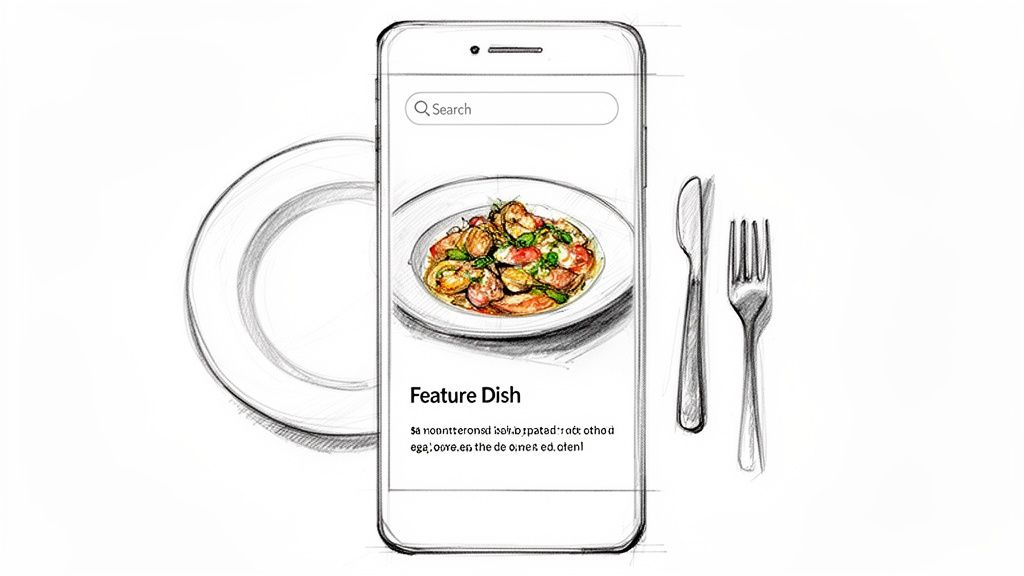
Think of your online menu as the heart of your website. It’s the main event, the very reason people showed up. Giving it the care and attention it deserves can be the single biggest factor in turning a curious browser into a confirmed reservation. The goal is to create an experience so tempting that placing an order feels like the only logical next step.
Making Every Dish Look Irresistible
Great food photography is so much more than just a quick snapshot. A truly delicious-looking photo tells a story. It’s about capturing the wisp of steam rising from a bowl of ramen or the glossy sheen on a perfectly cooked steak.
You don’t need a Hollywood-level budget, but you absolutely need to pay attention to the details:
-
Lighting is everything. Natural light is your best friend here. Try shooting near a window in the morning or late afternoon to get that soft, appealing glow and avoid harsh shadows.
-
Styling matters. Consider the plate, the background, and any props you use. A simple sprig of parsley or a carefully placed napkin can elevate the whole shot, giving it a professional touch.
-
Show off the texture. Get close enough to see the crunch of fried chicken or the creaminess of a risotto. You want to make people imagine what it tastes like.
High-quality images are your foundation, but they’re just one piece of the puzzle. How you present the menu itself is equally important. A well-designed menu is beautiful, a breeze to read, and even searchable.
Your online menu should be an experience, not a chore. It needs to guide visitors, answer their questions, and get them genuinely excited about the food you’ve poured your heart into creating.
Writing Descriptions That Sizzle
Once the photos have grabbed their attention, your words need to seal the deal. This is your chance to make mouths water. A great dish description goes way beyond a simple list of ingredients; it paints a vivid picture.
Instead of "Chicken Breast with Potatoes," try something like: "Pan-seared chicken breast with crispy golden skin, served over creamy garlic mashed potatoes and drizzled with a rich rosemary jus." See the difference? One is a list; the other is a story. Use evocative words that trigger flavour and texture, like “zesty,” “smoky,” “velvety,” or “flaky.”
The visual design is crucial here, too. Our team focuses on graphic design for the web that makes menus easy to scan and visually appealing. Clear headings, plenty of white space, and a clean, legible font can transform browsing your offerings from a task into a pleasure.
Organize for Easy Cravings
Put yourself in your customers' shoes. They might be looking for something specific, like vegetarian options, or they might just be exploring what you have to offer. Organize your menu logically with clear, intuitive categories: Appetizers, Mains, Desserts, Drinks.
If you have an extensive menu, adding filters or a search bar can be a complete game-changer. Allowing someone to quickly find all your gluten-free options or see every pasta dish at a glance shows that you’re thinking about their experience. This thoughtful approach to website design for restaurants makes all the difference.
A slow or outdated site can be a dealbreaker. In fact, research shows a staggering 68% of diners have skipped a restaurant entirely because of a poor online experience. You can discover more insights about these digital trends and see just how vital a modern, functional website has become.
Making Online Orders and Reservations Effortless
Alright, let's zoom in on a critical moment. A potential customer has seen your incredible food photos, they've read your mouth-watering menu, and they're ready to commit. This is where you can either secure a sale or lose them in a click.
Any friction here—a confusing form, a page that takes forever to load, one too many steps—and they're gone. Just like that. They’ll either give up or, worse, find another restaurant in Kelowna that makes it easier.
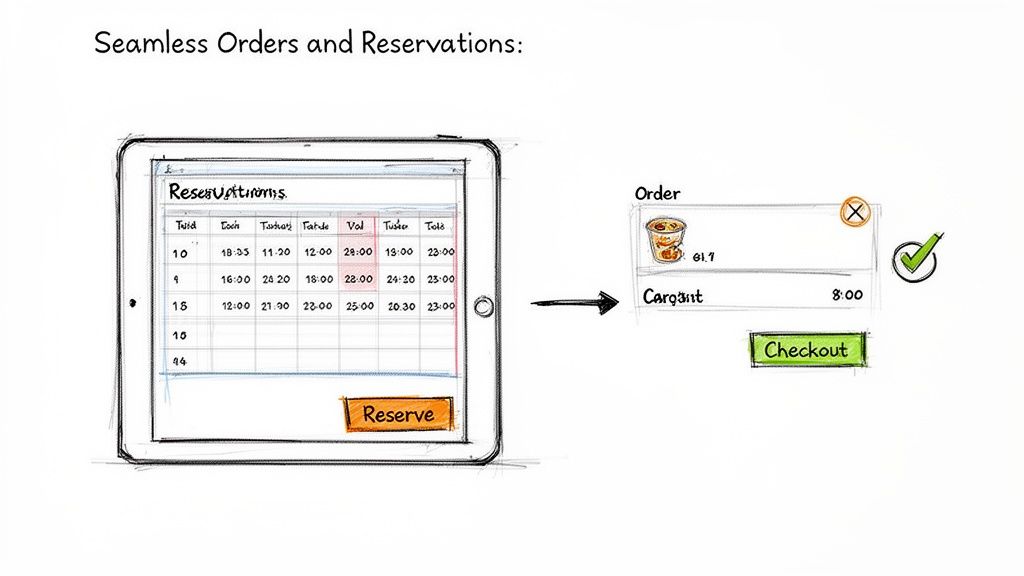
The goal is to create a path so smooth they don't even have to think about it. For online ordering, that means a clear, simple journey from choosing a dish to completing the checkout. For reservations, it means seeing available times and getting a confirmation in seconds. Anything less is a missed opportunity.
Choosing Your Online System
So, how do you actually handle online orders and reservations? There are a few different routes you can take, and there’s no single "best" answer. It really boils down to what fits your restaurant's needs, your budget, and how much control you want over the experience.
A simple, integrated form on your website might be perfect for a smaller spot that just needs to field basic reservation requests. On the other hand, a full-blown e-commerce setup is essential for any restaurant that relies heavily on takeout and delivery. We often guide clients through exploring different e-commerce platforms to find the one that can handle their menu complexity and order volume.
The best system is the one your customers will actually use. It needs to feel like a natural extension of your restaurant—seamless, reliable, and maybe even a little bit delightful.
To help you get a handle on your options, here's a quick comparison of the most common approaches.
Choosing Your Online System
| System Type | Best For | Potential Drawback |
|---|---|---|
| Built-in Website Forms | Simple reservation requests and small-scale catering inquiries. | Lacks real-time availability and payment processing. Can be labour-intensive. |
| Third-Party Platforms (e.g., DoorDash) | Restaurants wanting to reach a massive existing user base without building their own system. | High commission fees eat into your profits, and you have limited control over the customer experience. |
| Integrated Booking Software | Restaurants needing real-time reservation management and table assignments. | Monthly subscription fees can add up, and integration quality varies. |
| Direct E-commerce Integration | Eateries focused on maximizing takeout/delivery revenue with full control over the process. | Requires more initial setup and investment, but offers the best long-term value. |
Ultimately, whether you use a third-party app or build your own system, the goal is to make it feel like it's part of your website, not a clunky add-on.
Streamlining the Customer Journey
Once you've picked a system, the real work begins: making it dead simple to use. A smooth customer journey is non-negotiable for good restaurant website design.
For online ordering, this means:
-
Visual Cues: Use clear, professional photos for each menu item so customers know exactly what they’re getting.
-
Easy Customization: Let them add extra cheese or hold the onions with simple checkboxes or dropdowns. Don't make them hunt for a "special instructions" box.
-
Simple Checkout: Keep the payment process down to the absolute minimum number of steps. Offering one-click options like Apple Pay or Google Pay is a game-changer.
For reservations, the process should be just as clean:
-
Clear Availability: Show a simple calendar and time slots. Grey out times that are booked up.
-
Instant Confirmation: The second a booking is made, fire off an automated email or text message. This gives the customer peace of mind.
-
Easy Modifications: Include a link in the confirmation that allows them to easily cancel or change their reservation without having to call you.
Think about how many times you’ve personally abandoned an online cart or booking because it was just too much of a hassle. Your customers are no different. We’ve seen Okanagan restaurants boost their bottom line significantly just by upgrading their ordering system to be faster and more intuitive. It directly translates to more orders and frees up your staff to focus on the guests already in the dining room.
Getting Found by Hungry Customers on Google
Think about the last time you looked for a new place to eat. You probably grabbed your phone and searched something like "best tacos in Kelowna" or "sushi near me." And just like that, you’ve hit on the most common way your customers find you, too.
That little screen in their hand is the new battleground for dinner plans. If your website doesn't show up and shine there, you're missing out.
Mobile Is Everything
This is a hard-and-fast rule now. If someone lands on your website from their phone and has to pinch, zoom, or squint just to read your menu, they’re gone. Poof. It’s an instant turn-off that screams "outdated," and it's an incredibly frustrating first impression.
The solution is called mobile-responsive design. All that means is your website automatically and gracefully adjusts to fit any screen, big or small. Booking a table should feel just as effortless on an iPhone as it does on a huge desktop monitor. On top of that, Google's search algorithm heavily favours mobile-friendly sites, so a clunky mobile experience can make you practically invisible online.
Having a mobile-responsive website is about meeting your customers where they are—which, overwhelmingly, is on their phones.
The difference this makes is huge. We know from industry studies that websites loading in under two seconds get way more customers, which is critical when 66% of people find new restaurants through Google searches.
Local SEO: The Basics That Matter
So, how do we actually get those hungry people in Vernon or Penticton to find you on Google in the first place? This is where local SEO (Search Engine Optimization) comes in, and you don’t need to be a tech wizard to grasp the fundamentals.
At its core, local SEO is all about making sure Google knows exactly who you are, where you are, and why you’re the best answer for what someone is searching for.
For restaurants, it really boils down to a few key things:
-
Your Name, Address, and Phone Number (NAP): This trifecta of information has to be 100% identical everywhere it appears online. I mean everywhere: your website, your Google Business Profile, your Yelp page, you name it. Even a tiny difference, like "St." versus "Street," can throw search engines off.
-
Keywords People Actually Use: Put yourself in your customer's shoes. Are they typing "fine dining Penticton" or "family restaurant with patio Kelowna"? We help our partners figure out these exact phrases and then weave them naturally into their website's content.
-
Your Google Business Profile: This is, without a doubt, the most powerful free marketing tool at your disposal. It’s that info box that pops up in Google Search and on Google Maps, showing your hours, photos, reviews, and a link to your site.
Keeping this profile complete, accurate, and active is absolutely critical for getting found. It’s so important that we’ve put together a dedicated resource on it. You can check out our guide on Google My Business to see how to put it to work for your restaurant.
When someone is ready to decide where to eat, you want your restaurant to appear at that exact moment. A strong mobile experience and a smart local SEO strategy are what make that happen. If you’re not sure how your site is performing on these fronts, that’s the perfect time to reach out to a partner for a helping hand.
Telling Your Story and Building Trust
Your restaurant is so much more than just the food on the menu. It’s got a story. Maybe it’s a family legacy handed down over decades, a deep-rooted passion for local Okanagan ingredients, or a lifelong dream you’ve poured every ounce of yourself into. Whatever your story is, that’s your secret ingredient.
People don’t just connect with businesses; they connect with other people. Sharing your “why” forges a genuine bond that can turn a first-time guest into a loyal regular who feels like they’re part of your journey. Your website is the perfect place to start that conversation before they even step through the door.
Crafting an Authentic About Us Page
Let's be honest, the "About Us" page is often treated like an afterthought, usually filled with stiff, corporate-sounding jargon. It’s time to ditch that approach entirely. Think of it less like a press release and more like you’re pulling up a chair and chatting with a new friend.
Share what makes your restaurant unique. Talk about that lightbulb moment when you knew you had to open this place. Maybe it was a trip abroad that inspired your signature dish, or a recipe from your grandma that the whole family always raved about. This is your chance to be real, to be human.
Your story doesn’t need to be some grand, epic saga. It just needs to be honest. Authenticity is what really connects with people and makes your restaurant stick in their minds long after the meal is over.
Stuck on where to begin? Here are a few prompts to get the ideas flowing:
-
What was the spark? Was it a person, a place, or a specific flavour you just had to bring to West Kelowna?
-
What do you stand for? Do you source everything from local farms? Is your team treated like family? Let people know what matters to you.
-
Who’s behind the curtain? Put a face to the name! A warm, friendly photo of you or your team can make a world of difference.
An "About Us" page that feels genuine is one of the most powerful tools you have when designing a restaurant website. It’s what truly sets you apart from the big chain down the street.
Let Your Happy Customers Do the Talking
Now, let's switch gears to building trust. While your story creates that crucial emotional connection, it's social proof that gives new customers the final nudge of confidence they need to book a table. Social proof is really just a simple concept: evidence that other people already love what you do.
You work incredibly hard for those glowing reviews on Google, Yelp, and TripAdvisor. So why let them just sit there? Weaving a live feed of your latest and greatest reviews directly into your website builds immediate credibility. Imagine a potential customer from Vernon browsing your site and seeing a stream of fresh five-star reviews from their neighbours—it instantly erases any hesitation.
It shows them, right then and there, that people just like them have had a fantastic experience at your restaurant. It's the digital equivalent of a friend leaning in and whispering, "You have to try this place." This is some of the most powerful and honest marketing you've got.
Telling your story builds the relationship, and showcasing your reviews seals the deal. Getting both of these elements right on your website creates an unbeatable combination. If you need a hand weaving your story and your reviews into your site in a way that feels natural, that’s something a good partner can help with.
Your Restaurant Website Launch Checklist
Feeling a bit overwhelmed by all the moving parts? I totally get it. Let's pull everything we've covered into a simple, actionable plan. Think of this as your final roadmap before you hit that "go-live" button.
This is a pre-flight check to ensure every component of your new website is primed to help your restaurant grow. When you know what you need and why you need it, you can have a much more productive conversation with a designer or agency, making sure the final product works as hard as you do.
The Technical Foundation
Before we get to the fun stuff like gorgeous photos and enticing menus, we need to make sure the engine is running smoothly. After all, the best-looking website in the world is useless if it's slow, broken, or impossible to find.
-
Fast Hosting: Your site has to load in a snap, especially on mobile. A slow website is the quickest way to lose a hungry customer. Your goal should be under two seconds.
-
Mobile-Responsive Design: This is completely non-negotiable. Your website must look and perform flawlessly on a smartphone. Period. Test every button, form, and page on your own phone before launch.
-
SEO Basics: At a minimum, your page titles, meta descriptions, and image alt-text should be set up to tell Google exactly who you are, where you are (hello, Okanagan!), and what delicious food you serve.
The Customer-Facing Essentials
This is what your visitors will actually see and interact with. It needs to feel clear, helpful, and inviting from the very first click.
The heart of a great restaurant website is building trust from the moment someone arrives. It starts with your unique story and is reinforced by what others are saying about you.
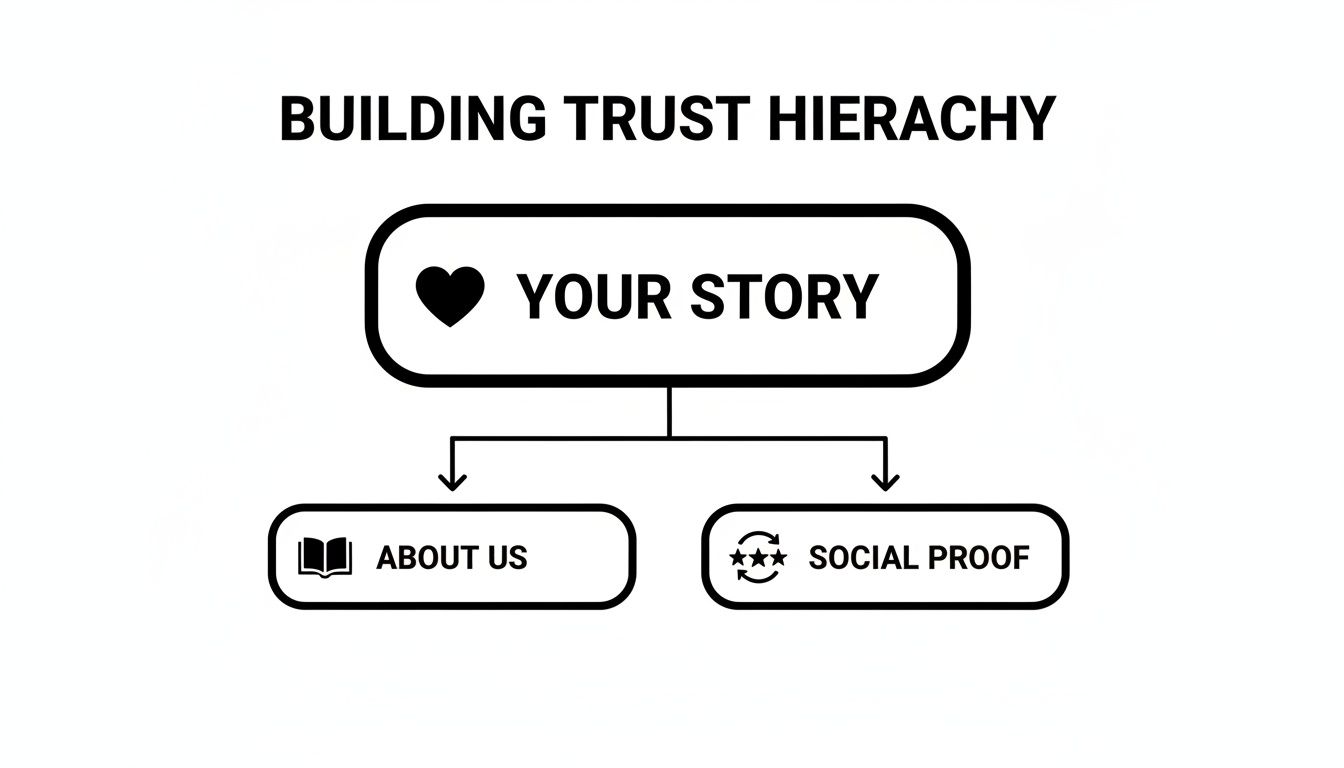
This really shows how a compelling personal narrative, backed up by real customer reviews, creates a powerful foundation for a new relationship with a potential diner.
Think of your website as an ongoing conversation with your customers, not a one-time announcement. It needs care and attention to stay fresh and effective.
Here’s what your audience is looking for right away:
-
Your "Big Three": Your address, phone number, and hours of operation must be impossible to miss. Stick them in the header or footer so they appear on every single page.
-
An HTML Menu: Please, no more PDFs! Your menu needs to be a proper web page that’s easy to read on any device, simple to scroll through, and quick for you to update.
-
Mouth-Watering Photos: Invest in professional, high-quality photos of your food, drinks, and the restaurant's interior. People eat with their eyes first.
-
Effortless Ordering & Reservations: Make the "Order Now" and "Book a Table" buttons stand out. The process itself should be dead simple, with as few clicks as possible separating a hungry visitor from their meal.
Ongoing Website Care
Your website is a living, breathing part of your business—it’s not a 'set it and forget it' project. Just like your physical restaurant, it needs regular upkeep to stay in top shape.
Get into the habit of updating your menu with seasonal changes, adding fresh photos of new dishes, and posting about upcoming events or specials. This not only keeps your regulars engaged but also signals to search engines that your website is active and relevant.
Getting all these pieces right is what separates a mediocre website from one that actively brings people through your door. If you're ready to get started and want a partner to guide you through this checklist, you're in the right place. We’re here to help you build a website that becomes your best salesperson—just get in touch with us.
Your Questions, Answered
Let's be honest, starting a new website project can feel a bit overwhelming. It's a significant move for your restaurant, and you probably have a lot of questions. Here are a few of the things we hear most often from fellow Okanagan restaurant owners.
So, What's the Real Cost of a Professional Restaurant Website?
This is usually the first question, and the honest answer is: it depends entirely on what you're trying to accomplish. A straightforward, beautifully designed website that showcases your brand could be a few thousand dollars. If you’re looking for a fully custom design with integrated online ordering and a sophisticated reservation system, the investment will naturally be higher.
The best way to frame it is as an investment in your business's growth engine. A fantastic website isn't just a cost; it’s a tool that should pay for itself over and over by attracting new customers and making your life easier. We always start with a friendly, no-pressure chat to get a handle on your goals and budget before we even think about quoting.
Can I Update My Own Menu and Specials Without Calling You?
One hundred percent. This is non-negotiable for a modern restaurant website, and we wouldn't have it any other way. We build our sites on easy-to-use platforms like WordPress, which means you or your manager can jump in and change the daily soup, update a price, or add photos of a new dish in minutes.
The last thing you need is to be stuck waiting for a developer to make a simple change. We'll even walk you through the process to make sure you’re completely comfortable and confident handling it yourself.
How Long Does This Whole Process Take?
From our initial chat to the day your new site goes live, you can typically expect the project to take about 6 to 12 weeks. This timeline can vary a little based on the complexity of the features you choose and how quickly we can get assets like professional photos and finalized menu details from your team.
We map everything out in a clear project plan right at the beginning. You’ll always know exactly what we’re working on and what’s coming up next. Think of it as a partnership from day one.
If your current website feels more like dead weight than a sales tool, we can help you turn it into your hardest-working employee. For a site that genuinely fuels your growth, let's have a chat.