A Guide to Website Design for SEO That Actually Grows Your Business
A beautiful website built on a rock-solid technical foundation—that’s the core of designing for SEO. It’s all about creating a site that’s a pleasure for people to use and is crystal clear for search engines to understand. That dual focus is what ultimately helps you rank higher and bring in more business.
Your Website Is Your Hardest-Working Employee
Let's get real for a moment. Building a new website can feel like a huge project. You've poured everything into your business, and you need your online presence to reflect that same passion and professionalism. It’s a lot of pressure.
It’s so easy to get fixated on how a website looks. Of course, you want it to be visually stunning! But a gorgeous website that no one can find is like setting up a beautiful storefront on a deserted backroad. Website design for SEO bridges that gap, connecting beautiful design with the technical smarts required to get noticed online.
More Than Just a Pretty Face
Think of your website as your most dedicated employee—the one who works tirelessly, 24/7, without ever needing a coffee break. It should be constantly attracting new customers, answering their questions, and making it effortless for them to get in touch. For that to happen, it needs to deliver a fantastic experience for both Google and your human visitors.
Here’s what that looks like in practice for your business:
It Builds Trust Instantly: A clean, professional, and easy-to-navigate site shows potential customers you're credible and you care about their experience.
It Guides Visitors Naturally: Great design is about flow. It smoothly leads people where you want them to go, whether that's to a key service page or straight to your contact form.
It Answers Questions for Google: A logically structured site helps search engines quickly figure out what you do, who you serve, and why you’re the best choice in the Okanagan.
This thoughtful approach is what transforms your website from a passive online brochure into a dynamic, lead-generating asset for your business.
First Impressions Are Everything
You only get one shot at a first impression, and these days, that impression is almost always made by your website. It's the digital handshake that happens long before a potential customer ever picks up the phone or walks through your door.
The data doesn't lie—a staggering 75% of customers admit to judging a business’s credibility based on its website design. A poor design often leads to a high bounce rate, which can send negative signals to Google and torpedo your SEO efforts. In fact, websites with a subpar user experience can see conversion rates that are 400% lower than their well-designed counterparts.
We’ve seen it happen time and again with our partners in Kelowna and Penticton. A strategic redesign fundamentally changes the conversation they have with customers and dramatically boosts their visibility in local search results.
At the end of the day, designing for SEO is really about designing for people. When you focus on creating a clear, helpful, and fast experience for your visitors, you’re also sending all the right signals to Google. If you have a feeling your current site isn't pulling its weight, getting some expert help is often the best next step you can take.
Building a Strong Foundation with Site Architecture
Let’s talk about the blueprints of your website. The term “site architecture” might sound a bit technical, but it’s really just about how all your pages are organized. Think of it as the digital floor plan for your business.
Imagine someone walking into your physical shop for the first time. Is it obvious where to go? Can they easily find what they're looking for, whether it's a specific product or the service counter? Your website needs that same intuitive navigation. A confusing online layout is just as bad as a messy, disorganized storefront—it makes people want to leave.
When we start a new project, this is one of the very first things we map out. We literally draw it on a whiteboard. The whole point is to create a logical path that guides visitors from your homepage to your most important pages—like your services or contact form—without them ever feeling lost. This clarity helps your customers and helps Google understand what your business does.
URL Structure and Its Impact on SEO
Once you’ve got a solid plan for your site’s layout, the next piece of the puzzle is the web address for each page, known as the URL. This is one of those small details that packs a huge punch for SEO. Keeping your URLs short, clean, and descriptive is a simple but incredibly effective strategy.
Think of it like labelling the aisles in a grocery store. Clear signs help shoppers (and Google) know exactly what’s on each shelf. A URL that clearly states the page's purpose is always the best choice.
This is where the technical foundation and the visual design of your website really come together to support your SEO efforts.
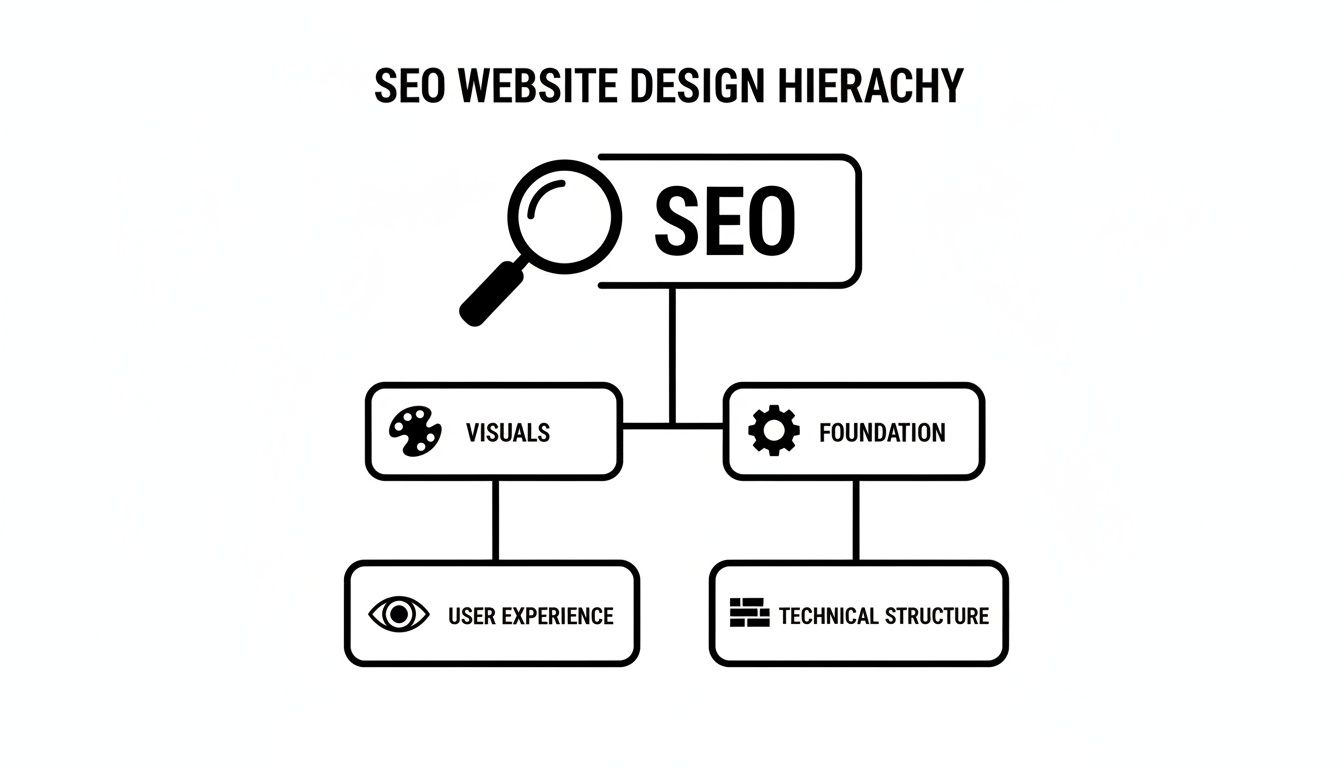
As you can see, a successful SEO strategy depends on having both a solid technical foundation and an appealing visual experience.
From Confusing to Clear
So, what does a good URL look like in the real world? It’s all about swapping a jumbled mess of numbers and random characters for something a human can actually read and understand. That simple shift does wonders.
Here's a quick look at how to structure your URLs to be clear for both users and search engines.
Simple URL Structure Examples
| Page Type | Confusing URL Example | SEO-Friendly URL Example |
|---|---|---|
| Service Page | yourbusiness.ca/page?id=42 |
yourbusiness.ca/vernon-roofing-repair |
| Blog Post | yourbusiness.ca/blog/post-123 |
yourbusiness.ca/blog/5-tips-winterizing-your-home |
| Product Page | yourbusiness.ca/products/sku-98765 |
yourbusiness.ca/products/okanagan-syrah-wine |
The difference is night and day. The SEO-friendly versions immediately tell both people and search engines what the page is about, which builds trust and improves your rankings.
A clean, logical site structure is like giving Google a map to your website. It removes all the guesswork and makes the entire experience smoother for everyone. This is a core part of building a site that actually brings in business.
This carefully planned architecture also lays the groundwork for creating an XML sitemap. That's a file that lists all your important pages, making it much easier for search engines to find and index your content. If you want to get into the nitty-gritty, you can check out this guide on how to create a sitemap.
Ultimately, building a clear structure is a strategic exercise. It forces you to think like your customer. What are they looking for? By answering their questions with your site's layout and URLs, you create a solid foundation that supports all your other marketing efforts.
Why Site Speed and Mobile Design Are Non-Negotiable
We’ve all been there. You click a link, and then you wait. And wait… Most of us don't stick around—we hit the back button and find another, faster option.
Your potential customers are no different. And you can bet Google notices every single time they do. How quickly your website loads isn't just a technical detail; it's a massive ranking factor that directly signals the quality of your user experience.
Slow websites are one of the first red flags we spot in our performance audits. It’s low-hanging fruit, but fixing it can make a world of difference for your visibility online.

What's Slowing Your Website Down?
So, what are the usual suspects behind a sluggish site? More often than not, a few common culprits are to blame, and they're all fixable with a bit of technical know-how.
Massive Image Files: This is the big one. High-resolution photos look fantastic, but if they aren't properly compressed for the web, they can bring your site to a screeching halt.
Clunky Code: Bloated code, often from cheap themes or an overload of unnecessary plugins, can add precious seconds to your load time. A clean, custom build sidesteps this issue from the get-go.
Poor Hosting: Your web host matters. A slow, shared server will throttle your site’s performance, no matter how well-designed it is.
Tackling these issues is a core part of any effective website design for seo. It’s about showing Google—and your visitors—that you care about their experience. If you want to dive deeper into image optimization, you can check out our guide on how to reduce image file size.
The Mobile-First Mentality
Even more important than desktop speed is how your site performs on a phone. Just think about your own habits. When you’re looking for a local service—whether it’s a winery in Penticton or a contractor in West Kelowna—you’re probably pulling out your phone.
Your customers are doing the exact same thing.
This is why we champion a mobile-first design philosophy. It means we plan and build the mobile version of your website first, then adapt that solid foundation for larger screens like tablets and desktops. This approach ensures a seamless and intuitive experience for the majority of your visitors.
It's about making your site so easy to use on a phone that people don't have to think twice. Buttons are easy to tap, text is readable without pinching and zooming, and the most important information is right at their fingertips.
This is essential for any modern business. For local companies like real estate agencies or tourism boards, it's pure gold. Consider this: 76% of smartphone users who search for something nearby visit a business within 24 hours—but only if the site loads quickly and feels intuitive.
Recent data drives this point home. A staggering 53.3% of all website traffic comes from organic search, and the top-ranking page gets nearly half of all clicks for its keyword. Meanwhile, almost nobody—just 0.63% of users—ever bothers to click to the second page of results.
When you nail the mobile experience, you’re directly influencing your ability to turn a casual search into a paying customer.
Putting Speed and Mobile Together
Ultimately, site speed and mobile design are two sides of the same coin. Both come down to a fundamental respect for your visitor's time and making their interaction with your business as smooth as possible.
When a potential customer lands on your site from a mobile search and it loads instantly and is a breeze to navigate, you’ve already won half the battle. You’ve built trust and made a fantastic first impression. Google sees that positive engagement and rewards you for it with better rankings.
It creates a powerful cycle: a great user experience leads to better SEO, which brings in more visitors who also have a great experience. If you feel like your current site is dropping the ball in these areas, talking with a partner who understands the technical side of things can get you back on track.
Designing for People First and Search Engines Second
This is where the real magic of website design for SEO comes into play. It all boils down to creating an experience that people genuinely enjoy. When you nail that, you’ll naturally start sending all the right signals to Google.
We're talking about User Experience, or UX for short. It might sound a bit technical, but it’s really just about how a website feels to use. Is the text a comfortable size? Are the buttons obvious and easy to click? Can someone find your phone number without going on a frustrating treasure hunt? All these little details add up to create a powerful, lasting impression.
When someone lands on your site and actually sticks around, clicking from one page to another, Google notices. This behaviour tells the search engine your website is high-quality, helpful, and exactly what people are looking for.
Make the Important Stuff Easy to Find
One of the biggest turn-offs for any website visitor is not being able to find what they need, and fast. For a local business, this usually comes down to a few key pieces of information. Your job is to make it incredibly easy for people to take that next step. This means strategically placing your contact details and creating crystal-clear calls-to-action (CTAs).
Think about what you actually want people to do:
Book a Tour: That button better be bright, clear, and visible right on your homepage.
Get a Quote: Don’t make them hunt for it. Place a simple form right on your service pages.
Call Us Now: Your phone number should always be clickable on mobile, ideally sitting right at the top of the page.
I remember working with a local Kelowna contractor whose website was beautiful, but their phone number was buried deep in the footer. We moved it to the top header and made it "sticky," so it stayed visible while scrolling. The result? Their inbound calls shot up by over 30% in the first month alone. Tiny changes can make a massive difference.
Guide Your Visitors on a Journey
A great website guides visitors on a journey. You can do this by using internal links—the kind that connect one page of your site to another.
For instance, on a page about your custom home building services, you could link to a gallery showcasing your recent projects. From that gallery, you could then link to a page full of client testimonials. This creates a natural flow that keeps people engaged and helps them discover more about what makes your business special.
This is also a huge win for SEO. Internal links help Google understand the relationship between your pages and effectively spread ranking authority throughout your site. It’s your way of showing the search engine which pages you consider most important.
Creating a great user experience is about being a helpful, authentic guide for your online visitors. You're anticipating their questions and providing clear, easy paths to the answers.
Design for Everyone with Accessibility
An often-overlooked—but critical—part of user experience is web accessibility. This simply means making sure your website is usable for everyone, including people with disabilities.
This isn't about complicated code; it's about thoughtful design choices:
Using strong colour contrast so your text is easy to read.
Adding alt text to images so screen readers can describe them.
Ensuring the site can be navigated with a keyboard for those who can't use a mouse.
Making your site accessible is, first and foremost, the right thing to do. It also happens to have a positive impact on your SEO. Google rewards websites that provide a good experience for all users, and a truly accessible site is a major part of that.
The Real Cost of a Poor User Experience
Focusing on the user has a direct financial impact. The SEO world is incredibly competitive. Some agencies charge $100-$300 per hour, and enterprise retainers can easily hit $15,000-$35,000 monthly. For a small business, getting the fundamentals right from the start is the key to sustainable growth.
Google’s algorithms explicitly reward sites with great speed and UX. Think about it: only 9% of users ever scroll to the bottom of the first page of search results. A thoughtful design that keeps users engaged is your ticket to the top. When you combine that with excellent site speed—especially since organic sources account for 53.3% of all web traffic—you're in a prime position to capture that top-spot traffic.
When you prioritize the person on the other side of the screen, you’re making a smart investment in your business’s long-term success. If you're ready to create an online experience that both your customers and Google will love, let's start a conversation.
Choosing the Right Platform and Measuring Results
Alright, let's talk about the engine under the hood of your website. The platform it's built on, known as a Content Management System (CMS), plays a massive role in how well your site can perform in search results. It’s the foundation for every other SEO effort you make.
We get asked all the time about different platforms. Here at Navigator, we specialize in building custom websites on WordPress and Shopify. There’s a good reason for that. Both of these platforms are incredibly powerful and flexible, giving small and medium-sized businesses a fantastic starting point for their SEO.
Why WordPress and Shopify Are Great Choices
Think of WordPress and Shopify as a well-stocked toolbox right from the get-go. They come with a ton of built-in features that are friendly to search engines and allow for deep customization when you need it. A custom-built site on one of these platforms gives you a significant edge.
A custom build is lean and mean. Every line of code is there for a reason, which means better site speed and a cleaner structure for Google to crawl.
We think of it as the difference between a tailored suit and one off the rack. The tailored suit is built specifically for you—it fits perfectly, looks sharper, and moves with you. A custom website does the same for your business online.
You Launched Your Site… Now What?
So, you’ve launched your beautiful, fast, and SEO-friendly website. That’s a huge accomplishment! But the work doesn’t stop there. In fact, this is where the real fun begins. Now it’s time to find out if it's actually working.
How do you know if all this effort is paying off? You have to measure it. Tracking the right metrics is the only way to understand what’s working, what isn’t, and where you can make improvements. This is a core part of how we partner with our clients—we build something excellent, and then we measure the results to make sure it keeps growing.
Key Metrics That Actually Matter
Diving into website analytics can feel a bit overwhelming, but you only need to focus on a few key numbers to get a clear picture of your performance. These metrics tell you a story about how visitors are finding you and what they do once they arrive.
Here are the big ones to watch:
Organic Traffic: This is the number of visitors who find your website through a search engine like Google, without clicking on a paid ad. An increase here is a strong signal that your SEO efforts are working.
Keyword Rankings: Where does your site show up when someone searches for terms related to your business, like "landscaping in West Kelowna"? Tracking this shows your growing visibility.
Bounce Rate: This is the percentage of visitors who land on your site and leave without clicking on anything else. A high bounce rate can indicate that your page isn't matching their expectations.
Conversion Rate: This is the ultimate measure of success. It tracks the percentage of visitors who complete a desired action, like filling out your contact form, making a purchase, or calling your business.
Understanding these numbers is key to making smart decisions. For example, if your organic traffic is high but your conversion rate is low, it might mean your call-to-action needs to be clearer. You can learn more by checking out our beginner's guide to Google Analytics.
This data-driven approach is how we turn a good website into a great one. We build it, measure its performance, and then refine it over time to make sure it’s always working as hard as you do. If you're ready to build a site that gets real, measurable results, we're here to help you get started.
Common Questions About Website Design and SEO
We’ve covered a lot of ground on what makes a website work for search engines. It’s totally normal to still have a few questions buzzing around. In fact, we hear these all the time from business owners just like you, right here in the Okanagan.
Let's sit down and tackle some of the most common ones. Here are a few straightforward answers to help clear things up.
How Long Does It Take for a New Website to Improve SEO Rankings?
That's the million-dollar question, isn't it? The best way to think about SEO is that it’s a marathon, not a sprint. It takes time and consistent effort.
After launching a brand-new, SEO-focused website, you can typically start seeing some positive movement in your rankings within 3 to 6 months. Google needs a bit of time to crawl, understand, and ultimately trust your new site structure and all that great content you've added.
What you'll likely see right away are improvements in user experience—things like a lower bounce rate or people spending more time on your site. For those valuable, traffic-driving ranking boosts, though, patience is key. Building that solid foundation correctly from day one is the most important first step you can take.
Can I Just Use a Cheap Website Template for My Business?
You can, but it often comes with hidden costs for your SEO down the road. It’s a bit like buying a discount tool—it might get the job done once or twice, but it’s probably not going to hold up for serious work.
Many pre-made templates look great on the surface, but under the hood, they’re often bloated with clunky, inefficient code. All that extra weight slows your site down, and as we’ve discussed, site speed is a major SEO killer.
They can also be incredibly rigid. This makes it tough to implement specific technical SEO fixes or to customize the user experience in a way that truly helps your customers.
A custom design, like the ones we build for our partners here at Navigator, is crafted for your specific business goals. Every single element is there for a reason, the code is clean, and the structure is built from the ground up to be search-engine-friendly from the moment it goes live.
What Is More Important for SEO: Looks or Technical Build?
This is a bit of a trick question because the two are so deeply connected. For great SEO, you really can't have one without the other. They're a team.
A beautiful, visually stunning design that’s slow to load or confusing to navigate will just frustrate your visitors, causing them to leave. Google sees this negative signal and can lower your rankings as a result.
On the flip side, a technically perfect site that looks dated or untrustworthy won't keep visitors engaged or encourage them to take action. People just won't stick around long enough to appreciate how fast it is.
The best website design for SEO is one where the visuals and the technical foundation work together seamlessly. The goal is to create an experience that is both delightful for your customers in Kelowna and perfectly clear for search engines to understand. When you get that balance right, you’re on the path to real, sustainable growth.
If you’re ready to build a website that not only looks fantastic but also becomes your hardest-working salesperson, Navigator Multimedia can help you get there. Let's start a conversation about your project.