A Guide To Understanding Website Maintenance Cost
Let's get straight to it: a typical website maintenance plan for a small business can run anywhere from $50 to over $500 a month. The final number really comes down to how complex your site is. It’s like the difference between a routine oil change for a dependable sedan and the specialized, constant attention a high-performance sports car demands.
So, How Much Is This Going To Cost?
Trying to nail down a budget for website maintenance can feel a bit like asking, "how long is a piece of string?" The answer seems frustratingly vague… but it doesn't have to be. You already know your website is a critical business tool, and keeping it healthy, secure, and running smoothly is just part of the deal.
Think of your website as your digital storefront, open 24/7. Just like a physical shop in downtown Kelowna, it needs regular upkeep. You have to pay for the space (that's your hosting), make sure the locks are secure against break-ins, and maybe give it a fresh coat of paint now and then to keep things looking sharp for your customers. Neglecting it isn't an option, unless you're cool with an unexpected "Closed for Business" sign popping up one day.
To give you an honest look at what to expect, most small and medium-sized businesses find their annual maintenance budget falls somewhere between $420 and $12,000. This translates to monthly plans ranging from about $35 to $1,000, depending on your specific needs. This range typically covers everything from essential security patching to minor content tweaks.Quick Glance At Monthly Website Maintenance Costs
Here’s a simplified look at what you might invest monthly for different types of business websites.
| Website Type | Typical Monthly Cost Range | What's Usually Included |
|---|---|---|
| Brochure/Info Site | $50 – $150 | Hosting, daily backups, software updates, security scans. |
| Small Business/Lead Gen | $150 – $400 | Everything in Brochure, plus performance monitoring & small content edits. |
| E-commerce Store | $400 – $1,000+ | All of the above, plus e-commerce platform support & priority service. |
This table provides a general baseline, but remember that custom features or higher traffic levels can definitely shift these numbers.
Key Parts of Your Maintenance Bill
So, what exactly are you paying for each month? It usually boils down to a few core services that keep your site in fighting shape.
-
Secure Hosting: This is pretty much the "rent" for your website's home on the internet. Quality hosting is what keeps your site fast, reliable, and accessible. Our secure website hosting is specifically designed to give Okanagan businesses that crucial peace of mind.
-
Regular Backups: Think of backups as your website's time machine. If something ever goes wrong—a botched update, a security breach, or just plain old human error—a recent backup lets you restore your site to a perfectly working version in minutes.
-
Software Updates: Websites built on platforms like WordPress rely on themes and plugins. These parts need constant updates to patch security holes, fix bugs, and ensure they all continue to play nice together.
-
Security Monitoring: This is your 24/7 digital security guard. It actively scans for malware, blocks suspicious activity, and watches for any other online threats trying to get past your defences.
Your website is one of your hardest-working employees. It never calls in sick, works around the clock, and talks to hundreds of customers. Giving it a small maintenance budget is just part of its salary.
Ultimately, this investment protects your most valuable digital asset and ensures it keeps working hard for your business. From Vernon to Penticton, a well-maintained site is the foundation for all your other marketing.
Understanding What You’re Paying For
So, you’ve got a price range in mind, but what does that monthly fee actually cover? It’s completely normal to look at an invoice and wonder where your money is going. Let's pop the hood and take a look at the essential parts of any good website maintenance plan.
Think of it this way: some parts of your plan are about keeping the lights on, while others are about actively helping your business grow.
The Non-Negotiables: Keeping Your Site Safe and Sound
First up are the foundational pieces. You can think of these as the rent and security system for your digital storefront. They’re the absolute must-haves that protect your investment and keep your website online, period.
-
Secure Hosting: This is the plot of land your website is built on. Quality hosting ensures your site loads quickly for visitors and doesn't just disappear offline without warning. It's the engine that keeps everything running smoothly.
-
Domain Name Renewal: This is your website's address on the internet. Forgetting to renew it is like losing the keys to your shop—customers won't be able to find you. Simple, but critical.
-
Security Monitoring & SSL Certificate: This is your 24/7 security detail. An SSL certificate encrypts customer data (that little padlock icon in the browser), while active monitoring scans for malware and blocks hacking attempts before they can do damage.
Without these basics, your website is vulnerable and unreliable. It's the baseline of protection every business needs.
This visual breaks down the typical tiers you'll see in maintenance plans, from basic protection to all-in growth support.
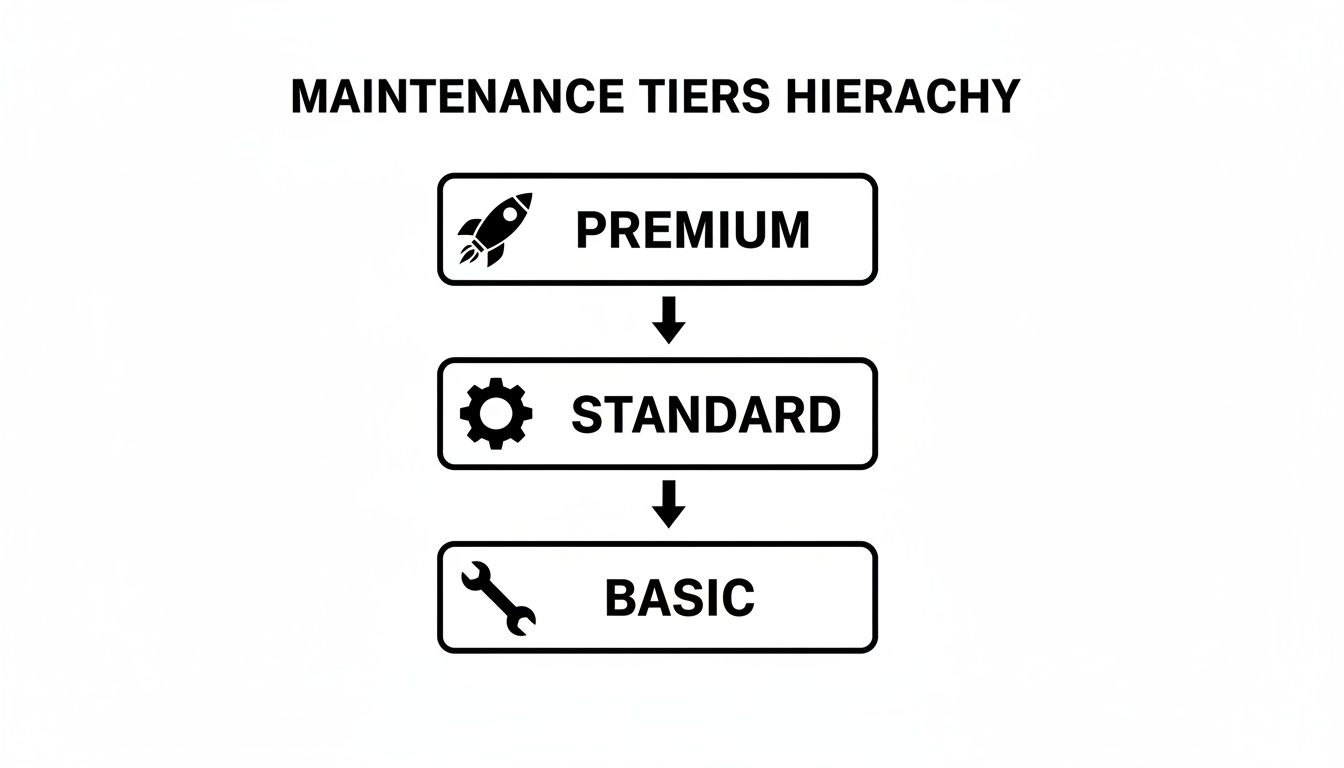
As you can see, the higher-tier plans build on these essentials, adding services designed to actively improve your site and help it perform better.
Growth-Focused Tasks That Drive Results
Beyond just keeping the site alive, a great maintenance plan focuses on making it better. This is where you move from defence to offence, turning your website into a tool that actively works for you.
Letting your site just "sit there" is a recipe for trouble. For instance, we once worked with a client whose outdated plugins caused their contact form to break. They lost weeks of customer leads before they even noticed. That’s a silent business killer.
A website isn't a brochure you print once and forget about. It’s a living part of your business that needs regular care to perform at its best.
Here’s what proactive, growth-focused maintenance actually looks like:
-
Software & Plugin Updates: Platforms like WordPress are always evolving. Regular updates patch security holes, fix bugs, and ensure all the moving parts of your site continue to work together without conflicts.
-
Regular Backups: This is your ultimate safety net. If an update goes wrong or something breaks, a recent backup means we can restore your site in minutes, not days. It’s peace of mind in a file.
-
Performance Tuning: Is your site slow to load? A slow site frustrates visitors and hurts your Google rankings. We regularly check your site’s speed and make tweaks to keep it running lightning-fast.
A Typical Website Maintenance Budget Breakdown
So, where does the money really go? A big chunk of any maintenance cost is for a skilled developer's time, but other recurring items make up a predictable slice of the pie. The table below gives you a clear picture of how a typical annual maintenance budget is allocated.
| Maintenance Category | Typical Budget Allocation (%) | What This Covers |
|---|---|---|
| Hosting & Domain | 2% – 10% | The "rent" for your website's space online and your annual address renewal. |
| SSL Certificate & Security | 2% – 8% | Encryption for user data, malware scanning, and firewall protection. |
| Developer Labour | 25% – 40% | Hands-on time for updates, bug fixes, performance tuning, and compatibility checks. |
| Software & Plugin Licenses | 5% – 15% | Annual fees for premium tools that add functionality (e.g., e-commerce, forms). |
| Support & Content Updates | 15% – 30% | Time allocated for you to request small changes, fixes, or content additions. |
| Contingency Fund | 5% – 10% | A buffer for unexpected issues or urgent fixes that fall outside the regular scope. |
As you can see, the biggest piece is the hands-on labour. That expert work is what prevents small issues from becoming catastrophic failures. You can read more about how website budgets break down to see the full picture.
Ultimately, you’re paying for a partner to handle the technical headaches so you can focus on what you do best—running your business. If you’re ready to have an expert partner take care of this for you, we’re always happy to chat about what a plan for your business could look like.
Finding The Right Maintenance Plan For You
Alright, let's talk about finding the right fit. Website maintenance isn't a one-size-fits-all deal, and honestly, that's a good thing. It means you can find a plan that actually lines up with your business goals and, just as importantly, your budget.
Some folks might try to sell you a single, catch-all package, but that often means you’re either paying for services you'll never use or missing the critical support you actually need. Think about it this way: a Kelowna-based real estate agent with a complex site featuring live property listings has completely different needs than a Penticton plumber with a simple five-page website. One requires constant attention to keep listings fresh and functional, while the other just needs rock-solid security and reliability.
That’s why you’ll typically run into a few different pricing models. Let’s break down the most common approaches so you can figure out what makes sense for your business.
Hourly Pay-As-You-Go Support
This model is pretty straightforward—you only pay for help when you need it. If something on your site breaks or you want to make a small change, you simply pay an hourly rate for the time it takes an expert to sort it out.
-
Pros: On the surface, it seems cheaper because there's no monthly commitment. If your site is brand new and super simple, you might get away with a few months of not needing anything.
-
Cons: This approach can get expensive, and fast. Emergency, last-minute fixes almost always carry a higher hourly rate. More importantly, this is a purely reactive strategy. You’re waiting for something to go wrong, which usually means lost business and a major headache for you.
For tiny, non-critical websites, this might work in a pinch. But for most businesses, the unpredictable costs and total lack of proactive care are pretty big drawbacks.
Monthly Retainer Plans
This is the most common model out there, and for good reason—it’s the most effective for the vast majority of businesses. You pay a predictable fee each month for a clearly defined set of services. It takes the guesswork out of budgeting and builds a real partnership with your support team.
A monthly plan is like having a trusted mechanic who not only fixes your car when it breaks down but also performs regular oil changes and tune-ups to prevent breakdowns in the first place.
At Navigator, we build our plans around this very idea of partnership. It lets us get to know your business and your website inside and out. That deep familiarity means we can often spot potential issues long before they become catastrophic problems. We're all about protecting and improving your most valuable digital asset.
Tiered Maintenance Packages
Within that monthly retainer model, you’ll usually find different tiers of service. This is great because it lets you pick a level of support that matches your site's complexity and where your business is at right now.
-
Basic Tier (The Essentials): Think of this as your foundation. It covers the non-negotiables: secure hosting, regular software updates, security scanning, and daily backups. It’s the perfect fit for simple brochure sites or small businesses that just need solid peace of mind.
-
Standard Tier (Growth-Focused): This level builds on the basics. You'll get everything in the essential plan, plus things like performance monitoring to keep your site speedy, a small block of time for content edits each month, and more advanced support. It’s a great choice for lead-generation sites and growing Okanagan businesses.
-
Premium Tier (All-In Partnership): For e-commerce stores or complex, high-traffic websites, this is the comprehensive option. It often includes priority service, specialized e-commerce platform support, proactive performance optimization, and a dedicated chunk of developer time for ongoing improvements.
Choosing the right tier is about being honest about your website's role in your business. If your site is your primary engine for leads or sales, investing in a higher-tier plan is simply a smart business decision.
If you’re ready to find a plan that feels less like a bill and more like a partnership, let’s talk about what your business truly needs.
Should You DIY Or Hire A Professional?
It’s a common thought, and an understandable one. You see the line item for website maintenance, and the little voice in your head whispers, "I'm pretty good with tech… I could probably handle this myself." And for a handful of people with the simplest of websites and a lot of free time, that might even be true.
For a little while, at least.
But for most business owners, the DIY route is a classic case of being penny-wise and pound-foolish. It’s a path littered with unexpected headaches, hidden risks, and a whole lot of time spent on things that don't actually grow your business. Let's get real about what that choice actually involves.
The True Cost Of DIY Maintenance
Going it alone isn't just about clicking "update" in WordPress a few times a month. It’s a serious commitment, and the real costs aren't always measured in dollars.
First up is your time. Everything in the digital world takes longer than you think, especially when you're learning on the fly. That one hour you block off on a Friday afternoon can easily spiral into a five-hour rabbit hole, troubleshooting why a routine plugin update suddenly broke your contact form. That’s five hours you could have spent serving customers or… you know… having a life.
Then there's the steep learning curve. Properly managing a website requires a specialized skillset. You need to understand security protocols, know which updates are safe to run, and—most critically—know how to restore a backup flawlessly when things go wrong. That’s not something you can absorb from a single YouTube tutorial.
The biggest risk of DIY isn't the time you'll spend; it's the cost of a single mistake. Taking your site offline by accident during a busy season could cost you thousands in lost revenue.
Imagine your West Kelowna winery's e-commerce site crashing right before a holiday weekend. The potential loss in sales and customer trust would instantly eclipse the cost of an entire year of professional maintenance. Suddenly, that "free" DIY approach looks incredibly expensive.
The Value Of A Professional Partner
This is where bringing in an expert changes the game. It’s about shifting your perspective—seeing maintenance as an investment in stability and peace of mind.
When you partner with a professional, you're not just paying for their time; you're paying for their expertise and hard-won experience. You get a team that has seen it all before. That strange error message you spent two hours Googling? They’ve likely fixed it a dozen times.
Here’s what that partnership truly delivers:
-
Expert Oversight: We get to know your site inside and out. We understand how all the different parts work together, allowing us to spot potential issues before they escalate into full-blown emergencies.
-
Proactive Care: A professional plan is about preventing problems, not just reacting to them. We handle the routine updates, security scans, and backups so your site is always protected and performing at its best.
-
Accountability: If something does go sideways, you have one number to call. You're not on your own. Our team is accountable for getting things back online quickly and minimizing any disruption to your business.
-
Your Time Back: This might just be the biggest benefit. You get to stop wearing the hat of a part-time web developer and get back to focusing 100% on what you do best—growing your business.
At Navigator, we view ourselves as an extension of your team. We’re in your corner, handling all the technical headaches so you don’t have to. It's all about giving you the freedom and confidence to know your most important digital asset is secure, healthy, and always ready for business.
If you’re ready to hand over the technical stress for some genuine peace of mind, getting expert help is the smartest move you can make.
How to Choose the Right Maintenance Partner
Okay, so you’ve decided to hand over the technical headaches and bring in a professional. That’s a huge, smart step. But now comes the big question: how do you find the right agency?
This decision is about so much more than just finding the cheapest price tag. You’re looking for a true partner, someone who’s genuinely invested in your business’s success. The right partner becomes an extension of your team—an expert in your corner who you can trust to keep one of your most valuable assets safe and sound.
Starting The Conversation
When you start talking to potential agencies, the goal is to get a feel for what it would actually be like to work with them. Are they straight shooters, or do they hide behind a wall of confusing jargon? A great partner will always speak your language and make you feel comfortable asking questions.
Think of it like an interview. You’re trying to find out if your values align and if they have the skills and dedication to help you reach your goals.
To help you out, here’s a simple checklist of questions to ask any potential provider. This will help you cut through the sales pitch and get to the heart of what matters.
Your Agency Vetting Checklist
Use these questions to guide your conversations and compare your options. The answers will tell you a lot about their process, their communication style, and their commitment to their clients.
-
How Do You Handle Communication?
Do they have a dedicated point of contact? Will you get clear, understandable reports, or will you be left guessing what they're actually doing each month? Good communication is the bedrock of a great partnership. -
What’s Your Response Time for Emergencies?
This one is critical. What happens if your website goes down on a Saturday morning during your busiest season? Ask about their guaranteed response times for urgent issues versus regular requests. You need to know they’ll be there when it counts. -
Can You Share Examples of Your Work?
Ask to see websites they currently maintain, especially for businesses similar to yours here in the Okanagan. Do they have experience with a Vernon-based non-profit like yours, or a bustling Penticton e-commerce store? This shows they understand the unique challenges and opportunities in our local market. -
What’s Included in Your Plans (And What Isn’t)?
Get a crystal-clear breakdown of what each maintenance tier includes. Are there limits on support time? Are small content updates covered? Knowing exactly what you’re paying for prevents frustrating surprise invoices down the road.
At the end of the day, you’re looking for a partner who prioritizes accountability. When things are going great, that's easy. But when something inevitably breaks, you want a team that says, "We're on it," and fixes it—fast.
At Navigator, this idea of partnership is at the core of everything we do. We believe in total accountability. If something on your site breaks, we take ownership and get it sorted out immediately. It’s that simple. We’ve built our website maintenance and support services on a foundation of trust and clear communication because we know that’s what business owners truly need.
Choosing a maintenance partner is a big decision, but it doesn’t have to be a stressful one. By asking the right questions and looking for a team that values partnership as much as you do, you can make a confident choice that will protect your website and help your business thrive for years to come.
Your Website Is An Asset—Let's Protect It
Before we dive into the numbers, let’s take a step back and think about what your website truly represents. It's not just a collection of pages and code; it's one of the most valuable, hardest-working assets your business owns. Seriously.
Think about it: your website is your 24/7 salesperson, your digital storefront, and often the very first impression a potential customer will have of your brand. It’s out there, working for you, even when you’re asleep.
Protecting Your Hardest-Working Employee
Neglecting your website is like letting the sign on your brick-and-mortar shop fall off its hinges or ignoring a leaky roof. Broken links, painfully slow load times, and security warnings send a clear message to visitors: you might not be on top of the details. It silently chips away at your hard-earned reputation.
Investing in professional website maintenance is how you protect that asset. It ensures your hardest-working employee shows up every single day, ready to perform flawlessly. This is all about empowering your site to do its job properly.
Think of website maintenance as the foundation for all your other marketing efforts. Every social media post, every ad, every business card points back to your site. If that foundation is cracked, everything else you build on top of it is at risk.
You need visitors to land on your site and feel confident and secure, not frustrated or suspicious. A well-cared-for website builds that trust in an instant.
More Than Just Tech Support
Good maintenance also provides a crucial safety net. Things happen. A software update can clash with a critical plugin, or a new security vulnerability can pop up overnight. Knowing you have a team ready to jump in and resolve issues offers incredible peace of mind.
A core part of this safety net is having a solid backup strategy. For example, an expert partner knows precisely how to properly back up your WordPress website so your data is always safe and recoverable.
Ultimately, your focus should be on your customers and growing your business, not troubleshooting error messages. We want you to feel secure, knowing your online presence is in good hands and always ready to attract new clients.
If you’re ready to stop worrying about your website and start treating it like the valuable asset it is, we’re here to help. You can reach out to our team anytime.
Common Questions About Website Maintenance Costs
We hear a lot of the same questions from business owners around Kelowna and the Okanagan when it comes to website maintenance costs. It’s a topic that can feel a bit confusing, so let's clear up a few of the most common ones right now.
Can I Pay For Maintenance Only When Something Breaks?
Technically, you can. But it’s a bit like waiting for your car’s engine to seize before you decide to get an oil change. This “break-fix” approach might seem cheaper upfront because you aren't paying a monthly fee, but it almost always becomes far more expensive down the road.
An emergency call to fix a hacked website or a critical feature that suddenly stops working costs a fortune in urgent developer hours—not to mention the lost business while you're offline. Proactive maintenance is always more cost-effective because it's designed to stop those expensive emergencies from ever happening.
Does My Website Hosting Include Maintenance?
That’s a great question, and the answer is almost always no. It's best to think of your web hosting as renting a plot of land for your business. The hosting company provides the space and makes sure the power is on (the server), but they aren't responsible for what happens inside your building (your website).
Website maintenance is the service that takes care of the building itself. It's the crew that patches the roof, updates the security system, and makes sure everything inside is running smoothly for your customers. They are two separate, but equally critical, services.
How Often Does My Website Need Maintenance?
For most business websites, especially those built on a platform like WordPress, maintenance should be an ongoing, continuous process. We strongly recommend a monthly plan at a minimum.
Waiting months between check-ups is like ignoring a check engine light—a small issue can quickly become a major, expensive problem.
Critical security patches need to be applied the moment they’re released to protect your site from new threats. Regular backups, performance scans, and software updates are also best handled on a consistent schedule. This steady attention is what keeps your website a healthy, secure, and reliable asset for your business.
If you're ready to stop worrying about your website and want the peace of mind that comes with an expert partner, Navigator Multimedia is here to help. Let's have a chat about what a maintenance plan could look like for you.