What is a meta description? And why it actually matters for your business
A meta description is that little blurb of text you see under a website’s title in Google’s search results. The easiest way to think of it is as the summary on the back of a book—it gives you a quick preview of what’s inside and helps you decide if it’s worth the click.
So, What Is a Meta Description, Anyway?
You’ve probably heard the term “meta description” tossed around, and it might sound a bit technical or jargony. Let’s cut through the noise. It’s simply that short, descriptive text that lives under your page title on a search results page.
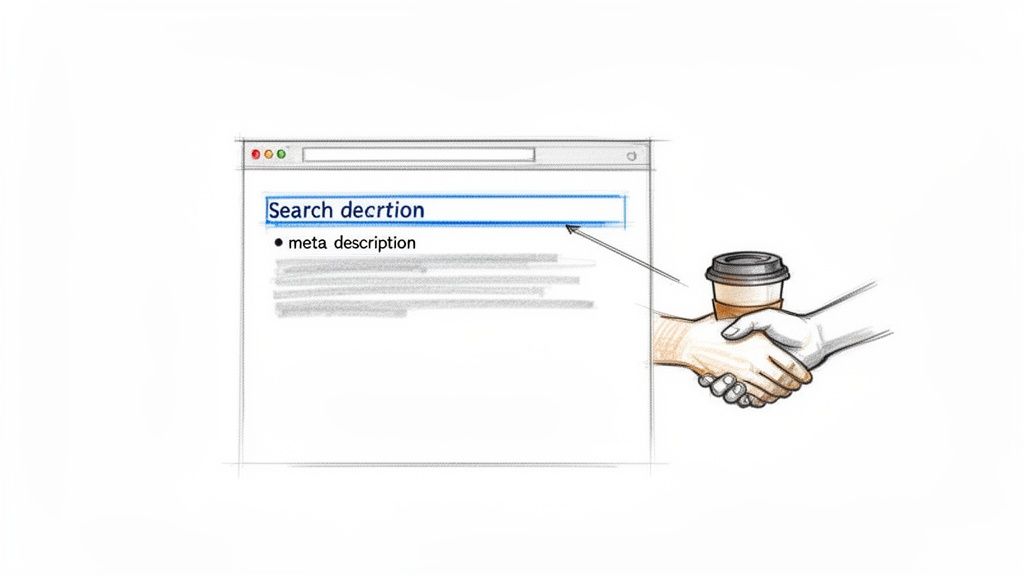
Picture this: someone in Kelowna is searching for a local service you offer. They’re staring at ten blue links on the page. What’s going to make them click your link? A lot of the time, it comes down to that little summary.
It’s your digital handshake, your first chance to say, “Hey, you’ve found exactly what you’re looking for right here.”
This tiny snippet of text has a surprisingly big job. It needs to:
Grab attention in a sea of search results.
Accurately summarize what the person will find when they click through.
Convince them to click by showing you have the answer to their problem.
Essentially, it’s your 155-character sales pitch to a potential customer who is actively looking for what you do.
Meta Description at a Glance
To put it all together, here’s a quick breakdown of the core components of a meta description.
| Component | What It Is | Why It Matters |
|---|---|---|
| Length | The character count, ideally around 150-160 characters. | Ensures your full message is visible on both desktop and mobile without being cut off. |
| Primary Keyword | The main search term you want the page to rank for. | Tells search engines and users that your page is relevant to their search query. |
| Call-to-Action (CTA) | A direct instruction encouraging a click, like "Learn More" or "Shop Now." | Motivates the user to take the next step and visit your website. |
| Value Proposition | The unique benefit or solution your page offers. | Differentiates you from others and answers the user's "What's in it for me?" |
Getting these elements right transforms your meta description from a simple summary into a powerful click-generating tool.
Why This Tiny Text Matters So Much
It’s easy to dismiss something so small, but a well-written meta description can be a real game-changer for your online visibility. It’s one of the very first impressions a potential customer has of your business. When done right, it builds trust and relevance before they even land on your website.
A great meta description connects what someone is searching for with the solution you provide. It’s really about making a genuine, human connection.
The character count is also a key piece of the puzzle. While the general advice is to stick to around 155 characters, it's interesting to see how different organizations approach this. For example, the Government of Canada’s design guidelines stress the importance of meta descriptions for making content easy to find, recommending a shorter limit of 130 characters to better accommodate both English and French.
For a busy business owner, this isn't just another menial task to add to an already long list. It’s a powerful tool to turn searchers into visitors, and visitors into customers. Getting it right means attracting more relevant traffic from people who are already looking for what you offer. If you're feeling a bit overwhelmed by all these details, getting expert help can make a huge difference.
How Meta Descriptions Influence Your SEO Success
You might have heard that meta descriptions don't directly boost your Google rankings, and that’s technically correct. Search engines don’t read your description and decide to push you straight to the top spot. But here’s what seasoned pros know: they have a huge indirect impact on your success.
Think of it like a compelling movie trailer. A great meta description makes people choose your link over the nine others on the page. That click is a powerful signal.
We call this measurement your click-through rate (CTR), and it's a very big deal in the world of SEO. When Google sees a lot of searchers clicking on your website, it takes notice. It's a strong sign that people are finding your result highly relevant for their query. Want to learn more? We break down exactly what click-through rate is and why it matters in our detailed guide.
Over time, a consistently high CTR can absolutely help improve your rankings. Google's entire goal is to serve up the best, most helpful results. When your meta description helps prove you’re one of them, you’re playing the long game and winning.
From Clicks to Customers: A Kelowna Story
We saw this play out with a local Kelowna client in the home services industry. They had solid content on their website, but it just wasn't pulling in the traffic it deserved. People were seeing their site in the search results but scrolling right on by.
The meta descriptions were the problem. They were the default, auto-generated snippets from their website builder—basically just the first few sentences of the page mashed together. They were clunky, uninviting, and gave no one a compelling reason to click.
So, we rolled up our sleeves and got to work rewriting every single one. We focused on the specific problems their customers were trying to solve and positioned their services as the clear solution, using a friendly and approachable tone.
We explained the value a visitor would get. We made a promise that the page would solve their problem.
The change was dramatic. Within just a couple of months, their click-through rate for key services jumped significantly. More clicks led to more traffic, and this new traffic was full of high-quality leads. They started getting more phone calls from people who were ready to hire them.
It’s a perfect illustration of how a small detail can make a massive difference. You aren't just writing a summary; you're writing an invitation. It's about making every single word count to turn a casual searcher into a new visitor, and hopefully, a future customer. If you're wondering how to make your own website work harder for you, that’s exactly the kind of challenge we love to tackle.
How to Write a Compelling Meta Description
Alright, let's roll up our sleeves and get to the fun part. Writing a meta description that actually gets clicks is about being clear, helpful, and, most importantly, human.
Think of it like the friendly greeting you'd give a customer walking into your shop. You want to be warm, welcoming, and immediately let them know they’re in the right place. We'll walk through a simple, repeatable process to do just that.
Keep It the Right Length
The first rule is a simple one: keep your meta description under 160 characters. While Google doesn’t have a hard-and-fast limit, anything longer than that often gets cut off, leaving your sentence hanging.
Sticking to this length forces you to be concise and get straight to the point, which is exactly what a busy searcher appreciates.
Weave in Your Keyword Naturally
You absolutely want to include your page's main keyword, but please, don't just jam it in there. A description like, “Best Kelowna Plumber for Kelowna Plumbing Services,” sounds robotic and clunky. Nobody wants to click on that.
Instead, let it flow naturally within a helpful sentence. For example: "Looking for a reliable Kelowna plumber? We offer 24/7 emergency services and transparent pricing for all your plumbing needs." See the difference? It's helpful and the keyword feels like it belongs.
A great meta description answers a user's question before they even click. It builds instant trust by showing you understand what they're looking for.
Write for a Real Person
This is where the magic really happens. For a moment, forget about search engines and focus entirely on the person reading your description. How can you genuinely help them?
Here are a few tips to keep in mind:
Use an active voice. Start your sentences with a verb. Instead of saying, "Our services are designed to help…," try "Get expert help with…" It’s far more direct and engaging.
Focus on the benefit. What will they get by clicking on your link? Will they save time, solve a frustrating problem, or discover the perfect product? Lead with that value.
Add a gentle call-to-action. Encourage the click! Simple phrases like "Learn more," "Explore our services," or "Get your free quote today" give people a clear and easy next step.
Writing for people is a skill that benefits every corner of your marketing. We even put together a guide on how to write marketing copy for real people that you might find useful.
Ultimately, your goal is to make that little snippet feel like a genuine invitation, not just another ad. If you're struggling to find the right words, that's exactly what a good partner can help with.
Great Meta Description Examples From Okanagan Businesses
It's one thing to talk theory, but seeing these ideas in action is what really makes them stick. Think of it like a recipe—you can read the instructions, but seeing the final dish is what truly brings it to life. Let’s look at a few examples from businesses right here in the Okanagan to show how a few smart changes can make all the difference.
We'll compare a "before" version (the kind of generic text a website might auto-generate) with a thoughtfully crafted "after" version designed to earn that click.
Example 1: Penticton Real Estate Agent
A real estate agent in Penticton has to build trust and signal local expertise in a heartbeat. The meta description is often their very first chance to do that.
- Before: John Smith is a real estate agent serving Penticton. This page has listings for homes for sale. Contact us for more information about real estate.
This is… okay. It’s dry, a bit robotic, and doesn't exactly get your heart racing. It's just stating the facts.
- After: Searching for your dream home in Penticton? Explore beautiful properties in Wiltse & Redlands. Let's find your perfect Okanagan lifestyle. View listings today!
Now that's an upgrade. This version speaks directly to the searcher, drops the names of specific, desirable neighbourhoods (Wiltse & Redlands), and sells a feeling—the "Okanagan lifestyle." The call to action is clear, direct, and inviting.
Example 2: Vernon Tourism Company
Let's imagine you run a company offering paddleboard rentals on the stunning Kalamalka Lake. You're not just renting out equipment; you're selling an unforgettable summer experience.
- Before: We have paddleboard rentals in Vernon. We have many types of boards for rent by the hour or by the day.
Again, it’s functional, but it's completely flat. There's none of the magic you'd feel paddling out on that beautiful water.
- After: Ready to explore the stunning waters of Kalamalka Lake? Get your Vernon paddleboard rental from us! All gear included for a perfect day. Book your adventure now!
See the difference? This version has energy. It kicks off with an engaging question and uses evocative words like "stunning" and "adventure." It also removes a point of friction by confirming that all gear is included. It makes the reader feel like a perfect day is just one click away.
This quick visual guide summarizes the key elements—length, keywords, and voice—that make these "after" examples so much more effective.
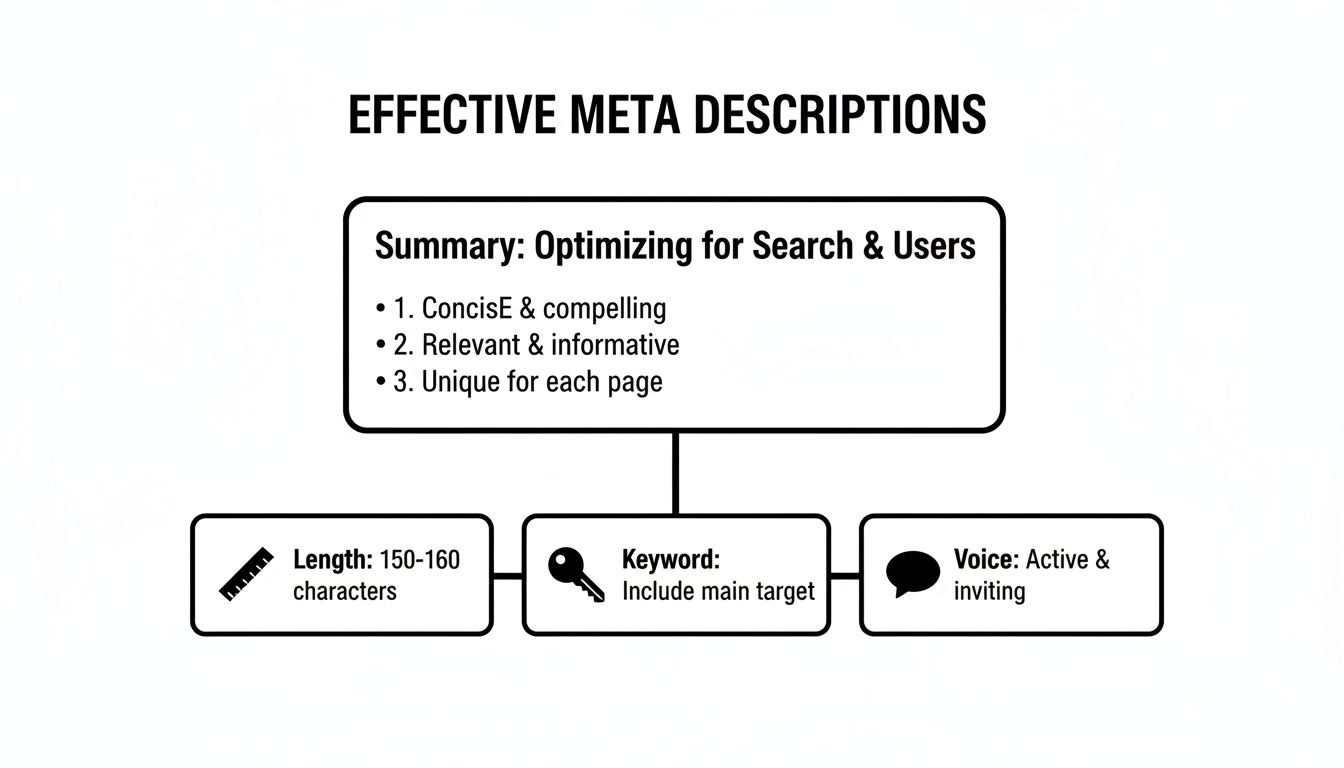
Getting the balance right between these three ingredients is how you write a description that satisfies Google's crawlers while also connecting with a real human being.
Example 3: West Kelowna Ecommerce Shop
Let's say you run an online store based in West Kelowna that sells gorgeous, handmade pottery. Your meta description needs to show off what makes your products special and convince people to start browsing.
- Before: This is the online store for Okanagan Pottery. We sell mugs, bowls, and plates that are all handmade. New products are added all the time.
This description feels passive and lacks any real punch. It doesn't give a shopper a compelling reason to choose this store over countless others.
- After: Discover beautiful, one-of-a-kind pottery, handmade in West Kelowna. Perfect for gifts or your home. Free shipping on orders over $100! Shop the collection.
This version is so much more powerful. It highlights the unique, local quality ("one-of-a-kind," "handmade in West Kelowna"), gives the reader ideas ("gifts or your home"), and throws in a killer incentive with the free shipping offer. It's a direct invitation to shop.
Ultimately, these examples show that a great meta description is an exercise in empathy. It’s about putting yourself in your customer’s shoes, understanding what they're really searching for, and showing them—in just a couple of lines—that you have the solution. If crafting these little digital invitations feels like a chore, working with a partner can help turn them into one of your website’s most powerful assets.
Common Meta Description Mistakes to Avoid
Writing meta descriptions seems simple enough on the surface, but a few common traps can easily trip you up. The good news is that once you see them, they’re incredibly easy to fix. Let's go over the small but costly mistakes we often see business owners make, so you can steer clear of them completely.
One of the biggest culprits? Letting your website platform, whether it's WordPress or Shopify, auto-generate your descriptions. We know it's tempting when you're busy, but relying on the default setting almost never ends well.
What you get is usually a clunky, chopped-off first sentence from your page that makes no sense out of context. It has zero persuasive power and certainly doesn't inspire anyone to click.
Forgetting Every Page is Unique
Another frequent misstep is just copying and pasting the same description across multiple pages. It feels like an efficient shortcut, but it does more harm than good. Think about it: every page on your site has a different purpose, from your homepage to a specific service page or a blog post.
Your descriptions need to match that unique purpose. A generic, one-size-fits-all summary doesn’t tell a searcher what that specific page offers, which ultimately frustrates them and hurts your click-through rate.
Your meta description is a promise to the searcher. Each one should accurately reflect the unique value of the page it represents to build trust from the very first click.
We’ve seen this firsthand with clients. A Kelowna-based e-commerce store was using the same description for all of its product categories. After we gave each category a unique description that highlighted the specific products inside, they saw a noticeable jump in clicks from people searching for those niche items.
Trying Too Hard to Please Google
It’s easy to get so wrapped up in the SEO side of things that you forget a real human is reading your description. This mindset often leads to a couple of classic blunders:
Keyword Stuffing: This is when you try to jam your main keyword into the description repeatedly, thinking it'll help you rank higher. It always sounds unnatural and forced—something like, "Best plumber in Vernon for Vernon plumbing needs"—and it's a huge turn-off for actual people.
Making Promises You Can't Keep: This is clickbait, plain and simple. You write a flashy description promising something incredible, but the user lands on a page that completely fails to deliver. That’s a surefire way to send your bounce rate through the roof and damage your credibility.
Just avoiding these simple mistakes is a massive step in the right direction. It shows you're putting real thought into helping your customers, which is the foundation of any good marketing. If you suspect your site might be guilty of some of these, it's the perfect time to bring in a partner to help you get things back on track.
Making Your Meta Descriptions Work Harder
Getting your meta descriptions right is a fundamental part of building a solid online presence. It’s one of those crucial details we obsess over for our partners here at Navigator because we’ve seen firsthand how these small pieces add up to create big results.
We don’t just write a description, publish it, and move on. For us, this is a living, breathing part of your overall marketing strategy.
It all starts with digging into the right keywords to attract customers who are already out there looking for what you offer. From there, we craft compelling copy that captures your brand’s voice and speaks directly to your ideal customer. But once a description goes live, that’s when the real work begins. We start watching the data.
Continuous Improvement for Better Clicks
We keep a close eye on click-through rates to see how your descriptions are performing in the wild. If a description isn’t pulling its weight and earning the clicks it should, we get back to work.
We’ll test new phrasing, try out a different call-to-action, or highlight a stronger benefit. This cycle of continuous improvement ensures your website is always putting its best foot forward to bring you new business. Think of it like tuning an instrument; sometimes, the smallest adjustments make all the difference in the final sound.
Your website should be your best salesperson, working 24/7 to bring in leads. A meta description is its opening line, and it needs to be perfect.
This iterative process isn't unique to meta descriptions; many technical SEO elements benefit from small, ongoing tweaks. If you’re curious about other ways to fine-tune how your site talks to search engines, you can learn more about what schema markup is and the impact it can have.
If you’re ready to stop guessing what works and want a partner to manage the details, a simple chat with us could be the first step toward making your website your most valuable salesperson.
Got Questions About Meta Descriptions? We’ve Got Answers.
We get asked about meta descriptions all the time. It’s one of those seemingly small details that can feel surprisingly tricky. Here are a few of the most common questions we hear from business owners just like you.
What Happens If I Don't Write a Meta Description?
If you leave the meta description field blank, Google will step in and create one for you. It does this by pulling a snippet of text directly from the page that it thinks is relevant.
Sometimes, it gets it right. More often, though, it grabs a random sentence that doesn't make a great first impression. By writing your own, you’re taking back control of your message and crafting a pitch that’s far more likely to win that click.
Should Every Single Page Have a Unique Meta Description?
Yes, absolutely. Think about it: every page on your site has a unique job to do. Your ‘About Us’ page tells a different story than a specific product page or a blog post, so their descriptions need to reflect that.
Copy-pasting the same description across multiple pages can confuse search engines and give potential visitors a muddled message. It definitely takes more effort, but writing unique descriptions for your key pages is one of those best practices that really pays off.
How Often Should I Update My Meta Descriptions?
Good news—you don't have to rewrite them every week. It's smart to give them a quick review every so often, maybe once or twice a year, or whenever you make major updates to the content on a page.
A simple test to improve a page’s performance is to rewrite its meta description, especially if you notice it has a low click-through rate from search results.
This is a low-effort way to see if you can attract more visitors without having to overhaul the entire page. It's one of those small tweaks that can deliver surprisingly big results.
At Navigator Multimedia, we know it's the small details that build a powerful online presence. If you want a partner to handle the fine-tuning so you can focus on running your business, we're here to help.