What Is Website Hosting? A No-Jargon Guide for Business Owners
Let's get straight to it. Website hosting is the service that puts your website on the internet. Simple as that.
Think of it like renting a digital plot of land where all your website’s files, images, and content live. Without hosting, your website is just a folder of files stuck on your computer, totally invisible to the world.
What Is Website Hosting, Really?
Alright, let's break this down with an analogy every business owner gets.
Imagine you've just built a brand-new physical storefront. It's perfect—it has all your products beautifully displayed, your branding is sharp, and it's ready for customers.
But where does it go? You can't just leave it in a warehouse. You need to put it on a piece of land with a real street address so people can find it and walk in.
In this scenario:
-
Your Domain Name: This is your street address, like
www.yourbusiness.ca. It's the unique identifier people type into their browser to find you. If you're just starting, we can walk you through registering a domain name for your business. -
Your Website Files: This is everything inside your store—the products, the signs, the decor. It’s all the text, images, videos, and code that make up your website.
-
Website Hosting: This is the actual plot of land and the building itself. It's the physical foundation where your store is built and operates.
Simply put, website hosting is a service that provides the space and tech needed for your website to be viewed online. Your site’s files are stored on a powerful, always-on computer called a server.
When a potential customer in Kelowna or Penticton wants to check out your site, they type your domain name into their browser. Their computer instantly connects to the server holding your website files, and boom, your homepage pops up on their screen.
Why You Can’t Have a Website Without It
Your website doesn't just float around in the digital ether. It needs a physical home—a reliable server that’s connected to the internet 24/7. Without a hosting service, your domain name would be an address that leads to an empty lot. There’s nothing there for anyone to see.
For your Okanagan business, choosing the right "plot of land" is a huge decision. A prime location (great hosting) means your site is fast, secure, and always open for business. A poor one is like setting up shop in a sketchy back alley with a door that keeps jamming. It frustrates potential customers and damages your reputation. Finding a solid hosting partner is one of the most important first steps you can take.
The Main Types of Website Hosting
Okay, so your website needs a "plot of land" on the internet. But what kind of property are you looking for? Just like scouting for commercial real estate in Kelowna, there's a perfect spot for every type of business and budget.
Choosing a hosting plan can feel like a maze of technical jargon, but it gets a lot clearer with a few real-world examples. Let's break down the most common options.
First, here's a simple flowchart that shows how getting a domain name and a hosting plan are the two foundational steps to bringing your website to life.
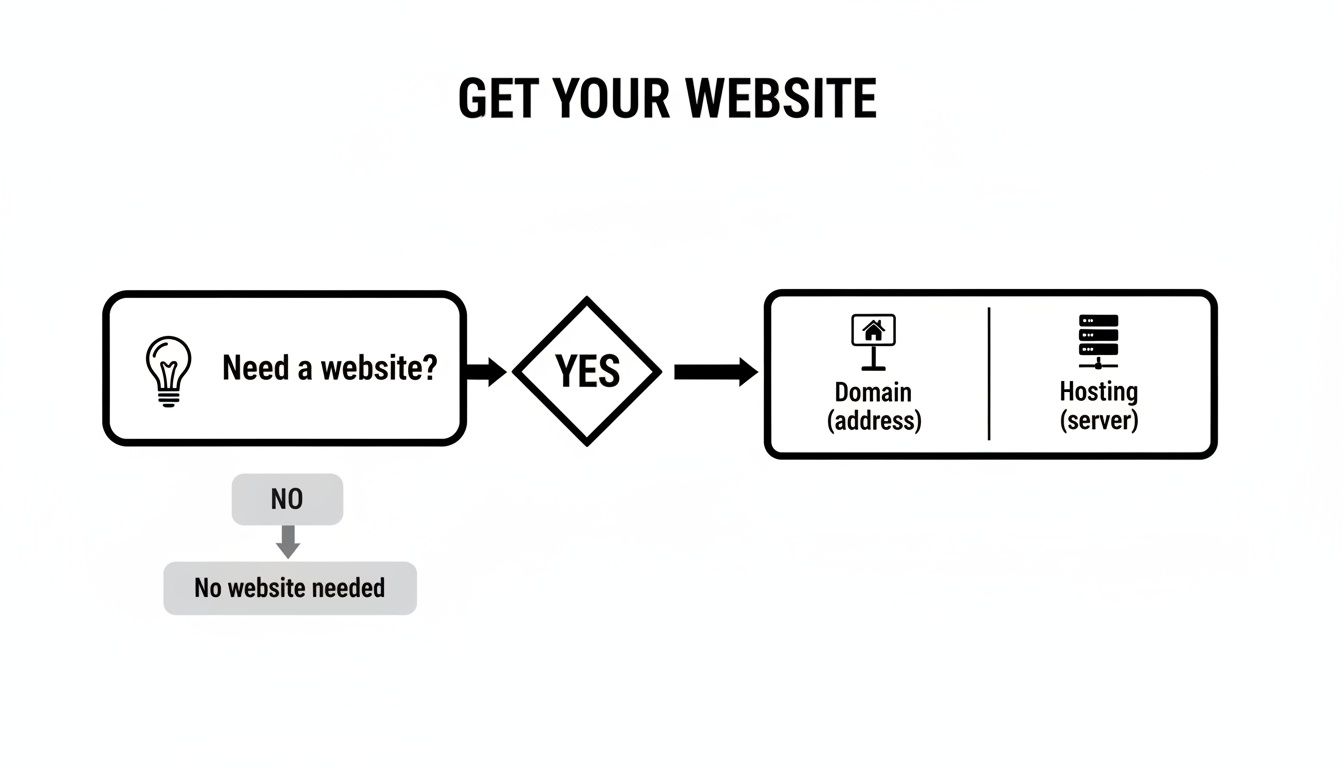
This little map makes it clear: your website needs both an address (the domain) and the property itself (the hosting) to exist online. With that in mind, let's look at the different kinds of "property" you can rent or own.
Shared Hosting: The Busy Marketplace
Shared hosting is the most popular starting point, and for good reason—it’s incredibly affordable. Think of it like renting a stall in a bustling, vibrant market.
You get your own space to display your goods, but you're sharing the building, the utilities, and the parking lot with dozens (or hundreds) of other vendors. It's a fantastic, cost-effective way to get your business off the ground.
-
Who it’s for: Perfect for brand-new businesses, personal blogs, or any small, simple website that isn't expecting a flood of traffic right away.
-
The upside: It’s cheap. Really cheap.
-
The downside: If another website on your shared server suddenly gets a massive wave of visitors, it can slow your site down, too. It’s the digital version of a traffic jam in that shared parking lot.
VPS Hosting: The Storefront in a Business Park
The next step up is Virtual Private Server (VPS) hosting. This is a big upgrade in performance and control.
Imagine leasing your own storefront in a well-managed business park. You're still in a building with other businesses, but you have your own secure, walled-off space with your own resources. The power and water usage of the shop next door won't affect yours at all.
Technically, a VPS is one powerful physical server that has been digitally split into several "virtual" servers. Each one acts like its own independent machine, giving you far more stability and power than a shared plan.
With a VPS, you get a guaranteed slice of the server's resources—like memory (RAM) and processing power (CPU)—that nobody else can touch. This means your website's performance stays consistent, even if your neighbours are busy.
This is a fantastic middle ground for businesses that have outgrown their shared hosting but don't quite need to lease an entire building just yet.
Dedicated Hosting: Owning the Whole Building
Now we’re at the top tier: dedicated hosting. Just like the name says, you get the whole server to yourself.
This is like owning your commercial building outright. The entire server and all its resources belong exclusively to you. No neighbours, no shared utilities, no compromises. It's all yours.
You get complete control over every single aspect of the server, from the operating system to the specific security protocols. This setup offers the absolute best performance, security, and flexibility.
Of course, owning the building also means you're responsible for all its maintenance. While incredibly powerful, it's often overkill for most small-to-medium-sized businesses in the Okanagan and comes with a much higher price tag.
Managed Hosting: The Full-Service Property Manager
Finally, we have a special category that can overlap with the others: managed hosting. This is less about the type of building and more about who takes care of it for you.
Whether you're using a VPS or a dedicated server, "managed" means you have a professional team handling all the technical heavy lifting behind the scenes. They take care of critical tasks like security updates, software patches, daily backups, and performance monitoring.
We’re huge fans of this approach for our clients in Vernon and Penticton, especially managed WordPress hosting. It’s exactly like having a dedicated property manager for your website. If a pipe bursts or a window breaks, you make one phone call, and it gets fixed—fast. This frees you up to focus on running your business, not on learning how to be a server administrator.
This is the kind of partnership we believe in. We handle the technical headaches so our clients can focus on what they do best. If that sounds like the kind of support you need, we should talk about how we can help. Your time is far better spent growing your company than troubleshooting server errors.
Key Website Hosting Terms, Translated
Alright, when you start digging into different hosting plans, you're going to hit a wall of technical-sounding terms. Don't let them scare you off! Once you peel back the jargon, the concepts are pretty simple.
Think of this as your quick translation guide. You don't need to become a server wizard, but understanding these basics will help you know exactly what you’re paying for.

Uptime: Your Digital 'Open for Business' Sign
Uptime is just a percentage that shows how often your website is online and reachable. When a hosting provider promises 99.9% uptime, it means your site might be offline for about 43 minutes over an entire month.
That might not sound like much, but for an e-commerce store in West Kelowna or a tourism operator during peak season, every minute counts. Solid uptime is the digital version of keeping your shop's front door unlocked during business hours.
SSL Certificates: The Padlock of Trust
Ever notice that little padlock icon next to a website's address in your browser? That's an SSL Certificate in action. Its job is to create a secure, encrypted link between your website's server and your visitor's browser.
This is absolutely essential today. It shields sensitive information—like credit card numbers and personal details—from hackers. Just as importantly, it signals to your customers, "This site is safe." Modern browsers like Google Chrome will actively warn users away from insecure sites, which can kill a potential sale before it even begins. You can learn more about why an SSL certificate is essential for your business in our detailed guide.
An SSL certificate is a powerful trust signal. It shows your customers you take their security seriously, which is fundamental to building a strong online reputation.
Bandwidth: The Highway for Your Website's Traffic
Bandwidth is the amount of data your site can transfer to visitors in a given period. The easiest way to think about it is like the number of lanes on a highway leading to your business.
A two-lane road might work just fine for a slow trickle of traffic. But if you launch a big sale and suddenly get a flood of visitors, that road will become a parking lot, and everything will grind to a halt. More bandwidth gives you a wider highway, allowing more people to access your site quickly, even during your busiest moments.
Backups: Your Business's Safety Net
Let's be real: things go wrong. A software update can break something, an accidental click can delete a critical page, or in a worst-case scenario, your site could be compromised.
This is where backups become your most valuable asset. A good hosting provider automatically creates regular copies of your entire website—all the files, databases, and content. If disaster strikes, you can restore your site from a recent backup with minimal downtime. It’s the ultimate insurance policy for your digital storefront.
The Canadian web hosting market is booming because business owners are demanding these kinds of reliable and secure services. Recent industry upgrades have managed to slash website response times by 60% and deliver an industry-leading 99.99% uptime—a huge deal when WordPress powers a massive portion of the internet. For a local Okanagan business, this means a faster site that keeps visitors engaged and helps turn them into customers.
Getting a handle on these terms helps you compare hosting plans like a pro. You’re no longer just staring at a price tag; you're evaluating the core features that will keep your website fast, secure, and ready for business.
How Your Hosting Choice Impacts Your Business
It’s tempting to see website hosting as just another item on a long technical to-do list—some behind-the-scenes plumbing you don't really need to think about. But honestly? The hosting plan you choose is one of the most important decisions you'll make for your online presence. It has a direct impact on your bottom line.
Think of it as an investment, not just an expense. The right hosting can be the difference between a website that makes you money and one that just… sits there.
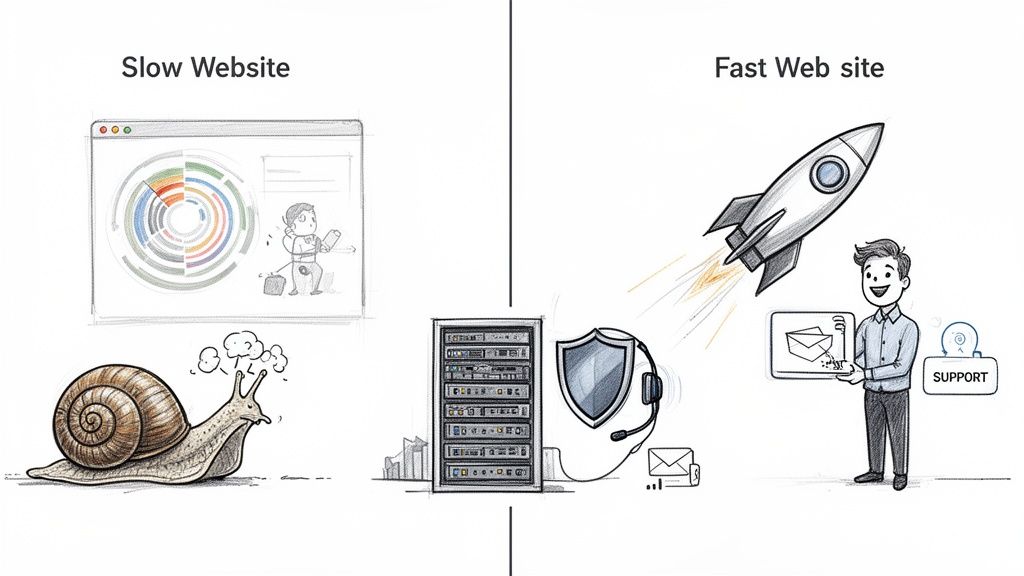
Speed Is Everything (No, Really)
We’ve all done it. You click on a website, and then you wait. And wait. After about three seconds of watching a loading icon spin, you’ve had enough and hit the "back" button.
That’s a lost customer. A slow-loading website is a silent business killer. It frustrates potential clients and sends them straight to your competitors. Good hosting ensures your website’s files are delivered from the server to your visitor's screen in a flash.
Fast site speed keeps visitors happy, and Google also actively rewards faster websites with better search rankings. A snappy, responsive site can mean the difference between showing up on page one or getting buried on page five.
We recently worked with a tourism operator right here in the Okanagan whose website was gorgeous but painfully slow. We could see from their analytics that potential customers were giving up before they even got a chance to see the amazing tour packages. We moved them to a high-quality, managed hosting plan, and their page load times plummeted. The result? A 20% jump in online bookings in just a few months. That’s a real-world impact.
Security That Lets You Sleep at Night
Imagine waking up to find your website has been defaced by a hacker or, worse, discovering your customer data has been stolen. For a small or medium-sized business, a security breach can be devastating for your finances and your hard-earned reputation.
This is exactly where cheap hosting providers often cut corners. Those bargain-basement plans might not have the robust firewalls, regular malware scanning, or timely security updates needed to shield you from online threats.
Good hosting is like having a top-tier security system for your digital storefront. It works around the clock to keep the bad guys out, so you can focus on your business without that nagging worry in the back of your mind.
Support When You Need It Most
Let’s play out a scenario. It’s the middle of the Black Friday rush, and your West Kelowna boutique’s e-commerce site suddenly goes dark. Every minute it's down, you're losing sales. Who do you call?
With a cheap, faceless hosting company, you’re probably stuck submitting a support ticket and hoping for a reply within 48 hours. But with quality hosting, you have a dedicated team on standby. You get to talk to real people who understand the urgency and have the expertise to get you back online, fast. That kind of accountability is priceless.
The demand for reliable hosting is growing fast, especially here in Canada. North America accounts for a massive 40% of the global web hosting market, with Canadian businesses being a major driver. Keeping data on Canadian soil helps with both speed and privacy laws, which is why partnering with local experts who understand the market is so valuable.
Ultimately, your hosting choice lays the foundation for your entire online strategy. A solid foundation supports a fast, secure, and reliable website—one that builds trust with customers and drives growth. A shaky one just leads to headaches and lost revenue.
Your Checklist for Choosing a Hosting Partner
Alright, you've got the lay of the land. You understand what website hosting is, why it's so important, and the different kinds of "digital properties" you can rent. Now for the crucial part: making the right choice for your business.
It’s tempting to just grab the cheapest deal you can find, but picking a hosting provider is more like hiring a partner. You're handing them the keys to your most valuable digital asset. To help you make a decision you'll feel good about, here's a checklist of questions to ask yourself—and any provider you're considering.
How (and When) Can You Get Help?
Honestly, this is the most important question. Picture this: your e-commerce site crashes during a holiday sale, or the booking form for your Penticton B&B suddenly breaks. You need help, and you need it fast.
Ask any potential provider about their support. Is it actually available 24/7? Can you get a real person on the phone, or are you stuck firing off an email into a ticketing system and hoping for the best? Good support is an absolute necessity.
A great hosting partner understands that when your website is down, your business is closed. Their sense of urgency should match yours. This is a core part of our philosophy at Navigator; if something breaks, we're on it immediately.
Where Are The Servers Located?
This might sound like a minor technical detail, but it has a huge impact on your Okanagan customers. When someone in Kelowna visits your site, the data has to physically travel from the server to their computer. The shorter that distance, the faster your site snaps to life on their screen.
For any Canadian business, having your website hosted on servers located in Canada is a massive advantage. It measurably improves your site speed for local visitors and can even give you a small leg up in local Google search results. It’s a simple factor that delivers a better, faster experience for the people who matter most.
Are Backups Automatic and Frequent?
A website without a solid backup plan is just a disaster waiting to happen. Things go wrong online—that’s just a fact. A plugin update goes sideways, a security breach occurs, and all your hard work could be gone in a flash.
Your hosting provider should be your safety net. Don't be afraid to ask them these specific questions:
-
How often do you perform backups? The only right answer is "daily." Anything less is a gamble.
-
Are the backups automatic? You have enough to do without having to remember to back up your own site.
-
How easy is it to restore a backup? If your site goes down, you need to get it back online with a single click or a quick call—not some complex headache.
This feature alone is often worth paying a little extra for. It’s the peace of mind that lets you sleep at night.
What Specific Security Features Are Included?
Security is simply non-negotiable. A cheap hosting plan often cuts corners here, leaving your digital storefront vulnerable to break-ins. Don't settle for a vague "we take security seriously" promise.
Get specific. Ask if their plans include these essentials:
-
A Web Application Firewall (WAF) to block malicious traffic before it ever reaches your site.
-
Regular malware scanning to actively hunt for and remove any threats.
-
A free SSL certificate to encrypt data and build trust with your visitors.
Protecting your website and your customer's data is a fundamental responsibility. Make sure your hosting partner gives you the tools to do it right.
Can The Hosting Grow With Your Business?
Your needs today won't be your needs next year. A simple shared hosting plan might be perfect for a brand-new Vernon startup, but what happens in two years when your business is really taking off?
A good provider makes it easy to scale your resources. You should be able to seamlessly upgrade your plan to handle more traffic and more customers without the pain of a complicated migration.
Think about where your business is headed. A local winery might need a plan that can handle huge traffic spikes during the Okanagan Wine Festivals. A real estate agent needs hosting that’s optimized to load thousands of high-resolution property photos in a heartbeat. Your hosting should support your ambition, not hold it back.
Choosing a provider isn't just about ticking boxes on a feature list. It’s about finding a reliable, accountable partner who is genuinely invested in your success. If you're looking for that kind of hands-on support for your website, that's exactly what we do. Feel free to reach out to us, and we can talk about what your business truly needs.
Common Website Hosting Questions
We’ve covered a lot of ground, and it’s totally normal if you still have a few questions. This stuff can feel a bit abstract until you get your hands on it.
To help clear things up, let's walk through some of the most common questions we hear from business owners just like you.
Can I Host My Own Website?
Technically, yes, you could. But for any serious business, it’s almost always a terrible idea.
Hosting your own site isn't just a matter of plugging in a computer. You’d need to buy expensive server hardware, configure it, make sure it has a powerful, redundant internet connection, and then handle all the security and software updates yourself. That also means you're the one getting a call at 3 a.m. when it inevitably goes down.
It’s a massive headache and a huge expense. Using a professional hosting provider is infinitely more reliable, secure, and affordable. It frees you up to do what you do best: run your business.
What's the Difference Between a Domain Name and Web Hosting?
This is a great question. Think of them as a team—they do two completely different jobs, but you can’t have one without the other. They’re like a street address and the actual building.
Here’s a simple way to break it down:
-
Your Domain Name: This is your business’s address online (e.g.,
www.yourkelownabakery.ca). It’s the unique name that tells people how to find you. -
Your Web Hosting: This is the physical plot of land and the building at that address. It’s the digital space where all your website files—your text, images, and code—are actually stored.
You register the address (the domain) with a registrar, and then you rent the space (the hosting) to build your online home.
You need both a domain and hosting to have a functioning website. The domain is the address, and the hosting is the physical space where your website lives.
Does My Hosting Location Matter for My Okanagan Business?
Yes, absolutely. This is one of those small details that can make a surprisingly big difference. Choosing a hosting provider with servers located right here in Canada is a very smart move for a local business.
First off, it can give your website a noticeable speed boost for local customers in Kelowna, Vernon, or Penticton. When the data doesn’t have to travel as far, pages load faster. A quicker site makes for happier visitors who are more likely to stick around.
Second, it can help with your local SEO. Search engines like Google often give a slight preference to locally hosted websites when someone in the area is searching for your products or services. Finally, it keeps your data under Canadian jurisdiction, which is great for privacy compliance.
My Website Is Running Slow, Could It Be My Hosting?
Hosting is one of the first places to look when a website starts feeling sluggish. If you’re on a cheap shared hosting plan, you’re splitting server resources with potentially hundreds of other websites.
Imagine your server is a shared apartment building's water supply. If one of your neighbours decides to fill a swimming pool, everyone else's water pressure drops. The same thing happens on a shared server—if another site gets a huge traffic spike, it can slow your site down to a crawl.
It's also possible that your website has simply outgrown its current plan. As you add more content and attract more visitors, you might just need more resources. Upgrading your hosting plan is often the quickest and most effective way to get your site's performance back on track.
Navigating the world of website hosting can feel overwhelming, but you don’t have to do it alone. At Navigator Multimedia, we believe in being a true partner, handling the technical details so you can focus on what you do best. If your website isn’t pulling its weight, we can help you turn it into your hardest-working employee. Let's build something great together.