Mastering Real Estate SEO: A Quick Guide for Agents in the Okanagan
Trying to get your head around SEO for your real estate business can feel like… a lot. One minute you're focused on listing a gorgeous home in West Kelowna, and the next you're drowning in articles about keywords, algorithms, and backlinks. It's a lot to take in.
Building Your Digital Foundation for Local Leads
Let's take a step back. Think of this guide as a friendly chat over coffee, designed to make your website work just as hard as you do. It’s for the realtor in Penticton who knows every street and school district like the back of their hand but feels totally lost trying to get noticed on Google.
We've all been there—staring at a screen, wondering why the phone isn't ringing more. You're an expert in your field, but digital marketing can feel like a totally different language. It's so frustrating when you know you can help people find their dream homes, but they can't seem to find you online first.
The good news? You don't need to become a tech wizard to see a real impact. It's the small, consistent steps that build a powerful online presence. We're going to walk through the practical side of SEO, showing you exactly how to connect with people who are right now searching for properties in your specific neighbourhoods.
Think of it this way: a solid SEO strategy transforms your website from a static online brochure into your most reliable, 24/7 salesperson. It works around the clock, attracting potential clients who are already looking for what you have to offer.
The whole process boils down to a simple, logical flow: build a strong foundation, create genuinely helpful content, and then watch the leads start coming in.
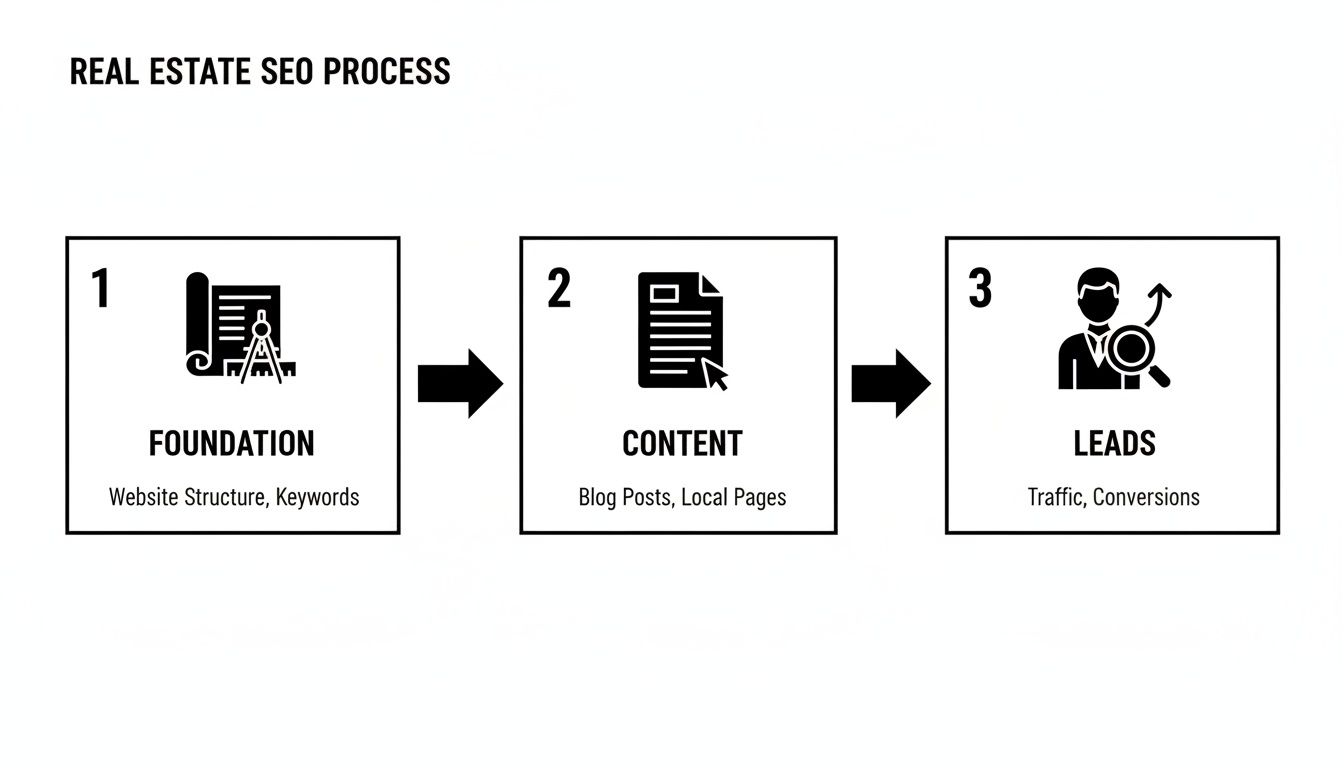
This image really highlights how it all fits together. Without that solid technical and keyword foundation, even the most amazing content won't reach the right people and turn them into leads.
What We'll Cover Together
We’re going to tackle everything you need to know, from making sure your website is technically sound to creating content that people in Vernon actually want to read. It's all about building that digital foundation that brings in leads, month after month.
To get us started, here’s a quick look at the core pillars of a successful strategy.
Real Estate SEO Quick Start Checklist
| SEO Pillar | Why It Matters for Realtors |
|---|---|
| Keyword Research | Pinpoints the exact phrases local buyers and sellers are using to find agents and properties online. |
| Technical SEO | Ensures your website is fast, mobile-friendly, and easy for Google to crawl and index your listings. |
| Local SEO | Makes you visible in local map packs and "near me" searches, attracting clients in your service area. |
| Content Strategy | Establishes you as the local market expert, building trust and attracting organic traffic. |
| Link Building | Builds your site's authority and credibility in the eyes of search engines, leading to higher rankings. |
This is about building a sustainable approach to real estate lead generation that puts you in control of your business's growth.
Ready to dive in? Let's get started.
Finding the Keywords Your Future Clients Use
Alright, let's get into the fun stuff. Before you can show up in search results, you have to figure out what your future clients are actually typing into Google. This is the heart of SEO for real estate agents, and it’s more about smart listening than guesswork.
It all starts with putting yourself in their shoes. Seriously. Imagine you’re a family looking to move to Kelowna. What would you search for?
You probably wouldn’t just type “houses.” You’d get way more specific.
Maybe your search would look more like “3 bedroom homes for sale in Kelowna” or “lakeview properties in Peachland.” This is the language of your clients, and your website needs to speak it fluently.
Thinking Like a Buyer and Seller
The real trick is to brainstorm phrases for every stage of their real estate journey. Someone just starting their search will use broad terms, while someone ready to make a move uses incredibly detailed phrases.
Let’s break down what that looks like:
-
Early Stage Searchers: These folks are just dipping their toes in. They might search for things like “best family neighbourhoods in Vernon” or “cost of living in Penticton.”
-
Mid-Stage Searchers: They’re getting more serious now. Their searches look like “new construction homes in West Kelowna” or “condos for sale downtown Kelowna.”
-
Ready-to-Buy Searchers: This is where the magic happens. These are the detailed, high-intent searches like “4 bedroom house with pool in Upper Mission” or “how much is my Glenmore home worth.”
These longer, more specific phrases are called long-tail keywords. Sure, they have less search traffic, but the people using them know exactly what they want. They're often your most qualified leads.
We’ve seen clients completely transform their lead quality by focusing on these specific phrases. A realtor we partner with in Kelowna started creating content around “pet-friendly condos” and quickly connected with a dozen highly qualified buyers. It’s all about targeting a specific need.
These detailed searches are incredibly valuable. You can learn more about how to find and use them in our guide to the secret weapon of SEO: long-tail keywords.
Uncovering the Phrases People Actually Use
So, how do you find these golden nuggets? The good news is you don't need fancy, expensive tools right out of the gate.
A great first step is to just start typing into Google. The “autocomplete” feature will show you what real people are searching for. Type in “homes for sale in Penticton” and see what Google suggests… things like “with a suite,” “on one level,” or “under 500k.” These are your keywords!
Another simple trick is to scroll down and look at the “People also ask” section on the search results page. This is a goldmine of questions your potential clients are asking. Answering these questions on your website is a fantastic way to attract them.
Finally, think about the questions you get asked every single day.
-
What are the best schools in the area?
-
What are the property taxes like here?
-
Is this a good neighbourhood for young families?
Each one of these is a keyword opportunity. By creating pages or blog posts that answer these questions, you build trust and authority, positioning yourself as the go-to expert. This is the foundation of a smart content plan—essential for any successful real estate SEO strategy. Once you have a list of these phrases, you can start mapping them to specific pages on your website, like property listings and neighbourhood guides.
Crafting a Website That Google and Clients Adore
Your website is your digital storefront, your 24/7 open house. If a potential client clicks on a listing and has to wait for photos to load… they’re gone. If they can’t easily find your contact info on their phone, they’ll just give up.
It’s a tough truth, but people have zero patience online. That's why the technical health of your website is a massive piece of the SEO puzzle for real estate agents. Your site needs to be fast, logical, and incredibly easy to use.
Think of it like staging a home. You want visitors to walk in and feel instantly comfortable, able to find everything they need without a second thought. Your website should do the same.
Site Speed is Everything
Ever tried to pull up a property on your phone during a lunch break, only to be met with a spinning wheel? It’s beyond frustrating.
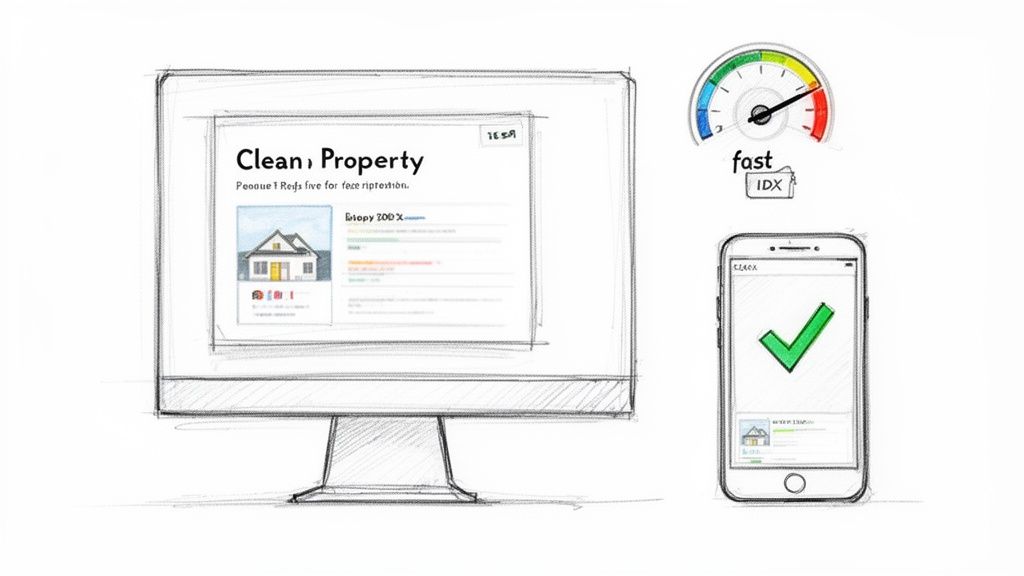
For real estate, where clients are scrolling through image-heavy listings, site speed is non-negotiable. A slow site doesn't just annoy users; it tells Google that your website offers a poor experience, which can seriously hurt your rankings. Every extra second it takes to load is costing you potential leads.
We once worked with a Kelowna agent whose site took nearly eight seconds to load a single listing. After we optimized their images and cleaned up the code, we got it down to under two seconds. Their organic traffic from search engines jumped by 40% in just three months because the experience was suddenly so much better for users.
Speed matters. A lot.
A Logical Structure is Key
Imagine walking into an open house where the kitchen is in the basement and the bedrooms are scattered randomly. You’d be confused, right? Your website needs a clear, logical structure for the very same reason.
Both Google’s web crawlers and your human visitors need to understand how your site is organized. This comes down to having a simple navigation menu and a clear path for people to follow.
A solid structure for a real estate website usually includes:
-
A Clear Homepage: This is your welcome mat, showing who you are and what you do.
-
Easy-to-Find Listings: Whether you have featured listings or an IDX feed, they need to be front and centre.
-
Neighbourhood Guides: Pages dedicated to areas you serve, like West Kelowna, Penticton, or Vernon.
-
About Page: Where people can get to know you, the human behind the business.
-
Contact Page: Make it incredibly simple for someone to get in touch.
This kind of clean layout helps search engines understand what your site is about and helps visitors find exactly what they’re looking for without getting frustrated and leaving.
Mobile-Friendliness is Non-Negotiable
More than half of all website traffic comes from mobile devices. In real estate, that number is often even higher. People are searching for homes while they’re on the go—in line for coffee, waiting to pick up their kids, or sitting on their couch.
If your website isn't designed for a small screen, you’re losing business. Period. All the elements, from your property photos to your contact forms, must work flawlessly on a phone.
It's also worth noting that a proper investment in SEO is essential. For instance, in competitive markets, it's often the top marketing channel for ROI. Businesses spending less than $500 per month are 75% more likely to be unhappy with their results than those who invest more. A proper budget makes a huge difference.
Sorting out the technical side of things can feel like a headache, especially when you’re busy with clients. If you’re looking to build a digital storefront that’s fast, user-friendly, and set up for success from the start, check out our approach to website design for real estate.
Winning the Neighbourhood with Hyperlocal SEO
Real estate is, and always will be, a local game. Someone looking for a home in the Okanagan isn't just buying a house; they're buying into a community, a neighbourhood, a lifestyle. This is where you, as a local expert, have a massive advantage.
The big national websites can show a thousand listings, but they can't tell a client where to get the best coffee in Pandosy Village or which park in Glenmore is perfect for toddlers. You can. Hyperlocal SEO is all about leaning into that local expertise and showing up when people are searching for an agent right here, right now.
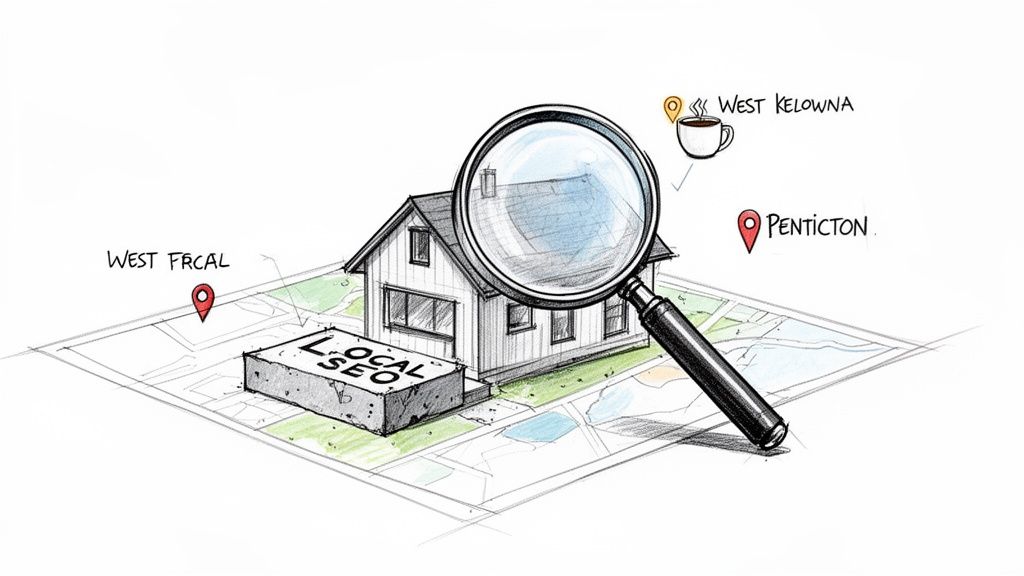
This focused approach is what gets you found in those "realtor near me" searches. It puts you on the map—literally—when a buyer is driving through a neighbourhood they love and pulls out their phone.
Your Most Powerful Local Marketing Tool
Let's talk about your Google Business Profile (GBP). If you take only one thing away from this section, make it this: your GBP is your single most powerful local marketing tool. Hands down.
It’s that info box that pops up on the right side of a Google search, showing your photos, reviews, address, and phone number. For many potential clients, this is the very first impression they'll have of your business. A neglected profile is like having a messy, uninviting storefront.
Optimizing it isn't rocket science, but it does demand attention. The goal is to fill out every single section completely and, just as importantly, keep it fresh.
Think of your Google Business Profile as a living, breathing advertisement for your services. It’s not a "set it and forget it" task. We have a client in Vernon who started posting weekly updates and adding new photos to their profile. Within two months, calls directly from their GBP listing tripled. It’s that powerful.
Making your GBP profile shine is a non-negotiable step in any seo optimization real estate strategy.
Building Your Digital Business Card Across the Web
Now, let's zoom out a bit. While your Google Business Profile is your digital headquarters, you need to ensure your business information is consistent everywhere else online.
Think of it as leaving your business card at every important local spot on the internet. We're aiming for consistency, specifically with your Name, Address, and Phone number (NAP). It needs to be identical across dozens of online directories.
-
Name: Is it "Jane Doe Real Estate" or "Jane Doe Real Estate Inc."? Pick one and stick with it.
-
Address: Did you write "Street" or "St."? These small details matter.
-
Phone Number: Use the same primary business line everywhere. No exceptions.
When Google sees the exact same information on your website, your GBP, Yelp, Zillow, and other local sites, it gains confidence that you're a legitimate, established local business. Inconsistencies, even tiny ones, can confuse search engines and drag down your local rankings. This is a simple but incredibly important detail to get right.
The Power of Five-Star Reviews and Trust
Reviews are the lifeblood of any local business. A steady stream of positive reviews tells both Google and potential clients that you’re trustworthy and great at what you do.
Don't be shy about asking for them! When you’ve helped a client have a fantastic experience buying their dream home in West Kelowna, that's the perfect time to ask if they'd be willing to share their thoughts online.
Equally important is how you respond to them—all of them.
-
For positive reviews: Thank them personally. Mention a small detail from your time working together to show it's not a canned response.
-
For negative reviews: Respond quickly, professionally, and with empathy. Always offer to take the conversation offline to resolve the issue. How you handle criticism can be more telling than a dozen five-star reviews.
This kind of active engagement builds a rock-solid reputation. In a business built on relationships, that reputation is everything.
Considering that about 30% of all mobile searches are location-related, a complete Google Business Profile filled with photos and prompt review responses is absolutely essential for attracting buyers in your target neighbourhoods. You can discover more insights about local SEO for real estate and see just how much these details matter.
If managing all these local signals feels like another full-time job, you're not alone. We can help you build a powerful local presence that brings in leads, so you can focus on your clients. Feel free to reach out to our team to chat about it.
5. Build Authority with Hyper-Local Content
Your listings are the main event, but it's your local expertise that builds lasting trust and keeps clients coming back. The best way to showcase that expertise? Create content that genuinely helps people navigate the local market.
It’s about becoming the undisputed, go-to authority for your community.
When you consistently deliver real value, you stop being just another agent in their search results. You become the expert for their neighbourhood.
A Blueprint for Content That Converts
So, what does this actually look like in practice? It’s simpler than you might think. You already have the knowledge locked in your head; it's just a matter of sharing it.
Start by thinking about the questions you answer over and over again. Every single one of those is a potential blog post, guide, or video that will attract your ideal clients.
Here are a few ideas to get you started:
-
In-Depth Neighbourhood Guides: Don't just list stats. Dive deep into what it's really like to live in a specific area like Rutland or Pandosy Village. Talk about the best schools, the quietest streets, the local parks, and where to grab the best coffee.
-
Local Market Updates: Break down what’s happening with pricing in plain English. No industry jargon. Just give an honest, clear-eyed look at the market trends in Vernon or Penticton.
-
First-Time Buyer Roadmaps: Create a simple, step-by-step guide for first-time homebuyers in Kelowna, walking them through everything from getting pre-approved to what happens on closing day.
-
Seller Checklists: A printable checklist for "Getting Your Home Ready to Sell" is incredibly valuable. It's the kind of resource people will download, print, and stick on their fridge—keeping you top-of-mind.
Creating this kind of content is a triple win. It positions you as the authority, builds massive credibility with search engines, and gives you valuable assets to share on social media and in your email newsletters.
Answering Questions Before They're Even Asked
A truly effective content strategy anticipates what your clients need to know. You want someone to land on your website and have that "aha!" moment where they feel like you're reading their mind.
What are the top concerns for a young family considering a move to West Kelowna? What are the real pros and cons of downsizing in a community like Penticton? Answering these specific questions on your website is the foundation of a solid real estate SEO plan.
Here’s a real-world example: We worked with a local realtor to develop a series of articles profiling different condo buildings in downtown Kelowna. They didn't just list the amenities. They talked about the lifestyle, the building's unique vibe, and the type of person who would be a perfect fit for each one. The leads that came from those articles were incredibly well-informed and ready to move forward.
This hyper-focused approach is critical in specialized markets. Take luxury real estate, where the sales cycle is often much longer. Your content has to demonstrate an intimate understanding of micro-neighbourhoods and exclusive properties. This is crucial, as some luxury markets are predicted to see a 10% jump in sales activity. Targeting sophisticated buyers with content that speaks their language delivers an incredible return.
If brainstorming content feels like just one more thing on your already packed to-do list, that’s where a good partner can make all the difference. We love helping our clients map out a content strategy that speaks directly to their ideal customers. If you'd like to chat about a plan for your business, feel free to get in touch with us.
Measuring What Matters for Your Business Growth
So, after all this work, how do you actually know if it’s paying off? It’s a fair question. The last thing you want is to pour time and resources into your website without seeing a real, tangible return for your business.
The good news is that the answer is in the numbers. But it's incredibly easy to get lost in a sea of data. We're going to cut through the noise and focus on the handful of metrics that truly tell the story of your SEO success.
Tuning into the Right Channels
First things first, you need the right listening tools. Two free platforms from Google are non-negotiable here: Google Analytics and Google Search Console. Getting these set up is the foundational step to understanding what’s actually happening on your site. Think of them as your website’s command centre, showing you who’s visiting, how they found you, and what they do once they arrive.
Connecting these tools to your site is essential. If that sounds a bit technical or you'd rather just have it done right, this is something a partner like Navigator can sort out for you in a flash.
Key Metrics That Signal Success
Once you’re set up, you don’t need to obsess over a million different stats. For a real estate business, your success really boils down to a few key performance indicators (KPIs) that show your SEO efforts are hitting the mark.
Here’s what to keep a close eye on:
-
Organic Traffic: This is the number of visitors who find your website through a search engine like Google, not from paid ads. A steady, upward trend here is a clear sign your visibility is growing.
-
Keyword Rankings: Are you starting to show up on the first page for crucial terms like "homes for sale in Lower Mission" or "Penticton real estate agent"? Tracking your position for your target keywords is a direct measure of progress.
-
Leads from Organic Search: This is the big one. How many people who found you via Google actually filled out a contact form, signed up for property alerts, or called your office? This metric ties your SEO work directly to your bottom line.
We always tell our clients to focus on leads over raw traffic. It's far better to have 100 highly motivated visitors actively searching in the Okanagan than 1,000 random visitors from across the country. Quality over quantity is the name of the game in real estate SEO.
Ultimately, tracking these numbers gives you a clear, honest picture of what’s working and what isn’t. It empowers you to make smarter decisions, like doubling down on content for a neighbourhood that’s driving a lot of traffic or tweaking a property page that isn’t turning visitors into leads.
If you’re feeling a bit overwhelmed by the data or just want an expert eye on your analytics, our team is always here to help. We can help you make sense of the numbers and build a clear plan for growth. Feel free to contact us anytime.
Your Top Real Estate SEO Questions Answered
We get it. Diving into the world of SEO for real estate can feel a bit overwhelming, and you probably have a few questions. Here are some of the most common ones we hear from agents and brokers right here in the Okanagan.
How Long Until I See SEO Results on My Website?
Honestly, SEO is a marathon, not a sprint. While you might get a small lift from quick technical fixes, building genuine authority and ranking for those valuable local keywords usually takes about 6 to 12 months of dedicated, consistent work.
Think of it like building your reputation in a new neighbourhood. It doesn't happen overnight. It’s built through one handshake, one open house, and one successful closing at a time. The effort you put in today is what builds a solid foundation for leads for years to come.
Can I Do My Own Real Estate SEO, or Should I Hire an Agency?
You can absolutely handle some of the fundamentals yourself! Things like polishing up your Google Business Profile or writing a fantastic guide to your favourite Kelowna neighbourhood are well within your reach.
But the deeper technical side—things like site audits, ongoing keyword research, and building a strong backlink profile—is a huge time commitment. Many realtors find that bringing in an agency lets them focus on what they do best: serving clients. It all boils down to your available time, your comfort level with the technical details, and your overall business goals.
Should I Focus My Budget on SEO or Paid Ads?
This is a classic question, and the best answer is: why not both? They work brilliantly together.
Paid ads are fantastic for immediate visibility. They're perfect for getting eyes on a brand-new listing or for a quick marketing push. SEO, on the other hand, is your long-term strategy for building a sustainable, cost-effective stream of high-quality traffic. A well-rounded marketing plan for any real estate business really needs a bit of both to cover all your bases.
Feeling like your website could be doing more to bring in leads? At Navigator Multimedia, we help real estate professionals turn their online presence into their hardest-working asset. Let's chat about how we can help you grow.