What Is Click-Through Rate? A Simple Guide for Business Owners
You’ve probably seen ‘CTR’ pop up in your marketing reports and wondered what it actually means. Let's get straight to it. Put simply, your click-through rate is the percentage of people who see your ad, email, or search result and are curious enough to actually click on it. It's one of the most honest metrics you can track.
So, What Is Click-Through Rate Anyway?
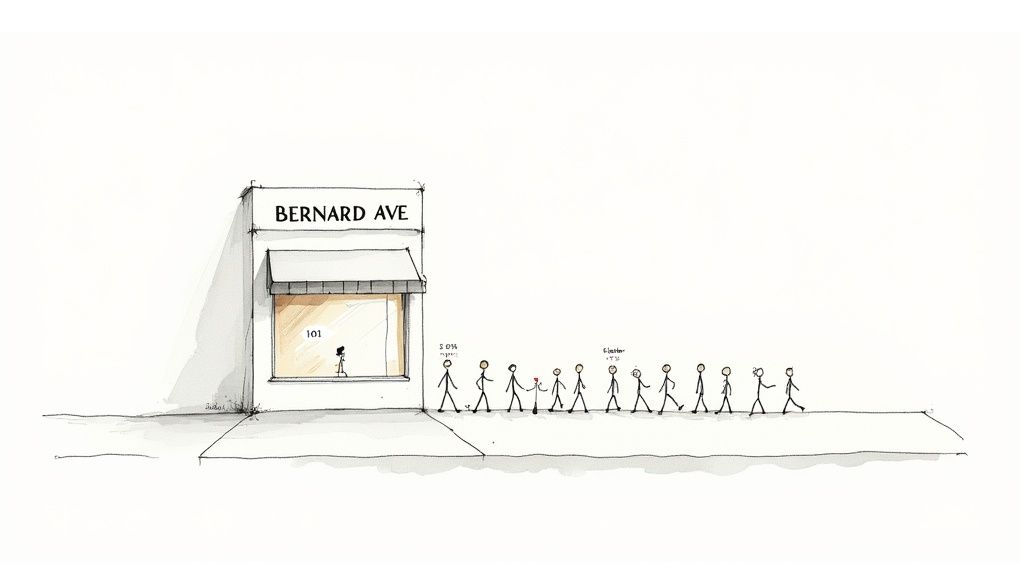
Imagine you own a shop on Bernard Ave in downtown Kelowna. It’s a sunny afternoon, and a hundred people walk past your storefront—in the digital world, we call these impressions. Out of those hundred people, five of them like what they see in your window display and decide to step inside. Those are your clicks.
Your click-through rate, or CTR, is just the percentage of those window shoppers who became actual visitors. In this scenario, it’s 5%. It's a simple way to measure if your message is catching people's attention or just getting lost in the noise.
A Simple Breakdown
Knowing what goes into your CTR helps you see the bigger picture. It’s all about the relationship between how many people see what you're putting out there and how many of them take that next step.
To make it even clearer, here’s a quick-glance table breaking down the core concepts.
CTR Explained in a Nutshell
| Component | What It Means | Simple Analogy |
|---|---|---|
| Impressions | The total number of times your ad or content was displayed on someone's screen. | The number of people walking past your shop window. |
| Clicks | The number of times someone actually clicked on your ad or content to learn more. | The people who decided to come inside your shop. |
| CTR | The percentage of impressions that resulted in a click. | The percentage of passersby who became visitors. |
And really, that’s it. Your CTR tells you if your online "window display"—be it an ad, a search result, or an email subject line—is doing its job. A strong rate means your message is hitting the mark; a weaker one is just a friendly nudge that it’s time to try something new.
Why Your Click-Through Rate Is a Big Deal
So, we've covered the 'what,' but let's get into the 'why.' For a busy Okanagan business owner, think of your click-through rate as a direct pulse check on your marketing's health. It’s really that straightforward.
A high CTR is a clear sign that your headlines, ad copy, and visuals are all working together perfectly. It means you’ve created something compelling enough to stop people mid-scroll and make them take action. They see you, they're curious, and they want to know what you're all about. That’s a huge win.
On the other hand, a consistently low CTR is a red flag that something’s not quite right. It’s your audience’s way of telling you that your message isn’t connecting. But don't sweat it—it's just a signal that it’s time for a different approach.
How It Directly Affects Your Wallet
Here’s where it gets really interesting: your CTR has a direct impact on your bottom line. This is especially true on platforms like Google Ads, where a higher click-through rate helps improve your Quality Score.
A better Quality Score is Google's reward for running relevant, high-quality ads. The best part? It can actually lower your cost-per-click, making your entire marketing budget stretch further.
We saw this in action with one of our Kelowna clients in the local service industry. By focusing purely on refining their ad copy to boost their CTR, we watched their ad costs drop significantly over time.
It was a powerful reminder that CTR is a lever you can pull to make every marketing dollar you spend work harder. If you're not sure how to start pulling that lever, our team is always here to help you get started.
What a Good Click-Through Rate Looks Like
This is always the million-dollar question, isn't it? And the most honest answer is… it really depends. What you’d celebrate as a good click-through rate for a Google Search Ad is completely different from a good one for a display ad you’re running on a news site.
Context is everything. You have to compare apples to apples. A 5% CTR on a search ad campaign for a Penticton winery could be fantastic, while a 1% CTR on a social media ad for a Vernon real estate agent might also be a huge win. The goals, audience, and platform all change the definition of "good."
Benchmarks Change by Channel
Think of it this way: when someone is actively searching on Google, they want to click something. They have a problem and they’re looking for a solution right now. When they’re scrolling through social media, they’re in a totally different mindset, just passively browsing.
This is why a strong CTR is such a great signal—it tells you that you’ve managed to connect with the right people at the right moment.
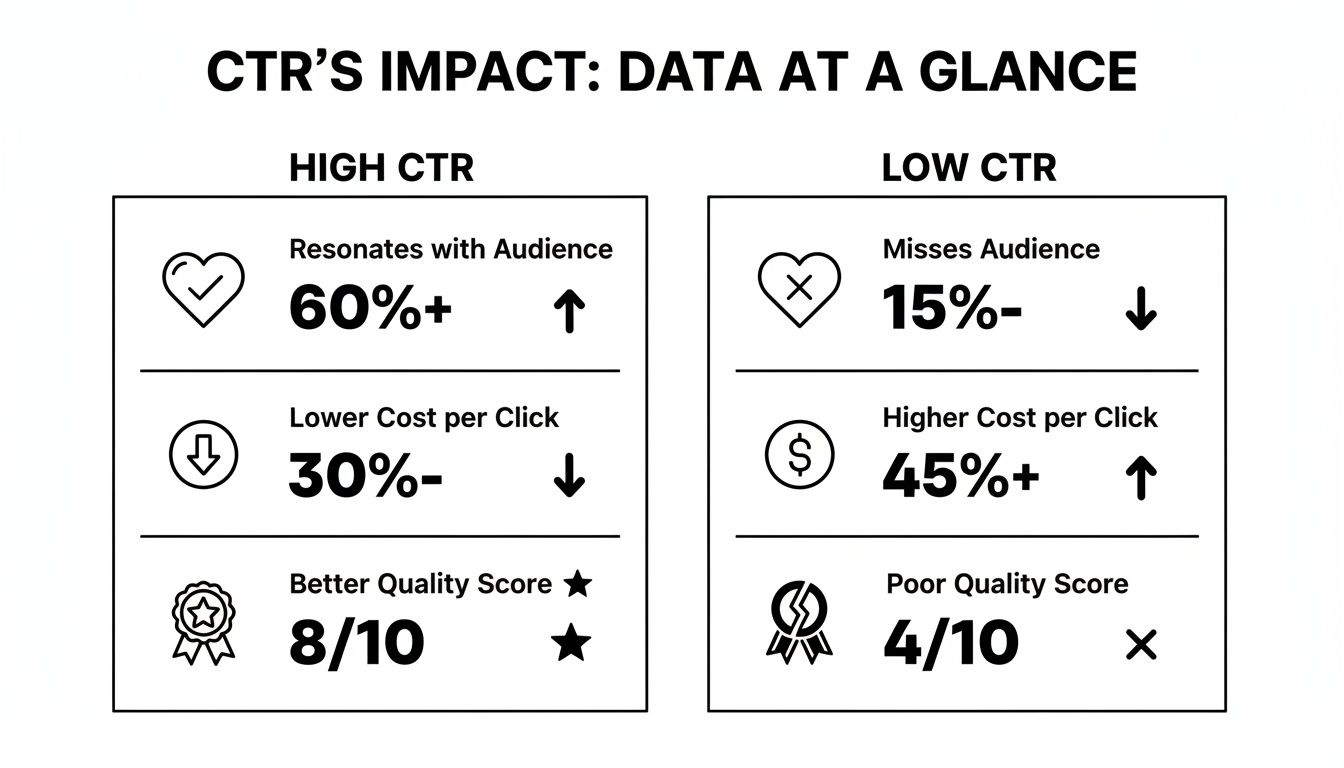
As you can see, a higher CTR is a sign your message is resonating. This often leads to lower ad costs and better overall quality scores from platforms like Google.
Because of this difference in user intent, some channels naturally have much higher average CTRs. Paid search advertising, for instance, produces much higher click-through rates than display or social media ads. Data shows average search CTRs can be anywhere from 3.2% to 6.7%, while display ads often sit below 0.6%.
The key takeaway is to set realistic benchmarks for each specific channel you're using. Judge your email marketing CTR against email standards, not your Google Ads CTR.
Understanding these nuances is the first step toward setting goals that make sense for your business. If you’re ever unsure what a "good" CTR looks like for your industry here in the Okanagan, that's a perfect time to get an expert opinion.
How Ad Position and Industry Change Everything
Location, location, location. We hear it all the time for real estate, but it’s just as true for your ads and search results online. Where you show up on the page makes a world of difference to your click-through rate.
Think about your own search habits. When you’re looking for something, you almost instinctively click on one of the first few results, right? Landing that coveted #1 spot on Google will always pull in more clicks than being buried at the bottom of the page. It’s human nature—we’re wired to trust the top results.
Why Your Industry Matters Just as Much
The type of business you run also plays a massive role in what you can realistically expect from your CTR. An emergency plumber in Kelowna, for example, will almost always see a higher click-through rate than a local shop selling luxury candles.
It all boils down to search intent. When a pipe bursts, the searcher is desperate for a quick solution and will click the first credible option they find. Someone casually browsing for scented candles isn't in any rush.
This context is everything. Understanding the urgency and mindset of your customer is key to setting smarter goals for your own campaigns and judging your performance fairly.
Recent industry reports back this up, showing that top paid search positions for high-intent businesses often pull in double-digit CTRs, capturing a huge share of the available clicks.
Getting to those top spots isn't a matter of luck; it requires a solid strategy. If your current ads aren’t getting the visibility you want, exploring professional PPC advertising management can help you compete for those valuable positions and attract more of those ready-to-buy customers.
Simple Ways to Improve Your Click-Through Rate
Feeling like your click-through rate is stuck in a rut? The good news is that you don't need a massive technical overhaul to see a difference. There are some surprisingly straightforward things you can do right now to make your ads, emails, and search listings far more enticing.
At its core, improving CTR is all about understanding what makes people want to click. It’s about psychology and compelling communication, not just algorithms. Nailing this is one of the quickest ways to squeeze more value out of your existing marketing spend.
Write Headlines That Grab Attention
Your headline is the first handshake. It’s often your only shot to convince someone you're worth their time. A great headline needs to be clear, spark curiosity, and speak directly to what your audience is searching for.
A simple trick? Use numbers or ask a direct question. This makes the headline feel more concrete and engaging. For example, "Plumbing Services in Kelowna" is functional but forgettable. But what about, "Need a Plumber in Kelowna? Get a Free Quote in 5 Minutes"? That one speaks to an immediate need and offers a clear, quick solution.
If you’re hunting for more ideas, check out our guide on how to write click-worthy ad copy for some practical tips.
Keep Your Message Focused
Ever heard of analysis paralysis? When you give people too many options, they often just give up and choose nothing. This is especially true for your call-to-action (CTA)—that crucial instruction like "Shop Now" or "Learn More." Decide on the single most important action you want someone to take and make it impossible to miss.
A single, focused CTA almost always performs better than giving people multiple choices. It removes confusion and makes the next step obvious and easy.
This isn't just a gut feeling; the data backs it up. Marketing reports have shown that emails with just one call-to-action can achieve a 371% higher click-through rate compared to those with several.
If you feel like you're too close to your own marketing to see the opportunities, a fresh pair of eyes can make all the difference. Don't hesitate to contact us for a second opinion—we can help you find what you might be missing.
Connecting Clicks to Business Growth
Alright, we've broken down what click-through rate is and how to nudge it higher. That's the first step. But the real goal is tying those clicks back to what actually matters: growing your business.
A better CTR is the most direct way to get more people to your website. More traffic creates more opportunities—more chances to generate a lead, close a sale, or book a consultation. Think of it as the first domino in a long chain; everything good that happens starts with that initial click.
Your CTR is really a vital sign for your marketing's first impression. If people aren't clicking, it's a clear signal that something in your core message isn't quite right. Maybe your headline isn't compelling enough, or your ad copy just isn't connecting with your audience.
From Clicks to Customers
The journey from a simple click to a paying customer needs to be as smooth as possible. Once someone arrives on your site, you have to understand what they do next. Are they easily finding what they came for? Are they filling out your contact form, or are they bouncing right away? This is where the most valuable insights live.
The real objective is to guide curious clickers into becoming loyal customers. It’s about making sure the promise made in your ad or search listing is fulfilled—and even exceeded—once they land on your page.
A good marketing partner can help you pinpoint the weak spots in this customer journey. We often discover that a few small adjustments can make a huge difference, turning your ads and search results from simple attention-grabbers into powerful customer-getting machines. To dig deeper into this, you can learn more about the importance of web analytics and how they uncover what's really happening on your website.
If you’re ready to see what a stronger click-through rate can do for your Okanagan business, let's talk. You can contact us anytime to get the conversation started.
Your CTR Questions, Answered
We get it—when you're busy running a business, marketing metrics can feel like a whole other language. So, let's clear up a few of the most common questions we hear about click-through rates.
Is a High CTR the Only Thing That Matters for Success?
Not quite. A high CTR is a great sign, don't get me wrong. It tells you that your ad or your search result is compelling enough to make people want to learn more. But it's just the first step.
You have to look at what happens after the click. Are those visitors actually buying anything, filling out a form, or calling you? If you're getting tons of clicks but no new business (meaning a low conversion rate), there might be a disconnect between your ad's promise and what people find on your website. Think of CTR as a key performance indicator, but not the only one.
Is a 100% Click-Through Rate Even Possible?
In a perfect world, maybe. If your ad was shown exactly once and that one person clicked it, you’d have a 100% CTR. But in the real world… that’s just not going to happen.
No matter how brilliant your ad is, not every single person who sees it will click. People get distracted, they aren't in the right frame of mind, or they're just not interested at that moment. It's far more productive to aim for a strong, realistic CTR based on your industry's benchmarks rather than chasing an impossible perfect score.
How Quickly Will I See My CTR Improve After Making Changes?
For things like digital ad campaigns on Google or Facebook, you can often see the impact of your changes pretty fast—sometimes within a few days or a week. Tweaking a headline or swapping out an image can give you a quick win.
On the other hand, improving your organic CTR through SEO is more of a long game. It can take weeks or even months for changes to your page titles and descriptions to influence your search engine ranking and, consequently, how many people click. The golden rule here is to test one change at a time. That way, you'll know for sure what's making the difference.
Feeling like you're guessing more than you're growing? At Navigator Multimedia, we help Okanagan businesses make sense of the numbers and turn them into real results. If you’re ready for a marketing partner who actually gets it, let's connect.